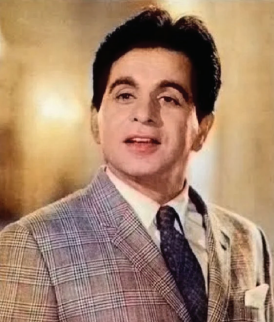
Phenomenon, instinctively natural performer, polyglot, and one who could harmonise mind, voice and body on screen — this is how colleagues, film historians and cinema enthusiasts remember Dilip Kumar.
Kumar was not only suave and soft, elegant and enchanting, but his performing skills continue to be respectfully emulated by leading actors and thespians of Indian cinema. He never studied the art and craft of acting in any drama or film school, yet his presence on screen had a certain rhythm, poise and movement derived from his own method of acting.
As the film industry and cinema lovers across generations mark the birth centenary of the silver screen icon, film historian Amrit Gangar notes that it is interesting that the celebrations coincide with a time when “we are talking not just about Hindi cinema but the pluralistic Indian cinema as a whole. Dilip Kumar sahab was a polyglot reflecting India’s polyphonic character as a nation. He knew or spoke fluently, besides his own mother tongue Hindko, Urdu, Hindi, Pashto, Punjabi, Marathi, English, Bengali, Gujarati, Persian, Bhojpuri and Awadhi… His birth centenary marks Indian cinema with an extraordinary poise and economy in today’s cacophonic environment.”
Born in a congested lane of Qissa Khwani Bazaar in Peshawar, Pakistan, Muhammad Yusuf Khan was one of the 12 children of Lala Ghulam Sarwar Khan and his wife Ayesha Begum.
In his 20s, he decided to pursue acting professionally, with Jwar Bhata as his first film. It marked the beginning of the journey of one of the biggest screen icons witnessed by Indian cinema — Dilip Kumar, a name suggested by legendary actor-producer Devika Rani.
From Jwar Bhata in 1944 to Qilla in 1998, Kumar had a 56-year-long illustrious career. The 1950s and 1960s marked his golden period. Mehboob Khan’s 1949 film Andaz, alongside Nargis and his childhood neighbour Raj Kapoor, brought him superstardom, and he reunited with Nargis the following year for Jogan.
His performances glided effortlessly between tragedy and comedy — from Paigham and Ram Aur Shyam to swashbuckling titles such as Aan, Azad, Kohinoor and Mughal-e-Azam. “His aplomb had its own elan,” Gangar said.
Kumar’s screen persona evolved under the directorial guidance of Bengali filmmakers such as Nitin Bose (Deedar and Ganga Jumna), Tapan Sinha (Sagina Mahato) and Bimal Roy (Devdas and Madhumati).
While the 1970s were a lean phase for the actor, he rose again in the 1980s and 1990s with films such as Subhash Ghai’s Karma, Saudagar, Vidhata, and Ramesh Sippy’s Shakti, his first collaboration with megastar Amitabh Bachchan. Bachchan, who frequently expresses his admiration for the late legend, calls him his idol.
“Dilip Kumar is a phenomenon in the world of cinema and society. He was not only a superstar for five decades but also a very profound man,” Ghai recalled. “He once shared with me that he was never a method actor… He never tried to dramatise or act it out; rather, he would surrender to the scene. He would say, ‘You create your own method while evolving yourself; you create your grammar through working.’” According to Ghai, Kumar had the power to “portray every character with dignity”.
“Whenever I write about a character of dignity and power — and whatever he speaks is true — I would always think of two actors, either Dilip Kumar or Amitabh Bachchan.” In his long acting career, Kumar starred in 65 films. But it is not the number of films but his range as a performer and his depth of awareness that made him a cinema legend.
“He is one of those who did very little work, always chose what he wanted to do and worked very hard on it. Sometimes it would be two or three years before his film came, while most actors did two or three films a year. It takes a lot of courage to do little work. He concentrated intensely on the work he did, he put in tremendous effort. I have no hesitation in endorsing him as the best ever,” Sippy said.
From Amitabh Bachchan to Naseeruddin Shah, Shah Rukh Khan to Nawazuddin Siddiqui, every major actor of Hindi cinema carries traces of Kumar’s genius in their performances.
Veteran actor-politician Shatrughan Sinha, who worked with him in Kranti, said that subconsciously all performers in India have learnt a great deal from Kumar. “Dilip Sahab has been a huge influence on all of us. We all have learnt a lot subconsciously from him — his intensity, the way he would emote with honesty. He was the tragedy and comedy king; he could do anything.”
But ultimately, what makes a man or woman memorable is their humanism. According to Ghai, Kumar had much more to offer to the world beyond his acting genius — a wider perspective on life.
“He was someone who would think beyond his work — for the nation, society and people. He would not flaunt anything. He would silently contribute to many causes: for cine workers, blind children, differently-abled people and others. This is what distinguished him from other stars or celebrities of the show business,” the director added.
Farida Devi, who worked as a child artist in Kumar’s classics Dil Diya Dard Liya, Ram Aur Shyam and Charity Master, remembers him as a “punctual, dedicated and co-operative” co-star.
“Dilip Kumar sahab treated us like his own children; he would take care of us and protect us. He would never sit alone and eat. He would make sure everybody — from the spot boy to Dilip Kumar — sat at one table. It is very rare to find a man like him today. He treated everyone equally,” she said.
Though a people’s person, Kumar remained away from the spotlight in the later years of his life. He spent most of his time with his wife, veteran actor Saira Banu, and met only a few colleagues who frequently visited him until his passing last year.
(Feature compiled by Ravi Rohmetra, he can be reached at M.No.9419652999; e-mail:[email protected])