
Col Dev Anand Lohamaror
The recent constitutional changes in Pakistan have once again made it clear that the actual control of the country has always remained with the military, and now this reality has been formally stamped into the Constitution. For years, Pakistan has witnessed the repeated “flipping of the deck” by its military establishment—removing prime ministers, pressurizing the Supreme Court, and engineering elections to install preferred governments. All of this has now emerged in the form of a formalized and fully sanctioned structural arrangement. Elevating General Asim Munir from Army Chief to the unprecedented post of Chief of Defence Staff (CDS)—a post that never existed in Pakistan’s constitutional structure—signals that the military now seeks total control not only from behind the scenes but also from within the constitutional framework.
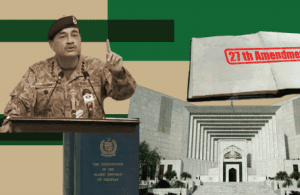
In this very context, Pakistan on 8 November 2025 introduced the Constitution (Twenty-Seventh Amendment) Act, 2025, which was passed by the National Assembly on 12 November 2025 and signed into law by President Asif Ali Zardari on 13 November 2025. The amendment altered Articles 243, 175A, and key judicial provisions, elevating Army Chief General Asim Munir to a new and extraordinarily powerful position—the Chief of Defence Forces (CDF). This role has been defined as the supreme commander of all three services—the Army, Air Force, and Navy. The amendment also abolished the post of the Chairman Joint Chiefs of Staff Committee (CJCSC), with the change taking effect on 27 November 2025. Simultaneously, the Supreme Court’s constitutional authority has been stripped and transferred to a newly created Federal Constitutional Court (FCC), which now holds ultimate interpretive power over the Constitution. Judicial appointments, bench formation, and the hearing of major constitutional cases will now be determined by Parliament and the President—both institutions effectively under military influence. For the first time in Pakistan’s history, military leadership has been granted constitutional supremacy, including lifetime rank, legal protection, and immunity for the CDF and other top military officials.
Under this new arrangement, the powers of the Supreme Court have been drastically curtailed, bringing the judiciary directly under the control of Parliament and the President—institutions that themselves are aligned with or dependent upon the military establishment. Reports indicate that judicial appointments, the allocation of cases, and decisions on who will hear major constitutional matters will now be made by Parliament, which in practical terms means by the military. The President, previously considered a ceremonial figure, will now exercise powers determined not by elected representatives but indirectly by the military leadership. This effectively places two pillars of the state—the executive and the judiciary—under a single power center. The end of judicial independence and the collapse of the minimal institutional balance that held the system together is now inevitable.
The concentration of power in the hands of Pakistan’s military has implications far beyond its domestic politics. The military establishment has always used an anti-India narrative to consolidate internal legitimacy. Whenever the military faced political instability, public dissent, or economic crisis, it heightened tensions along the border, strengthened terror proxies, deployed the Kashmir narrative, and projected to the world that Pakistan faced severe security threats—thereby justifying the need for a powerful military. Now, with constitutional protection and expanded authority, the military will advance its strategic agenda more openly, without civilian checks.
This change significantly impacts regional peace. The new model eliminates whatever limited scope existed for democratic reform within Pakistan. The possibility of meaningful action against extremist groups further diminishes because Pakistan’s military has long treated such groups as “strategic assets.” When all power is centralized, dissent and accountability disappear, increasing the likelihood that Pakistan will escalate cross-border activities to divert public anger arising from economic collapse and political stagnation. For India, this presents a new and more dangerous challenge, as Pakistan’s military structure is now more aggressive, more centralized, and more unconstrained than ever before.
The second major impact is on the Afghanistan–Pakistan–Iran triangle, which is already volatile. The new military-constitutional structure will reshape Pakistan’s relationship with the Tehrik-e-Taliban Pakistan (TTP) and the Afghan Taliban. Empowered by its new status, the Pakistani military may pursue more assertive regional interventions, increasing the risk of cross-border operations and supporting militant factions to secure leverage. This instability will spill over into India, Nepal, Bangladesh, and Sri Lanka in the long run, weakening regional diplomacy and cooperative frameworks.
Ultimately, Pakistan’s constitutional empowerment of the military represents a dangerous chapter—not only for its own democratic future but also for the entire strategic stability of South Asia. When a nuclear-armed nation grants full constitutional legitimacy to an all-powerful military authority and subordinates the judiciary, decisions are no longer guided by democratic responsibility but by military doctrine. This magnifies risks for neighboring countries and undermines regional peace, diplomatic dialogue, and economic cooperation. Pakistan is heading toward a centralized, military-dominated political structure whose consequences will shape South Asia’s security architecture for years. This development is not merely Pakistan’s internal matter anymore—it is a serious and emerging security challenge for the whole region.