PM’s Birthday messages conveyed the voice of a strong confident India
By T N Ashok
NEW YORK: On his 75th birthday, Prime Minister Narendra Modi found himself at the center of a carefully choreographed display of international diplomacy and domestic strongman politics that perfectly encapsulated his evolving foreign policy strategy.
As world leaders lined up to offer birthday greetings, Modi’s response to Russian President Vladimir Putin’s warm wishes, coupled with his fiery rhetoric against Pakistan at a political rally in Madhya Pradesh, revealed the complex balancing act that has come to define India’s position on the global stage.
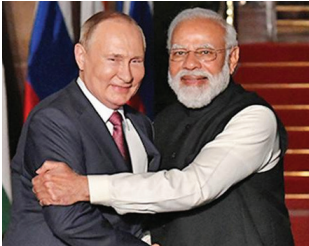
Modi thanked Putin for his “phone call and warm wishes,” reaffirming their commitment to “further strengthening our Special and Privileged Strategic Partnership.” This exchange, while diplomatically routine, carries significant weight given the shifting geopolitical landscape and India’s increasingly assertive foreign policy posture.
The Modi-Putin relationship has evolved into one of the most consequential bilateral partnerships in contemporary geopolitics. Putin praised Modi’s work as head of government, noting that “under your guidance, India has achieved impressive results in the social, economic, scientific and technological spheres.” This mutual admiration society reflects more than ceremonial diplomacy—it represents India’s strategic pivot toward multipolarity in international relations.
Modi’s embrace of Putin has been particularly pronounced as traditional Western partnerships have faced strain. The relationship gained momentum as India navigated the complexities of the Ukraine crisis while maintaining its strategic autonomy. Unlike European allies who have distanced themselves from Moscow, Modi has doubled down on the partnership, viewing Russia as a counterweight to both Chinese influence and Western pressure.
This alignment has been reinforced by practical considerations. Russia remains India’s largest defense supplier, providing crucial military hardware and technology transfer agreements. The energy partnership has also deepened, with India becoming one of the largest buyers of Russian crude oil despite Western sanctions. This economic pragmatism has allowed Modi to maintain India’s non-aligned tradition while securing favourable terms for energy imports.
The timing of Putin’s birthday greetings and Modi’s gracious response also serves domestic political purposes. By showcasing his personal relationships with major world leaders, Modi reinforces his image as a statesman capable of navigating complex international relationships while maintaining India’s sovereignty.
Hours after exchanging pleasantries with Putin, Modi took the stage in Dhar, Madhya Pradesh, where his tone shifted dramatically. Speaking at the rally, Modi reiterated his oft-quoted remark, “Naya Bharat ab gharmein ghuskar maarta hai” (New India enters their home and strikes). This statement, which has become a rallying cry for his supporters, represents a fundamental shift in India’s approach toward Pakistan.
Modi declared: “This is the New India, which does not fear any nuclear threats… Gharmein ghuske maarta hai” (enters their home and strikes). The phrase “ghuske marenge” has become synonymous with Modi’s approach to cross-border terrorism, signalling a departure from previous administrations’ more restrained responses.
The context for this aggressive rhetoric lies in Operation Sindoor, which Modi has repeatedly cited as evidence of his government’s new approach to national security. Modi also referred to the recent admission of a Jaish-e-Mohammed commander, who acknowledged that India’s Operation Sindoor strikes destroyed significant targets. This operation represents what Modi describes as the “new normal” for India’s response to terrorism.
Modi’s dual messaging on his birthday—diplomatic grace toward Putin and combative rhetoric toward Pakistan—reflects sophisticated political calculation. The Madhya Pradesh rally serves multiple purposes: it energizes his base ahead of crucial electoral battles while demonstrating his command of both diplomatic finesse and military resolve.
The “gharmein ghuske marenge” formulation has proven particularly effective with Indian voters who have grown frustrated with decades of cross-border terrorism. By contrasting his approach with previous governments, Modi positions himself as the leader who finally gave teeth to India’s national security policy.
This messaging resonates beyond his core constituency. Middle-class urban voters, traditionally concerned with economic issues, have increasingly prioritized national security. Modi’s ability to project strength while maintaining international relationships appeals to this demographic’s desire for India to be taken seriously on the world stage.
Modi’s approach reflects broader changes in India’s strategic thinking. The embrace of Putin while simultaneously taking a harder line against Pakistan demonstrates India’s commitment to strategic autonomy—the ability to pursue relationships based on national interest rather than ideological alignment.
This dual approach has yielded tangible benefits. India has maintained access to Russian military technology and energy while avoiding complete isolation from Western partners. The Pakistan policy has similarly balanced aggression with restraint, using targeted operations to signal resolve while avoiding full-scale conflict.
However, this strategy also carries risks. The close relationship with Putin could complicate India’s partnerships with Western democracies, particularly as the Ukraine conflict continues. Similarly, the aggressive rhetoric toward Pakistan, while popular domestically, raises the stakes for any future crisis.
Modi’s birthday performance exemplifies his cultivation of a strongman image that resonates across different audiences. For international partners like Putin, he presents himself as a reliable leader capable of maintaining relationships despite external pressure. For domestic audiences, particularly in venues like the Madhya Pradesh rally, he projects uncompromising strength against traditional adversaries.
This dual persona has become central to Modi’s political brand. He positions himself as simultaneously a global statesman worthy of respect from world leaders and a nationalist champion willing to confront Pakistan militarily. The juxtaposition of Putin’s birthday greetings with the “ghuske marenge” rhetoric on the same day perfectly captures this balance.
As Modi begins his third term, the synthesis of Putin partnership and Pakistan confrontation will likely continue defining India’s foreign policy. The approach reflects confidence in India’s growing economic and military capabilities while acknowledging the complex multipolar world emerging from the post-Cold War order.
The success of this strategy will depend on Modi’s ability to maintain these delicate balances. Overplaying the Putin relationship could alienate Western partners crucial for technology transfer and economic growth. Similarly, escalating rhetoric against Pakistan beyond the current controlled aggression could lead to miscalculation.
Modi’s 75th birthday messaging suggests he remains confident in this approach. By thanking Putin graciously while promising to strike Pakistan boldly, he projects the image of a leader comfortable operating across the full spectrum of international relations. Whether this confidence proves justified will largely determine India’s trajectory in an increasingly uncertain world.
The convergence of personal diplomacy, military doctrine, and electoral politics in Modi’s birthday performance offers a window into how contemporary leaders navigate the intersection of domestic and international pressures. For Modi, the ability to thank Putin and threaten Pakistan within hours of each other has become both a political asset and a defining feature of India’s emerging role as a major power. (IPA Service)