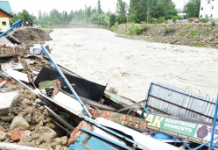
Jammu Tawi, Sep 7: Border villages in Jammu, long battered by cross-border shelling, are now reeling from devastating floods that have washed away homes, farmlands and infrastructure, leaving residents desperate for relocation and relief.
In Pallanwala sector along the Line of Control (LoC), flash floods caused by the swollen Chenab on August 26 submerged villages up to the first floor of houses, destroyed livestock and roads, and displaced nearly 4,000 people. “I have never seen such devastation. Everything is gone—homes, farmlands, livelihoods,” said 71-year-old Santok Singh of Gigrial, whose family was rescued by soldiers.
The people here have lived through mortar shelling in 1999, 2001, 2009, 2011, 2016, 2019 and 2023, and floods in 1984, 1992, 1998, 2003, 2014 and now 2024. Tehsildar Khour Ranjeet Singh said over 300 homes in 20 villages, including Gigrial, Pallanwala, Rangpur and Pindi, have been damaged. Shelter camps have been set up in schools to provide food and temporary relief.
“The situation is like being caught between the devil and the deep sea—Pakistan’s aggression on one side and Chenab’s fury on the other,” said villager Surender Kumar. Locals are demanding permanent rehabilitation on safer land. “For years, we have asked for relocation. Successive governments have ignored us,” said Yudhvir, who lost a relative in 1999 shelling.
Residents also lament the destruction of agriculture, their mainstay. Farmers in Pallanwala and R S Pura, known for prized Basmati rice, said their fertile fields have turned into wasteland. “We had Basmati everywhere, now it’s a desert,” said Naresh Kumar, 65. Others urged the administration to provide compensation, stronger embankments and agricultural guidance.
Many areas remain cut off as roads have been washed away, leaving villagers dependent on boats. “There is no water or electricity. Everything has been damaged,” said Garima Devi.
In response, BJP MLA Narinder Raina announced that 28 MLAs will contribute Rs 1 crore and two MPs Rs 2.5 crore from constituency funds to the State Disaster Relief Fund. Residents, however, continue to appeal for long-term rehabilitation. “We want 5 to 10 marla plots at safer places so our children do not suffer like us,” said teacher Bhishan Chand.