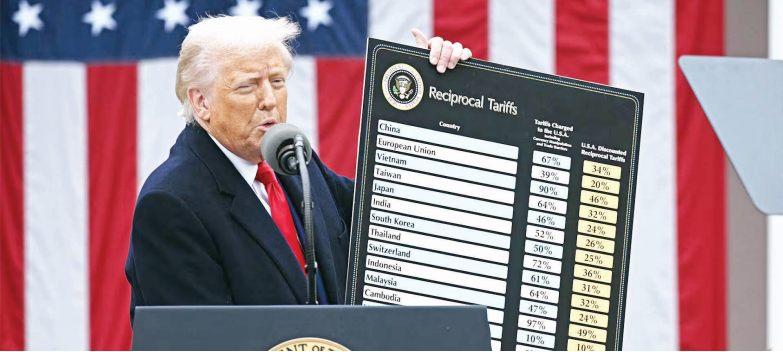
50% India Tariff may last at best until the next flip-flop
By K Raveendran
Donald Trump’s announcement of a 50 percent tariff against India is the latest in his string of economic pronouncements that ripple across borders with unpredictable force. While the White House may frame it as a move to “protect American interests,” the reality is that the decision inflicts immediate pain on American consumers, unsettles critical industries, and sets in motion a chain of economic reactions that extend far beyond bilateral trade with India.
Already, American households are feeling the pinch. Many of the country’s most recognizable brands have begun raising prices in anticipation of higher import costs, an unavoidable response when goods from a major trade partner suddenly become dramatically more expensive. What makes this episode particularly significant is that the target, India, is not merely another source of consumer goods — it is a linchpin in several sectors, most notably pharmaceuticals. India-made medicines have long dominated the US generic drug market, keeping healthcare costs under control for millions of Americans. For decades, the affordability of everything from life-saving heart medications to basic antibiotics has depended on a steady flow of Indian generics. By making these imports costlier, Trump’s tariff all but guarantees higher prices for patients, insurance providers, and hospitals.
The irony is hard to miss. While the rhetoric around tariffs usually paints them as a patriotic defence of domestic industry, the US does not have the manufacturing base to replace India’s role in generic drug production at the same scale or cost. This is not about giving American pharmaceutical factories a competitive edge — those factories, by and large, do not exist in the capacity needed to meet demand. Instead, the policy risks creating a supply squeeze in an industry where the margin between affordability and inaccessibility can literally be the difference between life and death for patients.
Trump, however, appears unbothered by these practical consequences. His political style thrives on the appearance of strength in the moment, even if the aftershocks are felt long after the initial applause dies down. The pattern is familiar: make a bold, confrontational move; dominate the news cycle; and, when the tide of public opinion or market reality turns, execute a hasty reversal. This is why the 50 percent tariff against India, though potentially damaging in the short term, may last only until his next pivot — something that, given his track record, could happen in days or weeks. In the Trump playbook, permanence is less important than impact.
Yet, for the period it remains in place, the damage will be real. Small and medium-sized American businesses that rely on Indian imports — from textiles to machinery parts — will face steeper costs, forcing them to either absorb the losses or pass them on to customers. Retailers will reprice products upward. And the broader global economy, still wrestling with post-pandemic supply chain fragility, will need to adjust to yet another source of uncertainty. In the interconnected marketplace of the 21st century, a sudden rupture in US-India trade is not a localized event. It sends signals to investors, alters shipping patterns, and invites countermeasures from the affected country.
India, for its part, is unlikely to remain passive. New Delhi has shown in past disputes that it can respond with targeted tariffs of its own, and the political climate in India makes it almost inevitable that Prime Minister Narendra Modi will be seen defending national economic interests. This could escalate into a tit-for-tat cycle, further constraining trade flows and raising costs on both sides. For an administration that claims to put “America First,” the result may be an own goal: higher prices for Americans, strained diplomatic relations with one of the world’s largest democracies, and reduced access to affordable medicines.
The pharmaceutical angle is perhaps the most politically combustible. Drug prices have been a persistent flashpoint in US politics, with bipartisan agreement on the need to keep them in check. Trump himself has railed against “sky-high” medication costs in the past, presenting himself as a champion of affordable healthcare for ordinary Americans. Yet this tariff, by making one of the country’s most important sources of inexpensive drugs more expensive, runs directly counter to that goal. It is an own contradiction, emblematic of a presidency often defined by the gap between rhetoric and reality.
But to understand why such contradictions persist, one must look at Trump’s governing style. He operates less as a traditional policymaker than as a showman, always conscious of the performance. His signing ceremonies for executive orders, where he often wields his pen like a stage prop, exude the air of a child playing with a toy gun — except, as critics point out, this is no harmless toy. These decisions are real, with consequences that touch millions of lives. The exaggerated gestures and self-congratulatory signatures make for great television, but they mask the gravity of what is being set in motion.
In this latest case, the theatrics of confrontation with India may score political points with a segment of the electorate that views trade imbalances as evidence of American weakness. But the actual mechanics of global trade are not so easily bent to political theatre. Tariffs rarely function as surgical tools; they are blunt instruments. Once imposed, they reverberate unpredictably, creating winners and losers in ways that even their architects often fail to anticipate.
This unpredictability is amplified by Trump’s penchant for abrupt reversals. Trading partners, foreign investors, and even domestic industries have learned to treat his announcements with caution, knowing that today’s “firm stance” could be tomorrow’s “deal on the table.” This may limit the long-term impact of the India tariff in terms of policy permanence, but it also corrodes the credibility of the United States as a reliable trade partner. When agreements or disputes can be upended at the stroke of a pen — or the impulse of a news cycle — the incentive to invest in stable, mutually beneficial trade relationships diminishes.
The global dimension cannot be overlooked. India is not only a major supplier to the US but also a key node in supply chains that feed into Europe, Africa, and Asia. A disruption in US-India trade can cause ripple effects in other markets, as suppliers redirect goods, adjust pricing, or seek alternative partners. In pharmaceuticals, for instance, Indian manufacturers often serve multiple countries from the same production lines. If US demand falters due to higher tariffs, these companies may reallocate supply to other markets, altering the availability and pricing of drugs elsewhere. This is the kind of systemic shift that makes tariffs more than a bilateral skirmish; it makes them a global disturbance.
The political timing of Trump’s move is equally telling. He has been floating the idea of a third presidential term — an ambition that, while constitutionally implausible, reveals his desire to project unending political relevance. In that light, the India tariff can be read as part of his broader strategy to keep himself at the centre of both domestic and international attention. Whether it works politically is an open question, but as economic policy, it risks becoming yet another example of short-term spectacle producing long-term complications.
If history is a guide, the 50 percent tariff may not survive the next shift in Trump’s political calculations. It may be walked back in exchange for some symbolic concession from India or replaced with a new headline-grabbing move aimed at another target. But in the time it remains, it will have real, tangible effects — many of them harmful — on consumers, industries, and the global economy. And whether or not the policy endures, the signal it sends about America’s unpredictability will linger far longer.
In the end, the image of a child with a toy gun remains disturbingly apt. In Trump’s hands, the mechanisms of trade policy become instruments of theatre — but it is performed with live ammunition. The shots may be fired at foreign targets, but the ricochet almost always finds its way back home. (IPA Service)