
By Ravi Rohmetra
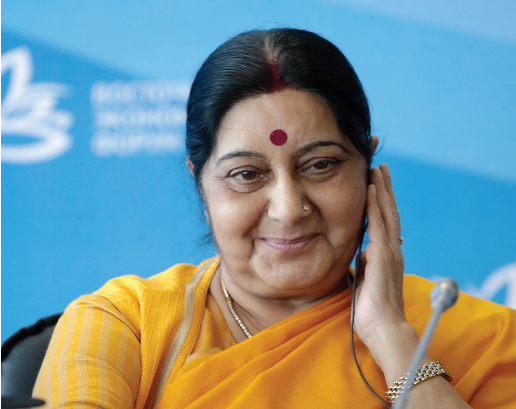
Sushma Swaraj (14 February 1952 – 6 August 2019) was an Indian lawyer, politician, and diplomat who served as the 5th Chief Minister of Delhi and as the Minister of External Affairs of India in the first Narendra Modi government from 2014 to 2019. She was the second person, after Jawaharlal Nehru, to complete a full five-year term in that role. A senior leader of the Bharatiya Janata Party (BJP), she was also the second woman to hold the office of External Affairs Minister, after Indira Gandhi.
Swaraj was elected seven times as a Member of Parliament and three times as a Member of a State Legislative Assembly. In 1977, at the age of 25, she became the youngest Cabinet Minister in Haryana. She also briefly served as the first female Chief Minister of Delhi in 1998.
In the 2014 general election, she won the Vidisha seat in Madhya Pradesh for a second term by a margin of over 400,000 votes. Appointed as External Affairs Minister on 26 May 2014, she earned the reputation of being India’s “best-loved politician,” as noted by The Wall Street Journal. She chose not to contest the 2019 general election due to health issues following a kidney transplant.
Sushma Swaraj passed away from a cardiac arrest on 6 August 2019. She was posthumously awarded the Padma Vibhushan, India’s second-highest civilian honour, in 2020 for her contributions to public affairs.
Early Political Career
She began her political journey as an MLA in Haryana from 1977 to 1982, and again from 1987 to 1990, representing the Ambala Cantonment constituency. She became a Cabinet Minister in the Janata Party government led by Devi Lal and handled Labour and Employment portfolios. From 1987 to 1990, she served as Education, Food, and Civil Supplies Minister. In 1979, she became the State President of the Janata Party (Haryana).
In April 1990, she was elected to the Rajya Sabha and remained a member until she was elected to the 11th Lok Sabha from South Delhi in 1996.
Union Minister and Chief Minister Roles
In 1996, during Atal Bihari Vajpayee’s brief 13-day government, she served as Minister of Information and Broadcasting. In October 1998, she resigned from the Union Cabinet to become the Chief Minister of Delhi—the first woman to hold that office—but stepped down in December the same year.
She returned to the Lok Sabha in 1998 and once again held the I&B Ministry, along with Telecommunications. Her notable achievements included granting film production industry status and initiating community radio in universities.
Bellary Battle and Return to Rajya Sabha
In 1999, Swaraj contested against Sonia Gandhi in Bellary, Karnataka, a Congress stronghold. Despite campaigning for only 12 days and speaking in Kannada, she secured 358,000 votes but lost narrowly.
She returned to Parliament via the Rajya Sabha in April 2000 from Uttar Pradesh, later representing Uttarakhand after its creation. She again became the I&B Minister from 2000 to 2003.
Minister of Health & Parliamentary Affairs (2003–2004)
From January 2003 to May 2004, she served as Minister of Health, Family Welfare, and Parliamentary Affairs. As Health Minister, she oversaw the establishment of six new AIIMS institutions across India.
Leader of Opposition and 2014 Victory
Elected to the Lok Sabha from Vidisha in 2009 by a massive margin, she succeeded L.K. Advani as Leader of Opposition in December 2009 and remained in that post until the BJP’s victory in 2014.
External Affairs Minister (2014–2019)
Swaraj took charge of the Ministry of External Affairs on 28 May 2014. She was widely praised for her prompt and humane diplomacy, especially in helping stranded Indians abroad.
One controversy involved her issuing a no-objection certificate (NOC) regarding Lalit Modi’s travel to Portugal. Though she clarified the legal and humanitarian context, the Opposition sought her resignation, which she successfully countered in Parliament.
She was also involved in sensitive consular matters, such as helping Gita, a hearing and speech-impaired Indian girl, return from Pakistan, and intervening in a child custody case involving Indian-origin parents in Norway.
Demise and Legacy
On 6 August 2019, Sushma Swaraj suffered a fatal heart attack and passed away at AIIMS, New Delhi. She was cremated with full state honours at Lodhi Crematorium.
Sushma Swaraj remains remembered as a trailblazing leader, a compassionate minister, and a powerful orator who left a deep impact on Indian politics and diplomacy.
(Ravi Rohmetra is Social Worker & Freelance Writer and can be reached @ Mob : 9419652999; E-mail : [email protected])


