
(11-27th September, 1893)
By Er.Rajesh Pathak, Bhopal
In the history wherever missionaries went to spread Christianity and, as also, to pave the way for their ruling overlords at home intending to lay control over its[foreign land] power and its resources, they[missionaries] and a section of scholars inspired by them invented a theory which world knows as ‘ White man’s burden theory’.
Since India had also been a part of the ‘mission’ they indulged in establishing in the eyes of world that this country is half-civilized, a country of snake charmers; its religious scriptures and their masters , likewise, lacks wisdom. And, therefore, to make it civilized, to redeem it from this state of self-ignorance that they had now come to make it their home. But fortunately at the same time there grew the trend among a section of scholars and philosophers of Europe and America to study Hinduism with fair mind. From the conclusions drawn from the study a process of exposing the falsehood of missionaries began to take shape. See, – ‘Vedas reveal every aspect of human-life such as— culture, religion, moral-code, surgery, medicines, music, astronomy, environment and architect etc.’-Sir William Jones. Similar views were held by the great thinkers like Arthur Shopenhower, Ralphwaldo Emerson, Wilhelm Von Humboldt and such others. But since their voices did not come from particular platform at particular event of recognition they could not draw much of attention of world.
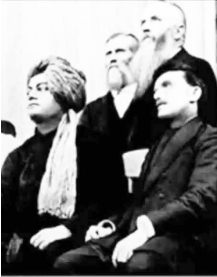
To India this opportunity came on 11th September, 1893 when in Chicago held Parliament of the World’s Religions , in which came together the greatest of proponents of different religions world over in order to present the tenets of their respective religions. This event proved to be one of transforming the views regarding India, its antiquity, its ancestors, its religion in the eyes of the people inside, as well as, outside the country. By joining the event one that succeeded in doing all by alone this seemingly impossible task, he was none other than Swami Vivekananda. In participating in the religious-parliament Vivekananda saw many missions to fulfill at one place and all at one time. Actually this was the time when having studied in Church sponsored mission schools and colleges’ Indian youths began to feel low about everything indigenous. These were the youths who were not ready to accept anything unless it was delivered by an Englishman.
And, most of all, the declared purpose of the event at Chicago had though been of bringing harmony among different religious faiths but Christian church was looking this as an opportunity when once knowing the tenets of Christianity the followers of all the faiths would admit the supremacy of it[Christianity] and grow excited to come under it. (‘The Parliament of Religions’-Mary Louise Burke (Sister Gargi)). For they were of belief that it was only due to their ignorance of Christianity that the people of the world forgetfully embraced their respective faiths.
Against the backdrop of this when Swamiji attained the Religious-parliament he had to wait to the last to deliver his speech. But when he began to speak, before the splendor of his discourse composed of all-inclusive Hindu philosophy none could save from its spell. Then 10-12 speeches that he gave in the days to come they were kept at last only so that the audiences could be made to stay in the auditorium till the end of the event to hear him. Seeing this many of the Newspapers then filled with his praise. The New York herald wrote- ‘In religious parliament the greatest personality is Vivekananda. After hearing his discourse all of a sudden a question raises how foolish is the idea to send religious missionaries to reform such country of wisdom.’ To the world that had got to be habitual of seeing bloodshed in the name of crusade and jihad the discourse of Vivekananda composed of Gita’s philosophy of religious co-existence and mutual harmony were beyond imagination. “Whoever comes to me- no matter from which of the ways- I get to meet him?” Explaining this message of Gita when Vivekananda told that Hindus not only believe in tolerance but hold every religion true, for the audiences this was something came to them from alien world.
Vivekananda went only to attend the Parliament of Religions but the response that he received there made him change his plan of returning India soon. In the words of Rashtrkavi Ramdhari Singh Dinkar-‘Enthused with Religious-parliament, Swamiji continued to stay for three years in Europe and England, and spread the essence of Hinduism all over there. It was difficult to convince Hindu intellectuals at home, who were deluded with learning English, but when they saw the men and women of Europe and America themselves being turned the disciples of Swamiji and got to engage in the service of Hindutva, their minds came to sense. Thus, the storm in the form of British-education, Christianity and European intellectualism that brewed up to swallow Hindutva went back colliding with Himalaya-like gigantic tree in the form of Vivekananda.’(‘Sanskriti ke chaar adhayay’)
(The writer is an Engineer by profession and a freelance contributor)