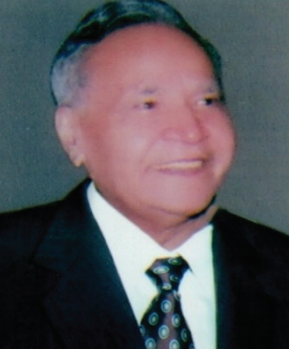
By Ravi Rohmetra
Jammu, often hailed as the “City of Temples,” has always been a crucible of history and culture. Beyond its spiritual grandeur, this land has given rise to towering personalities—rulers, sages, thinkers, warriors, scientists, and reformers—who have left a lasting imprint on society. Among the distinguished sons of this sacred soil was Harbans Lal Bhagotra popularly remembered as Judge Harbans Lal Bhagotra, a man whose life was devoted to justice, compassion, and public service.
Born on June 25, 1916, in an affluent Mahajan family in Mirpur (now in Pakistan-occupied Kashmir), Harbans Lal Bhagotra was destined for a life of meaningful contributions. His grandfather Kanshi Ram and father Lala Deewan Chand were respected businessmen of Mirpur. However, tragedy struck early when he lost his mother Ram Khetri at the tender age of one. Despite the personal loss and emotional challenges, young Harbans Lal showed remarkable perseverance in his pursuit of education.
He completed his matriculation from Government High School, Mirpur in 1931 and passed his FA (Intermediate) in 1933. At a time when education was rigorous and private tuition was rare, he pursued studies with determination. He joined Sanatan Dharma College in Lahore, graduating with a B.A. in 1935, and later pursued LLB from Law College, Lahore, completing it with distinction. His academic journey, though not marked by top rankings, remains a powerful example of how determination and sincerity can surpass academic hurdles.
After completing his legal studies, Bhagotra began practicing law under Pandit Roop Chand in Kotli. Soon after, he established an independent legal practice in Bhimber, gaining practical experience in the functioning of the judiciary.
His judicial career began in December 1946, when he successfully cleared the competitive examination for the Kashmir Judicial Service and was appointed as Munsif Magistrate. Initially posted at Mirpur, he was soon transferred to R.S. Pura on May 25, 1947. In the years that followed, his postings included key roles across the state, from Jammu to Srinagar, Rajouri, Reasi, Kathua, and Anantnag. His tenure in these conflict-prone and strategic regions underscored both his legal acumen and administrative integrity.
In 1951, he was appointed Deputy Registrar at the J&K High Court, a post he held until mid-1955. His further assignments included City Judge of Jammu, Additional District Magistrate (ADM) of Kathua and Jammu, and Administrator of Jammu and Srinagar Municipalities. As Secretary to the Delimitation Commission in 1961, he played a key role in shaping the political contours of legislative constituencies in the newly formed state assembly system.
One of his most sensitive assignments came in 1962, when he was posted as ADM Jammu with extended jurisdiction as Special Magistrate to try one of the accused in the Kashmir Conspiracy Case. His sense of duty, impartiality, and uprightness won wide respect.
In August 1964, he was appointed as the first Sessions Judge of the newly created Anantnag district. Later, from 1965 to 1971, he served with distinction as the District and Sessions Judge of Jammu—arguably the most prestigious judicial position in the region.
Post-retirement, his public service did not diminish. He served as a one-man commission probing food adulteration in prisons and was briefly appointed as Special Judge of the Anti-Corruption Organization. From 1972 to 1980, he was a Director of Jammu and Kashmir Bank Ltd., contributing to financial administration and public accountability.
His foray into politics came in 1977, when he was elected as MLA from Jammu West on a Janata Party ticket, serving in the state assembly until 1983. Even after leaving the legislature, he remained active in public life through his legal practice in the Jammu High Court until 2004.
Beyond his professional achievements, Judge Bhagotra’s life was a reflection of humanitarian values. He stood with the poor and underprivileged, not merely as a benefactor but as a true companion in their struggles. His charitable acts were rooted in a profound belief: “Service to humanity is service to God.” He often helped needy families, guided distressed couples away from divorce, and mediated in family disputes with compassion and wisdom.
In personal life, Judge Bhagotra faced profound loss when his wife, Pushpa Devi, passed away in 1981. Despite the emotional blow, he continued his community service, never allowing personal grief to overshadow his public responsibilities. He rarely spoke of his personal sorrows, even to his children, reflecting his deeply private nature and stoic character.
Respected and revered as “Judge Sahib” by people across communities, he held numerous leadership positions in social and religious organizations. He was the President of institutions like Mirpur Mahajan Sabha, Mirpur Refugee Committee, Ram Mandir Gura Bakshi Nagar, Arya Samaj Bakshi Nagar, Home for the Aged at Ambphalla, Central Mahajan Sabha, and more.
Judge Bhagotra also created welfare trusts in the memory of his parents and wife, donating large portions of his personal wealth to public causes. A notable example of his legacy is a spacious community hall constructed in the Sarwal area of Jammu, which serves the public for social and cultural gatherings.
He passed away on June 7, leaving behind a life rich in deeds and selfless service. His passing plunged his family, admirers, and countless beneficiaries of his charity into deep grief. Yet, he remains immortal in the collective memory of the Duggar community and the broader society of Jammu and Kashmir.
As a legal luminary, administrator, politician, reformer, and above all, a noble human being, Judge Harbans Lal Bhagotra exemplified the best of what Jammu has produced. His life is not just to be remembered but emulated—a beacon of integrity, compassion, and tireless public service.
In remembering him, we honor not just a man, but a legacy of righteousness, justice, and boundless love for humanity.
(The compiler is a Social Worker and a freelance writer on personalities of Jammu and can be reached at 9419652999;
Email : [email protected])