By- Vivek Koul
In light of India’s successful Operation Sindoor, which effectively crippled important air bases in Pakistan, a new front has been opened – not on the battlefield, but on the digital landscape. With no credible military response available, Pakistan has resorted to its own familiar playbook: a mass misinformation campaign designed to obfuscate the truth, distort the public’s perceptions, and spin a false narrative of success. When the Indian strike was over, social media in Pakistan was deluged with reports of a large counterstrike that caused harrowing destruction to India. None of these reports were verified, and by narrative, video “evidence” claiming the Indian military suffered casualties or infrastructure was either known older footage from other wars, or miscellaneous extracts from world events, or even, moving images taken from video games and stitched together by a technologist/model making a news montage. The invented reports also claimed Pakistan air force achieved destroy additional Indian jets and destroyed air bases in Rajasthan and Punjab and even breached Indian radar systems and created a jamming device interrupting Indian communications. These falsehoods were accompanied by celebratory hashtags and posts claiming a decisive Pakistani victory, attempting to boost domestic morale after the loss of strategic air power. The reality, however, paints a very different picture. Independent defense analysts and satellite imaging companies such as Maxar and StratFor confirmed the destruction of Pakistani air assets and the absence of any retaliatory strikes on Indian soil. Not a single credible report has indicated any damage to Indian military or civilian targets. Indian Air Force squadrons returned safely with zero losses. Radar logs, air traffic control data, and live monitoring confirmed that the operation was executed with high precision and efficiency. Moreover, high-resolution satellite images released by both Indian and international agencies clearly show the obliteration of aircraft hangars, fuel depots, and control towers at Murid, Masroor, and Sargodha airbases in Pakistan, while corresponding visuals of supposed Indian “targets” showed no activity or damage whatsoever.
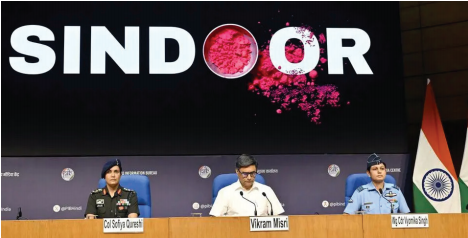
Pakistan’s move to aggressively disseminate false information can be interpreted as a desperate attempt to manage the narrative domestically. The embarrassment of losing key airbases and military hardware in less than an hour, coupled with the lack of preparedness against India’s electronic and cyber warfare units, left the Pakistani establishment scrambling for a response. In such situations, perception becomes as critical as reality. That is where digital propaganda comes in, seeking to shift attention away from the facts on the ground. A significant portion of the misinformation is being driven by fake accounts, bot networks, and troll farms often coordinated by Pakistan’s ISPR, which has long been involved in information warfare. These digital operatives work with high frequency and volume, spreading images and slogans intended to mislead, provoke, and emotionally manipulate viewers – especially younger audiences and international observers unfamiliar with South Asia’s complex conflict history. India, in contrast, has maintained a calm, responsible, and evidence-backed stance. Rather than engaging in digital chest-thumping or emotional rhetoric, Indian officials released verifiable proof of the operation’s success and denied baseless Pakistani claims with factual data. Ministry of Defence briefings, support from independent foreign media, and the use of publicly available satellite imagery gave the Indian side substantial credibility. Even traditionally neutral or cautious media outlets in the West acknowledged that Pakistan’s online narrative lacked substance and appeared designed more for internal political consumption than external credibility. In this era of hybrid warfare, it’s not just tanks and missiles that shape outcomes, but also tweets, videos, and digital impressions. Recognizing this, Indian citizens and media have a vital role to play in countering fake news. Sharing unverified content, engaging with troll accounts, or forwarding viral messages without fact-checking can unintentionally aid the propaganda goals of the adversary. Responsible digital behavior, including verifying sources, reporting fake content, and amplifying credible updates from defense analysts, journalists, and government sources, is critical. Independent Indian fact-checkers and cybersecurity analysts have also played a commendable role in this information battle, quickly identifying doctored content and exposing it with side-by-side comparisons and metadata analysis.
The truth about Operation Sindoor is now well-established. It was a carefully planned and flawlessly executed strike that achieved its objectives with zero casualties on the Indian side and massive disruption to Pakistan’s air capabilities. The fact that Pakistan’s only response so far has been digital noise, rather than a credible military counter, underscores the strategic superiority India demonstrated. While their online machinery may continue to churn out dramatic but false narratives, facts have a weight of their own. Global perception is slowly aligning with the reality that India acted in self-defense, with restraint, and with modern military acumen. Ultimately, the attempt to manufacture a victory online cannot substitute for real results on the ground. Pakistan’s disinformation campaign may mislead a section of its domestic audience, but it cannot change satellite evidence, neutral reports, or India’s clear and decisive gains. As always, India’s strength lies in its unity, its discipline, and its commitment to truth – whether in combat or in conversation. The falsehoods being peddled online will fade, but the impact of Operation Sindoor will be studied in strategic circles for years to come.