By Rameshwar Singh Jamwal
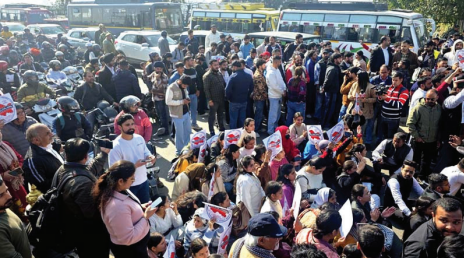
Jammu is smoldering and seems to be heading for another agitation, this time again for the discrimination meted out to it in allocation of a prestigious educational institution, National Law University and the issue has also been raised in the Assembly by BJP Legislators. Demands for setting up NLU in Surankot, in Rajouri and many other parts of Jammu hilly areas are also being raised. Having been a regular visitor to a couple of these Universities, and having seen their contribution in Nation’s stride, especially in the legal field, the author feels that the grievance of the agitating student community of Jammu, especially the Law Students of Jammu University and supported by Jammu University Teachers Association and having the support of many social organizations, including J&K High Court Bar Association Jammu, is genuine. But is it such an important academic institution, which has reignited the issue of discrimination with Jammu and may lead to the further impetus to the demand for a separate Jammu state, the problem needs to be viewed from different prisms. Firstly we need to have some knowledge about the history and controlling mechanisms of NLU’s and the effect they cause in the development of a state or a region. The National Law schools or the National Law Universities are recognized by the University Grants Commission as ‘State Universities’ and are affiliated to the Bar Council of India. Each of these Premier law schools have been established under a specific legislation, passed by the State legislature of the States which were desirous of establishing a law school. In terms of this legislation, these law schools are required to establish and practice very high standards, at par with other national level institutions imparting education in other walks of life like IIT’s and IIM’s. Only the top brains and meritorious students get admission in these NLU’s who are inclined to join legal profession, and who have to compete through CLAT or other similar high standard tests in some other NLU’s as the conferment of national status makes admittance to these law schools a prestigious choice and a sure recipe for good adjustment in Law Firms or chambers of top notch Advocates in the country.
J&K had lagged behind in this field as well but ultimately after a long process initiated several years back to upgrade legal education to national standards, a proposal for a NLU in J&K was mooted which was to be modeled after NLSIU Bangalore. State Legislature passed the National Law Universities Act in the year 2018, before the abolition of Article 370 which remained in limbo due to the developments following abolition of Article 370 but when new NC government came to power, in 2025 a resolution was passed in the assembly with an aim for its establishment in Srinagar. The Jammu students, J&K High Court Bar Association, legislators from BJP and many other agitators are seeing red in this entire move as the UT Government has decided to establish this prestigious institute in Kashmir which has led to the eruption of protests in Jammu. A deeper reading of this issue through the lens of earlier such moves reveals that what Jammu is witnessing today is not an isolated grievance, but a continuation and manifestation of a longstanding pattern of institutional invisibilisation. It has been my longstanding feeling that alienation does not always arise from overt oppressive actions, more often, it is cultivated silently through systemic neglect; unequal allocation of funds, institutions, and denial of participatory parity in political setup, in services and in other developmental activities. There is a long list of such discriminatory acts which has now been exacerbated by denial of NLU in Jammu. Educational institutions, especially institutions of national character like NLU play a decisive role in shaping regional confidence, professional opportunity, and psychological integration with the country.
National Law Universities are not buildings with just world class infrastructure or merely academic bodies for imparting legal education and conferring and distributing Degrees; they are constitutional institutions in spirit and nation makers. They produce judges, policy-makers, legislators, administrators, and legal scholars who shape the discourse in politics, governance, and nationhood and which depends upon the class of teachers they are able to recruit and the talent of students they get from the rest of country. Whether a violent and disturbed Kashmir would be able to attract this pool of talent is debatable and if such an institution is denied to a region with a long list of proven grievances but having a peaceful atmosphere for academic activities, strong legal tradition, nationalist spirit, an active Bar, and a substantial student population, the denial is neither accidental nor neutral; it is deliberate and can have grave ramifications for national cause.
The mandate of law itself supports decentralised and equitable access to national institutions. A monopolization of national institutions within one geographic region of a State or Union Territory is not what Nation expects and University Grants Commission framework, read with the Bar Council of India norms contemplate. In fact, the very philosophy behind the NLU movement, initiated with NLSIU Bangalore was to democratise elite legal education across India and reduce regional imbalance. Recognizing this vital aspect, several States like Uttar Pradesh, Maharashtra, Madhya Pradesh have established multiple NLUs, acknowledging that population size, regional spread, and aspirational equity justify more than one institution, a model that needed replication in J&K.
UT of Jammu & Kashmir presents a unique case and the UT government should have realized this aspect. J&K is not merely a large geographical unit; it is a socio politically sensitive region emerging from decades of instability, grievances against administrative and political centralization in one region, and a fractured trust. Ladakh separated from it only on these grounds. In such a context, the placement of all important and nationally branded institutions in one region, even if well intentioned, inevitably reinforces perceptions of exclusion. ‘Misgoverned Kashmir, the Indian Bane’ repeatedly emphasizes that perception of discrimination, when sustained, becomes a political reality, regardless of intent.
The legal procedure for establishing an additional National Law University in Jammu is not extraordinary or disruptive. All that is required is legislative sanction either through a fresh enactment or an amendment to the existing NLU Act followed by approval of the Bar Council of India and recognition by the UGC. Financial viability, land allocation, and administrative planning are small matters for a larger cause and should not be obstacles of principle. The Union Territory administration already possesses the constitutional competence and administrative apparatus to do so and so is the case with Central Government and all that is required is political will informed by constitutional morality, not appeasement politics.
The benefits of a NLU in Jammu are tangible and multi-dimensional. Academically, it would stem the migration of talented students from Jammu region to distant States, who after studies mostly settle outside and contribute there, not in J&K. It’s Brain Drain for J&K. it will also reduce financial and social burdens on families. Professionally, it would strengthen the nationalist elements in J&K High Court Bar Association Jammu, improve the quality of advocacy, and create a robust pipeline for judicial services, academia, and policy research. Economically, such an institution generates an ecosystem; housing, services, research projects, conferences, legal aid clinics that contribute to local economic boost and development. Changing face of Jagti on outskirts of Jammu is an example.
More importantly, from a criminological and governance perspective, a NLU in Jammu would serve as a norm building institution. It would promote constitutional culture, rights literacy, rule of law, culture of lawfulness and consciousness in a region that has often felt peripheral to decision-making. Ignoring this demand risks repeating the historical blunders regarding J&K, highlighted by me through my repeated academic works; treating regional grievances as episodic disturbances rather than symptoms of structural imbalance can be fatal for interests of Kashmir. When peaceful, reasoned, and legally grounded demands are dismissed, they tend to resurface in more polarised forms. Conversely, timely institutional correction acts as a safety valve, reinforcing faith in democratic processes.
Therefore, the demand for an additional National Law University in Jammu cannot be viewed as a competition between two regions, but would be a an effort for constitutional justice, an acknowledgment that dignity flows from institutions, and that unity is sustained not by rhetoric and words, but by equitable representation in national frameworks. If the objective is true integration, balanced development, and long term stability, then Jammu’s claim to a NLU is not only justified, it is inevitable and the Political leadership of J&K must see the writing on the wall.
…………………………………………………………………………………….
The author is a Practicing Advocate of J&K High Court.