
By Col Dev Anand Lohamaror
The debate over Iran’s regional strategy is no longer confined to West Asia; it now directly affects every nation dependent upon secure sea lanes, uninterrupted energy supplies, and a rules-based international order. For Bharat, this evolving geopolitical landscape raises a fundamental question: Is Iran truly a friend of Bharat? The answer cannot rest solely on historical goodwill or diplomatic rhetoric. It must be assessed through the prism of strategic conduct, national security, economic interests, and long-term geopolitical realities.
Bharat’s relationship with Iran has traditionally been viewed through the lens of centuries-old civilizational ties, cultural exchanges, and strategic cooperation. Projects such as the Chabahar Port and the International North-South Transport Corridor (INSTC) have given the relationship considerable geopolitical significance by providing Bharat with vital connectivity to Afghanistan, Central Asia, and Eurasia while bypassing Pakistan. Energy cooperation has also served as an important pillar of bilateral engagement. Yet, a realistic assessment of national interest demands that diplomacy be weighed alongside strategic behaviour. When examined against its regional policies, ideological posture, and the activities of the proxy networks it supports, Iran presents a far more complex picture than that of an uncomplicated strategic friend.
A historical review reveals that successive Iranian governments have, at critical moments, adopted policies that favoured Pakistan over Bharat. Long before the 1979 Islamic Revolution, Iran under Shah Mohammad Reza Pahlavi maintained an exceptionally close strategic partnership with Islamabad. Iran was among the first countries to recognise Pakistan in 1947, formalised relations through the 1950 Treaty of Friendship, and later joined the Western-backed Baghdad Pact (CENTO) alongside Pakistan in 1955. During both the 1965 and 1971 Indo-Pak wars, the Shah extended Pakistan diplomatic backing, concessional oil supplies, military equipment, ammunition, aircraft support, and logistical assistance. While these decisions belonged to the pre-revolutionary monarchy, they nevertheless established a historical precedent of Iran prioritising Pakistan’s strategic interests over those of Bharat during periods of regional conflict.
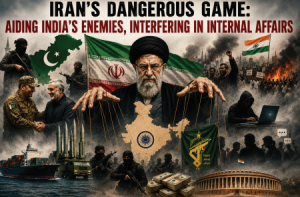
It must equally be acknowledged that Indo-Iranian relations improved significantly after the Cold War, particularly through cooperation in energy, regional connectivity, and infrastructure development. However, historical precedents remain relevant because they reveal enduring strategic preferences during moments of regional crisis, reminding policymakers that national interests often outweigh historical goodwill.
The Islamic Revolution of 1979 fundamentally transformed Iran’s strategic outlook through three defining pillars: Ayatollah Ruhollah Khomeini’s doctrine of the “Export of the Islamic Revolution,” the creation of the “Axis of Resistance,” and the establishment of the Islamic Revolutionary Guard Corps (IRGC) as the principal guardian of the revolutionary state. The doctrine of exporting the revolution sought to inspire, support, and organize ideologically aligned movements across the Muslim world. This transformed Iran from a conventional nation-state into a revolutionary ideological power pursuing influence well beyond its territorial boundaries.
Under Supreme Leader Ayatollah Ali Khamenei, this ideological strategy expanded considerably through the IRGC’s elite Quds Force, which cultivated, armed, trained, and financed a network of non-state armed groups across West Asia, including Hezbollah in Lebanon, Hamas in Gaza, and the Houthis in Yemen. While Tehran maintains that these relationships are defensive measures, the practical consequences have frequently conflicted with Bharat’s core national interests.
This ideological outreach has also extended into issues directly concerning Bharat’s sovereignty. Supreme Leader Ayatollah Ali Khamenei has repeatedly commented on Kashmir, notably in his Eid al-Fitr message in 2017, following the abrogation of Article 370 in August 2019, and again in 2022 and 2024, calling for support for the “oppressed people” of Kashmir. New Delhi has consistently rejected these statements as unwarranted interference. For Bharat, such repeated interventions constitute a direct challenge to its sovereignty, territorial integrity, and civilisational identity.
The most immediate and measurable challenge to Bharat’s interests lies in the maritime domain. The activities of groups associated with Iran’s “Axis of Resistance” have effectively globalised regional conflicts by targeting international shipping routes. Since late 2023, repeated Houthi drone and missile attacks against commercial vessels transiting the Red Sea and the Bab el-Mandeb Strait have severely disrupted one of the world’s busiest maritime corridors, through which a substantial share of Bharat’s trade with Europe passes.
As a consequence, numerous commercial vessels have avoided the Suez Canal and instead rerouted around the Cape of Good Hope, adding approximately ten to fourteen days to transit times. Freight costs have risen sharply, marine insurance premiums have increased substantially, and global supply chains have experienced significant delays. Indian exporters dealing in engineering goods, pharmaceuticals, textiles, chemicals, and agricultural products have consequently faced considerable logistical and financial burdens, directly affecting the competitiveness of an economy whose external trade exceeds one trillion US dollars annually.
Bharat’s energy security remains equally vulnerable. Any prolonged disruption—or even the credible threat of escalation—in the Strait of Hormuz, through which nearly one-fifth of global seaborne oil passes, immediately triggers international price volatility. Such fluctuations directly influence inflation, fiscal planning, industrial production, and economic growth within Bharat.
Recognising these evolving threats, the Indian Navy has responded with exceptional professionalism by significantly expanding its operational presence across the Arabian Sea and the Gulf of Aden. Through sustained escort missions, anti-piracy patrols, surveillance operations, and rapid-response deployments, it has safeguarded merchant shipping while reinforcing the principle of freedom of navigation. These operations demonstrate that protecting international sea lanes is a vital national security obligation. Neutral commercial shipping must never become an instrument of geopolitical coercion or proxy warfare.
Part II
An emerging and deeply concerning dimension for Indian security agencies is the growing political, ideological, and symbolic convergence between Iran-backed militant networks and Pakistan-based terrorist organisations. On 5 February 2025, during Pakistan’s annual Kashmir Solidarity Day, senior Hamas representatives travelled to Rawalakot in Pakistan-occupied Jammu & Kashmir (PoJK) to participate in the “Kashmir Solidarity and Hamas Operation Al-Aqsa Flood Conference.” Publicly available footage showed Hamas delegates sharing the stage with leaders of Lashkar-e-Taiba (LeT) and Jaish-e-Mohammed (JeM), both designated as terrorist organisations by the United Nations, while speakers explicitly attempted to draw parallels between Gaza and Kashmir.
Following the 22 April 2025 Pahalgam terrorist attack, in which Pakistan-backed terrorists brutally murdered 26 innocent civilians, Indian security agencies closely examined possible interactions between Hamas-linked individuals and Pakistan-based terrorist organisations such as LeT and its proxy, The Resistance Front (TRF). While no direct operational role by Hamas has been publicly established, the visible political and ideological convergence among these extremist organisations warrants sustained monitoring by Indian security agencies. This development assumes greater significance because Bharat’s military response to the Pahalgam massacre—Operation Sindoor, launched on 7 May 2025—targeted terrorist infrastructure belonging to the very organisations that had hosted Hamas representatives in PoJK only a few months earlier. Such symbolic convergence reinforces concerns regarding the broader transnational jihadist ecosystem confronting Bharat.
When evaluating whether Iran’s conduct corresponds with the traditional definition of a strategic friend, the answer becomes institutionally complex. The Islamic Revolutionary Guard Corps exercises extraordinary influence over Iran’s political, military, and economic systems. Through its extensive presence across construction, energy, telecommunications, logistics, shipping, and port operations, the IRGC possesses considerable institutional autonomy that often limits the civilian government’s freedom to pursue an independent foreign policy. Consequently, it becomes increasingly difficult for external partners to distinguish between official state policy and the strategic actions of Iran’s powerful security establishment.
For decades, Bharat has successfully pursued a balanced West Asia policy by maintaining constructive relations simultaneously with Iran, Israel, the Gulf monarchies, and the United States. This policy of strategic autonomy has served New Delhi well by enabling cooperation across competing geopolitical blocs without becoming entangled in their rivalries. Nevertheless, the changing regional security environment demands that Bharat evaluate every partnership through the lens of hard realism rather than historical sentiment.
Moving forward, Bharat’s strategic response must rest upon diversification, resilience, and deterrence. Expanding Strategic Petroleum Reserves, diversifying crude oil imports, strengthening renewable energy capacity, and investing further in maritime infrastructure will reduce vulnerability to geopolitical shocks. Simultaneously, continued investment in the Indian Navy, maritime domain awareness, anti-drone capabilities, and long-range surveillance will remain indispensable for safeguarding the sea lanes upon which Bharat’s economic future depends.
At the same time, New Delhi should continue pragmatic engagement with Tehran where genuine mutual interests exist. Projects such as the Chabahar Port and the International North-South Transport Corridor (INSTC) continue to offer important strategic and commercial advantages for Bharat’s connectivity with Afghanistan, Central Asia, and Eurasia. Constructive diplomatic engagement in these sectors remains consistent with Bharat’s long-standing policy of strategic autonomy. However, such engagement cannot become a shield behind which proxy warfare threatens international commerce, energy security, or regional stability.
Ultimately, friendship in international relations cannot be measured solely by diplomatic exchanges, historical goodwill, or economic cooperation. It must be judged by whether a nation’s strategic conduct strengthens or undermines another nation’s security, sovereignty, and long-term national interests. History consistently demonstrates that nations are defined less by their declarations than by the consequences of their actions. Iran remains an important regional actor with whom Bharat should continue to engage wherever mutual interests converge. Yet prudence demands that every engagement be guided not by sentiment, but by an uncompromising commitment to national security, economic resilience, strategic autonomy, and the protection of Bharat’s civilisational and sovereign interests. Only through such clear-eyed realism can Bharat safeguard its rise as a responsible global power while navigating the increasingly turbulent geopolitics of West Asia.