By Girdhari Lal Raina, Ex-MLC
While at first glance the act may appear as a simple law-and-order issue, its symbolism and timing suggest something deeper. Hazratbal has, for decades, stood not only as a centre of religious devotion but also as a focal point of political contestation. The shrine’s sanctity has often been overshadowed by the struggle for influence, legitimacy, and control.
A Shrine of Faith and History
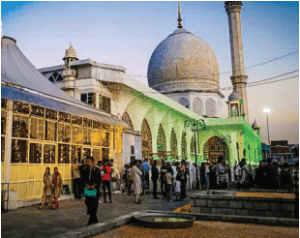
The Hazratbal site has a layered history, predating its Islamic significance. What began as a Mughal pleasure house, the Ishrat Mahal, was converted into a prayer hall in 1634 under Emperor Shah Jahan. Its enduring importance came later, in 1699, with the arrival of the Moi-e-Muqqadas—a hair of Prophet Muhammad. Initially housed at the Naqashband Sahib shrine, the relic was transferred to Hazratbal due to the swelling crowds.
The shrine’s marble structure, familiar today with its iconic white dome, was developed much later under the Muslim Auqaf Trust led by Sheikh Mohammad Abdullah between 1968 and 1979. This period saw Hazratbal not only as a religious centre but also as a symbol of Kashmiri identity.
The Relic Crisis of 1963
The most dramatic turn in Hazratbal’s political journey came in December 1963, when the holy relic was stolen. At the time, Kashmir was experiencing political instability. Sheikh Abdullah had been dismissed and arrested in 1953, and the state was governed by Bakshi Ghulam Mohammad. By the early 1960s, Bakshi was accused of corruption and removed under the Kamraj Plan, replaced by the weak leadership of Khwaja Shams-ud-Din.
The theft created an unprecedented wave of anger and anxiety. While the relic was soon recovered, suspicion about who engineered the theft lingered. Some believed Bakshi staged the drama to regain political ground; others thought G. M. Sadiq benefitted most, as the episode discredited Shams-ud-Din and paved his way to power. Even Pakistan was suspected of fanning the flames to destabilise Delhi’s hold on Kashmir.
Amid these speculations, one undeniable consequence was the revival of the plebiscite slogan and the re-emergence of Sheikh Abdullah as a central political figure. The crisis transformed Hazratbal into more than a shrine—it became a political pulpit.
Shrines as Instruments of Influence
The history of Hazratbal illustrates how religious institutions in Kashmir have repeatedly intersected with politics. The Muslim Auqaf Trust (MAT), established in the 1930s under Sheikh Abdullah, was envisioned as a community institution to manage endowments. Yet, its control gave Abdullah’s party, and later the National Conference (NC), significant influence over community affairs.
This institutional dominance was disrupted in 2003, when Mufti Mohammad Sayeed’s PDP-Congress government dismantled the MAT and created the Jammu and Kashmir Waqf Board. The move was officially justified as a reform to check corruption, but it also served to weaken the NC’s hold over religious infrastructure.
The post-2019 extension of the Central Waqf Act further shifted this balance. The Waqf Board became answerable to the Central Waqf Council in New Delhi, reducing its function as a purely state-controlled body. The NC criticised this as “centralised misappropriation,” but the change undeniably diluted local political control over one of the Valley’s most influential institutions.
Conflict and the Sanctity of Hazratbal
Hazratbal’s vulnerability has not only been political but also militant. In 1993, terrorists occupied the shrine, leading to a 34-day standoff with security forces. The confrontation sparked widespread public unrest and was eventually resolved by granting safe passage to the terrorists. Again in 1996, security forces laid siege near the shrine to prevent its reoccupation by terrorists, resulting in heavy gunfire and casualties.
These episodes underscore the dual identity of Hazratbal: sacred for common devotees, yet strategically significant for those seeking influence—whether political actors or armed groups. Its sanctity has thus been repeatedly tested by forces far removed from faith.
Contemporary Controversies
Recent years have brought new flashpoints. In 2024, the removal of Hazratbal’s head priest, Kamal-ud-Din Farooqui, by Waqf sparked heated debate. Farooqui was accused of overseeing a controversial religious conversion. His removal was interpreted by some as an administrative necessity, but by others as an attempt to curtail NC’s influence within the shrine.
A second controversy arose when Omar Abdullah was allegedly denied entry to the sanctum during renovation works. While officially denied, as per some published reports quoting locals, plywood barriers had been erected to block his access. The timing of the shrine’s renovation, unveiled just before the Prophet’s birth anniversary—a period when Hazratbal draws maximum crowds—added to the perception of calculated politics.
A Pattern Across Decades
From the relic theft of 1963 to the militant occupation of 1993, and from institutional reshaping in 2003 to the current disputes over shrine management, the story of Hazratbal reveals a consistent pattern: faith is interwoven with power struggles. Each era has seen the shrine appropriated, whether to consolidate political authority, challenge rivals, or mobilise public sentiment.
The vandalisation of the National Emblem inside the shrine premises must be understood within this wider historical canvas. It is not an isolated act but part of a recurring cycle in which religious symbolism is exploited to provoke outrage, assert influence, or undermine authority.
The Larger Question
The persistence of such episodes raises a fundamental question: can shrines like Hazratbal ever be insulated from politics? Their deep emotional resonance, combined with their centrality in Kashmiri life, makes them attractive instruments for political mobilisation. Yet, this very entanglement has repeatedly endangered their sanctity.
A way forward requires restoring shrines to their essential role as centres of faith and community service rather than arenas of political contestation. This does not mean severing their social relevance but ensuring that their administration remains transparent, accountable, and independent of partisan interests.
Conclusion
Hazratbal’s history is not just the story of a shrine; it is a mirror reflecting Kashmir’s political evolution. From the relic crisis that revived separatist sentiment, to militant occupations, and to present-day disputes over Waqf control, Hazratbal has stood at the crossroads of faith and politics.
The recent vandalisation of the National Emblem is another reminder of how fragile this balance remains. For Kashmir to move beyond cycles of manipulation, shrines like Hazratbal must be preserved in their true essence—as places of devotion, not as stages for political theatre.
Only then can they serve the purpose they were meant for: spiritual refuge, community harmony, and cultural continuity.
(Author Girdhari Lal Raina is a former Member of the legislative council of erstwhile Jammu Kashmir and spokesperson of BJP JK-UT)