Winter of discontent for desi techies as confusion over status grows
By T N Ashok
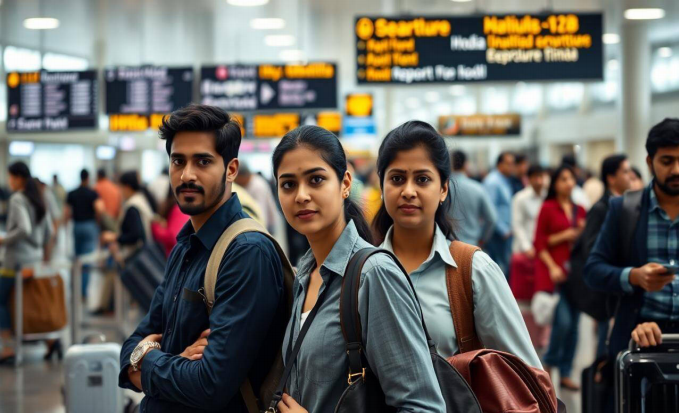
Hundreds of Indian professionals working in the United States on H-1B visas are stranded in India after returning home for what they believed would be routine visa renewals — a process that has now spiralled into months-long uncertainty, financial distress, and professional limbo.
Many of these workers travelled to India in early December after explicit assurances from the US Department of Homeland Security that H-1B holders could safely visit their countries of origin and return without facing punitive fees or extraordinary delays. Those assurances, reiterated publicly by Homeland Security Secretary Kristi Noem, now ring hollow for families caught in an abrupt policy shift linked to enhanced social media vetting by the US State Department.
According to immigration attorneys and affected workers, consular interviews scheduled between December 15 and 26 were suddenly postponed to March 2026 or later, often without explanation beyond a generic email citing “additional administrative processing.”
The timing could not have been worse. December is traditionally when thousands of Indian-origin professionals schedule renewals to coincide with holidays, weddings, and family emergencies. Instead, many now find themselves unable to return to the US, unsure when — or if — they will be allowed back.
“This is the biggest disruption we’ve seen in years,” said Veena Vijay Ananth, an immigration lawyer who represents several multinational companies. “People followed the rules, relied on official assurances, paid the required fees — and are now stranded with no clarity and no recourse.”
Raghav Malhotra, a 34-year-old software engineer based in suburban Detroit, flew to Delhi in early December to attend his sister’s wedding. He had two consular appointments scheduled — December 17 and December 23 — as a precaution in case one was cancelled. Both appointments were later marked “expired.”“I didn’t miss anything. I didn’t overstay. My employer filed everything on time,” Malhotra said in a phone interview. “Now I’m stuck at my parents’ house, working odd US hours remotely, hoping my company doesn’t decide I’m more trouble than I’m worth.”Malhotra’s wife and two-year-old child remain in the US on H-4 visas. X-mas will pass without him.
For Ananya Rao, a healthcare data analyst working in Boston, the consequences are even more severe. Rao returned to Bengaluru to renew her H-1B after her mother suffered a stroke. Her interview, scheduled for December 19, was postponed to March.“My US employer has been supportive — for now,” she said. “But they’ve already hinted that if this drags on too long, they may have to replace me.”Immigration lawyers say employers are increasingly uneasy, particularly smaller firms that lack the flexibility of tech giants. Extended absences raise compliance issues, payroll complications, and project disruptions.
Just weeks earlier, Homeland Security Secretary Kristi Noem had sought to reassure foreign workers amid growing anxiety over visa policies under President Donald Trump’s second term. She publicly stated that existing H-1B visa holders would not be subjected to the newly hiked visa fees and that routine renewals would continue without disruption. Those assurances encouraged many to travel — a decision they now regret.“What changed was not the law, but the implementation,” said a former US consular official familiar with visa operations in India. “Enhanced social media vetting has created a massive processing bottleneck, and the system simply wasn’t prepared.”
The State Department has confirmed that H-1B and H-4 visa applicants are now subject to enhanced social media scrutiny, an expansion of a policy previously applied mainly to students and exchange visitors.
Applicants were instructed earlier this year to make their social media profiles public — a move civil liberties groups argue is vague, intrusive, and inconsistently enforced.“Every visa adjudication is a national security decision,” the State Department said in a written response, without addressing delays or backlogs. Lawyers say even benign online activity — political opinions, satire, or associations — can now trigger additional review, delaying cases indefinitely.
On December 9, the US Embassy in India issued a sharply worded advisory warning applicants not to appear at consulates on their original interview dates if they had received rescheduling emails, or risk being denied entry altogether. For many stranded workers, the advisory felt like salt in the wound.“It’s Kafkaesque,” said one visa holder in Hyderabad. “You follow instructions, and that becomes the reason you’re punished.”
While H-1B holders form the largest group impacted — Indians account for roughly 71% of all H-1B visas, according to USCIS — immigration lawyers warn that other categories are also being quietly squeezed.
L-1 visa holders (intra-company transferees) report similar delays, particularly those working in technology consulting.J-1 exchange visitors, including researchers and medical fellows, are facing heightened scrutiny, especially if they have worked previously in sensitive sectors.H-4 dependents are caught in the crossfire, with work authorization renewals delayed, forcing some spouses to quit jobs in the US.“This isn’t isolated,” said an immigration partner at a New York law firm. “It’s a systemic slowdown masquerading as security.”
The fallout has reached corporate boardrooms. Google and Apple have reportedly advised employees not to travel internationally unless absolutely necessary, citing visa processing delays that could extend up to 12 months. Google’s external counsel warned staff they risked “extended stays outside the US” due to consular backlogs — language rarely used in internal advisories.
For Indian professionals, the episode has revived long-standing fears that US immigration policy can change overnight — and that official assurances may offer little protection overnight — and that official assurances may offer little protection. No More India Hiring says – Donald Trump sending a chill down the spine of the Indian community, the largest ethnic group of H-1B visa holders at 71%.“This feels like discrimination by design,” said Malhotra. “The rules exist, but they’re applied in ways that make you feel unwelcome.”
As the backlog grows and clarity remains elusive, stranded workers face a stark reality: careers built over years can unravel in months, families can be separated indefinitely, and trust — once broken — is hard to restore. For now, all they can do is wait. (IPA Service)