Cooperation extends to mutually beneficial new sectors
By K Raveendran
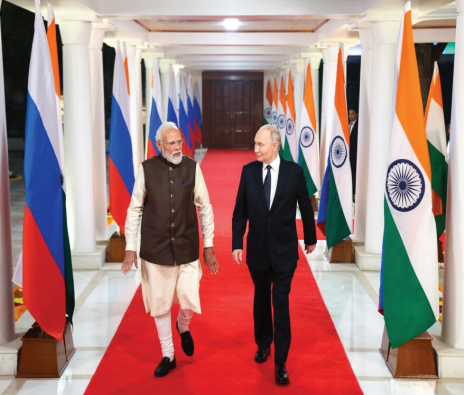
Russian President Vladimir Putin’s visit has drawn attention for the way it reinforced a partnership shaped increasingly by economic interdependence and investment-driven priorities. The backdrop to this year’s summit made the outcome particularly notable, as both countries have expanded trade, diversified energy cooperation, and opened new avenues for labour mobility and market access despite heightened global sanctions pressure. Expectations before the meeting suggested that talks might end without a joint declaration because of the complexity of issues under discussion, especially those linked to cross-border payments and energy logistics. Yet the eventual statement went further than anticipated, highlighting advances in sectors central to both economies and signalling confidence in areas that have significant commercial implications.
Energy cooperation featured prominently as a central binding element. India has sharply increased its intake of Russian crude, transforming the nature of their trade relationship and positioning energy as a pillar of engagement. The summit built on this shift, with discussions aimed at stabilising supply channels, improving payment mechanisms, and supporting infrastructure tied to refining, shipping, and insurance. Despite external constraints on Russia’s export routes, India has maintained a steady flow of purchases, supported by favourable pricing and the reconfiguration of supply chains. The joint statement acknowledged this, suggesting both sides are prepared to sustain and refine these arrangements over the medium term. The dialogue extended beyond crude imports to consider LNG, coal, and options for joint ventures in upstream and downstream projects, indicating attention to long-term investment horizons.
Trade and investment formed another major area of focus. Bilateral trade has grown considerably over the past two years, though imbalances remain due to the dominance of energy in overall volumes. Russia’s willingness to open its market further to Indian exporters is part of an effort to rebalance trade flows. Pharmaceutical products, agricultural goods, textiles, and engineering equipment are sectors where India has been pushing for greater access, and Moscow’s indication that it is prepared to expand import categories marks a structural shift. This aligns with Russia’s attempt to diversify supply partners and secure stable consumer goods channels in the face of sanctions. The summit discussions suggested a shared recognition that durable economic ties require attention not only to headline numbers but also to the composition and sustainability of trade baskets.
Investment collaborations received greater emphasis than in earlier years, reflecting a move toward deeper commercial integration. Russian entities have explored new opportunities in Indian infrastructure, energy distribution, and manufacturing, while Indian companies have examined prospects in Russian mining, agriculture, and logistics. Sanctions have complicated traditional investment routes, but both sides have been developing alternative frameworks, using currency arrangements, special investment zones, and project-specific financial structures. The summit reaffirmed intent to strengthen these channels and encourage private-sector participation by reducing regulatory friction and improving clarity around payment systems. The degree to which these mechanisms function efficiently will shape the pace of future investment flows, and the discussions underscored the importance placed on institutional stability.
One of the more distinctive features of this summit was Russia’s readiness to broaden immigration, employment, and skill-mobility opportunities for Indian workers and students. This marks a meaningful economic development, as Russia’s labour shortages have become more pronounced while India’s workforce continues to expand globally. Both sides have explored formal frameworks to regulate and facilitate movement of skilled professionals, technical workers, and students. Such pathways could support sectors in Russia facing demographic gaps while offering new employment and education destinations for Indians. This dimension of the relationship, though less visible than energy or defence cooperation, has practical economic implications and may evolve into a stable component of bilateral engagement.
Logistics and connectivity also formed part of the summit’s economic focus. Long-discussed projects such as the Chennai–Vladivostok maritime corridor and the International North–South Transport Corridor were revisited with an eye to accelerating timelines and improving cost efficiencies. These corridors have the potential to reshape trade routes by shortening transport times for goods flowing between Asia and Russia’s Far East and between India and markets in Central Asia and the Caucasus. Progress has been uneven, but both sides see these infrastructure networks as critical to long-term commercial resilience. Discussions at this year’s summit pointed to renewed attention to financing models, port readiness, and sector-specific incentives that could encourage private investment.
The cumulative effect of these developments is a partnership increasingly centred on economic pragmatism. The joint declaration’s emphasis on trade, investment, energy, and mobility reflects clear priorities aimed at lowering transaction costs, diversifying economic risk, and supporting growth sectors. The economic relationship has been expanding at a pace shaped partly by sanctions-induced shifts in global supply chains, but also by deliberate policy choices on both sides to treat commerce as the central stabilising element of the partnership. India’s approach aligns with its broader strategy of diversifying supply chains and strengthening domestic capacity, while Russia has sought to develop new markets and investment partners as it restructures its external economic links.
Putin’s visit thus served as a marker of the economic evolution of the India–Russia partnership. A relationship once defined primarily by defence cooperation is being reshaped by trade, energy, investment, and workforce linkages. The joint statement, which many had thought might be omitted due to sensitivities around sanctions and financial channels, ultimately underscored the progress achieved and pointed toward areas where further expansion is anticipated. The narrative emerging from the summit is one of economic consolidation, informed by practical needs and mutual benefit rather than political theatre. The emphasis on commercial outcomes suggests both sides view economic resilience as the core of their long-term engagement, and the summit reinforced that trajectory by outlining tangible areas of cooperation expected to define the next phase of the partnership. (IPA Service)