Narendra Modi is still holding against big US pressure in trade talks
By T N Ashok
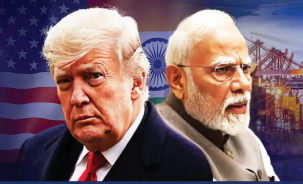
NEW YORK: When President Donald Trump told reporters on November 8 that trade talks with India were “going good” and floated the possibility of visiting New Delhi next year, he was doing more than exchanging diplomatic pleasantries. He was attempting damage control on a relationship his own administration had badly strained.
The question now preoccupying strategists in both capitals is whether this represents genuine strategic recalibration or merely tactical positioning ahead of India’s hosting of the Quad summit—where Mr Trump’s presence would signal American commitment to the Indo-Pacific, but his absence would broadcast dysfunction.
The stakes are considerable. For much of the past decade, American foreign policy has treated India as an indispensable pillar of its Indo-Pacific architecture—a democratic counterweight to an assertive China, a partner in the Quad alongside Japan and Australia, and increasingly a node in supply chains being rewired away from Chinese dependency.
Yet Mr Trump’s August imposition of tariffs reaching 50% on Indian goods—ostensibly punishment for New Delhi’s continued purchases of Russian oil—threatened to unravel years of careful diplomatic cultivation. Indian officials bristled at what they perceived as economic coercion. Trust evaporated. And crucially, the episode pushed Prime Minister Narendra Modi closer to forums like the Shanghai Cooperation Organisation, where both Russia and China loomed large.
For Washington, this was more than a trade spat gone awry. It risked transforming India from strategic partner into strategic problem—a nation that might hedge so aggressively between great powers that its value as a counterbalance to China would diminish to insignificance.
The trajectory had seemed promising. When Narendra Modi visited the White House in February 2025, both leaders announced an ambitious target: doubling bilateral trade to $500 billion by 2030. Five subsequent negotiating rounds tackled thorny issues—agricultural market access, digital trade frameworks, energy imports, and the thicket of non-tariff barriers that frustrate American exporters. The “Mission 500” branding suggested momentum.
Then came August. The Trump administration, apparently convinced that economic pressure would force Indian concessions, slapped heavy tariffs on a broad swath of Indian exports. The stated rationale—India’s Russian oil imports—was hardly secret; India had been transparent about purchasing discounted Russian crude as part of its energy diversification strategy. What shocked New Delhi was the severity and unilateralism of Washington’s response.
Indian officials made their displeasure clear. Commerce Minister Piyush Goyal emphasised that India’s relationships with Russia and China were matters of sovereign decision-making, “completely unlinked” to American trade preferences. The message was unmistakable: India would not be bullied. The tariffs, rather than producing compliance, produced defiance. Momentum on the trade talks stalled. Analysts described the episode as a nadir in the relationship.
More troublingly for American strategists, the episode demonstrated the limits of economic coercion against a large, proud nation with alternatives. India is not a small economy dependent on American goodwill. It is the world’s most populous country, a fast-growing market, and increasingly a player in critical sectors from pharmaceuticals to semiconductors.
When pushed, it can—and did—signal its capacity to deepen ties with China and Russia, reminding Washington that the Indo-Pacific strategy depends more on India’s cooperation than India depends on American approval.
Trump’s recent comments, then, reflect recognition that the maximalist approach failed. His warm words about Narendra Modi—calling him “a friend” and “a great man”—are not merely personal affection. They are strategic signalling. So too is his claim that India has “largely stopped buying oil from Russia,” a statement New Delhi has not confirmed and which appears generous at best. These are the words of a president attempting to de-escalate and create space for renewed negotiation.
The hint of a possible visit to India adds weight to this interpretation. If Trump attends the Quad summit in India, it will constitute a visible symbol of strategic re-engagement. Such a visit, however, cannot occur in a vacuum. For it to succeed—and not merely expose continued friction—Washington will likely need to offer tangible concessions. Perhaps a signal of tariff relief, or commitments on agricultural market access, or favourable terms for Indian investment in American manufacturing.
Precedence exists. Trump suspended tariffs on China in exchange for rare earth access and commitments to purchase American soybeans. A comparable arrangement with India is plausible: trimming the most punitive duties in exchange for commitments on American energy imports, defence equipment purchases, or gradual reduction in Russian oil dependency. The challenge lies in crafting terms that allow Modi to present the outcome domestically not as capitulation, but as strategic positioning.
From New Delhi’s perspective, the Trump may have shifted. India enters these negotiations with enhanced bargaining power, aware that Washington needs the relationship as much as India does. Modi faces his own domestic constraints—farmers wary of American agricultural imports, manufacturers concerned about competition, a political base that values “strategic autonomy” as a badge of honour. He cannot be seen as a supplicant.
Yet India also recognises opportunity. Positioning itself as the democratic alternative to China in global supply chains offers immense economic potential. American companies seeking to diversify away from Chinese manufacturing need destinations; India aims to be primary among them. Defence cooperation brings technology transfer and capability enhancement. Energy imports from America could reduce long-term dependence on volatile suppliers.
The question is whether Trump’s softer rhetoric translates into policy substance. Indian officials remain cautious. Piyush Goyal’s recent comments—describing talks as “going on very well” but noting “many sensitive, serious issues” remain—suggest neither euphoria nor despair, but rather a hard-headed assessment. India will engage, but on terms that preserve its autonomy and serve its interests.
Several scenarios appear possible. The optimistic case involves a limited interim arrangement—sector-specific agreements rather than a comprehensive pact. Perhaps expanded American liquefied natural gas exports to India, paired with Indian commitments on defence procurement and gradual diversification away from Russian energy. Perhaps reciprocal market access in specific industries. Such an approach would allow both sides to declare progress while deferring more contentious issues.
A presidential visit could then provide the theatre: public affirmation of strategic partnership, announcements of business deals, symbolic gestures toward the $500 billion target. For Mr Trump, this offers a foreign policy win and reassures American farmers and exporters that India remains a priority market. For Mr Modi, it demonstrates that India commands respect from Washington and can extract value from engagement.
The pessimistic case is a renewed deadlock. If Washington overreaches—demanding too many concessions, underestimating Indian sensitivities, or reverting to tariff threats—New Delhi may calculate that deeper engagement with China, Russia, and other partners offers better returns. The Quad would lose salience. American influence in the Indo-Pacific would diminish.
Ultimately, Mr Trump’s recent comments reflect a learning curve. His earlier approach—unilateral pressure, economic threats—may work with smaller nations possessing limited options. India is different: large, proud, strategically positioned, and led by a prime minister who has built his political brand on asserting Indian sovereignty. Bullying such a partner risks pushing it into the opposing camp precisely when American strategy requires its alignment.
The challenge for both sides now is converting tactical repositioning into strategic convergence. Can Washington offer sufficient value—market access, technology transfer, respect for Indian agency—to make partnership attractive? Can New Delhi balance its relationships with Russia and China while deepening American ties sufficiently to satisfy Washington’s strategic requirements?
The answer will determine not only the fate of the $500 billion trade target, but the broader architecture of the Indo-Pacific order. In the great power competition between America and China, India’s choices matter profoundly. Trump’s warm words suggest he recognises this. Whether recognition translates into policy that remains the question that will define the next chapter of this vital relationship. (IPA Service)