New Delhi has to take lot of special measures to bridge the trade gap
By Dr. Nilanjan Banik
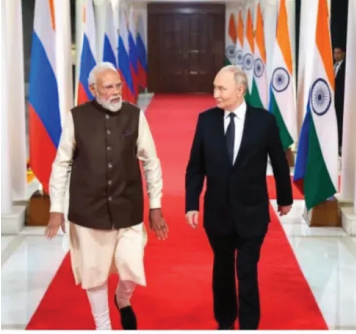
The world watched as Mr Vladimir Putin visited India. Indian Prime Minister Narendra Modi was particularly excited as the two countries signed deals spreading across defense, trade, healthcare, civil nuclear energy, and labour cooperation. How much of this bonhomie will translate into trade figures, particularly in achieving the much-touted goal of reaching $100 billion by 2030 in bilateral trade between these two trusted neighbours?
India-Russia economic ties emphasize inter-industry trade, where India exports labour-intensive manufactures like pharmaceuticals, chemicals, iron & steel, vegetable and marine products, while importing Russia’s capital- and resource-intensive goods such as crude oil, fertilizers, coal, and defence items. The nature of this trade is unlike intra-industry trade, which involves countries simultaneously exporting and importing similar products within the same industry, such as automobiles or electronics. The Russia-China trade is more of intra-industry, with the Russian dependent much on Chinese made automobiles, electronic items, and microchips. The literature on intra-industry trade suggests that trade between countries is more likely to grow and be sustained when it is intra-industry rather than inter-industry.
With India-Russia relations at a historic high, the key question is how long trade dynamics can sustain them. Russia’s growing economic dependence on China may constrain its ability to openly back India amid potential Indo-China tensions, mirroring India’s neutral stance on the Russia-Ukraine war by advocating peaceful resolution. India is more dependent on Russia, and China on the other hand is an equal trade partner with Russia.
Bilateral trade between Russia and India reached a record $68.7 billion in FY 2024-25, marking a sevenfold increase over five years, primarily driven by India’s surging imports of discounted Russian crude oil, coal, fertilizers, and defense equipment. Russian exports to India dominated at around $65 billion in 2024, while Indian exports, including pharmaceuticals, engineering goods, electronics, and chemicals, totalled about $4.9 billion. Both nations aim to sustain trade through diversification, industrial cooperation in sectors like metallurgy, IT, and agriculture, and infrastructure like the International North-South Transport Corridor.
In 2024, India exported $ 434.44 billion around the world, the main destinations being: United States (18.29%), European Union (EU) (17.80%), And United Arab Emirates (8.54%). Valued at US$ 4.84 billion, exports to Russian Federation accounted for 1.11%.On the other hand, considering the import data from Russia, a different picture emerges.
In 2024, India imported $ 656.84 billion of the world, the top sources being: China (18.52%), Russian Federation (10.22%), And United Arab Emirates (8.49%).
The trade surplus in 2025 between Russia and India in Russia’s favour stood at a mammoth $60 billion, the one between Russia and China was a much more modest $12 billion. Most of the burgeoning deficit is explained by increased oil imports from Russia. India’s Russian oil imports have surged dramatically since 2021, transforming the bilateral energy relationship. Before Russia’s invasion of Ukraine in February 2022, India purchased minimal Russian crude, accounting for less than 2% of its oil imports. However, steep Western discounts on Russian oil prompted a strategic shift. By 2023, Russia became India’s largest oil supplier, with imports exceeding 1.6 million barrels daily—nearly 40% of India’s total crude purchases.
But that is now going to change. With steep US sanctions, and threatening of a worsening trade relationship with the Western European nations, India has to cut its oil imports from Russia by 38% in value terms and 31% in volume terms in October 2025 as compared to last year. And all this means the value of trade that India and Russia are aiming at is likely to see a dramatic fall in the coming years unless India, like its Chinese counterparts, has something tangible to offer like some manufacturing tradable items.
Comparing the trade figures between Russia and China looks more organic and likely to sustain. Russia-China trade, far larger in scale, stood at $106.48 billion in the first half of 2025, with Russian exports (mainly oil, gas, and minerals) at $59.32 billion and Chinese exports (machinery, electronics, and dual-use goods) at $47.16 billion. China accounts for about 30-48% of Russia’s total trade, making it Moscow’s top partner, though early 2025 saw declines due to falling hydrocarbon prices and specific category slumps. Payments occur mostly in national currencies, reflecting de-dollarization efforts.
In 2024, China exported $ 3576.54 billion around the world, the main destinations being: United States (14.70%), European Union (EU) (14.42%), Hong Kong and China (8.13%). Valued at US$ 115.28 billion, exports to Russian Federation accounted for 3.22%.
Imports of Russian Federation explain 5.02% of total imports of China In 2024. China imported $2585.13 billion of the world, the top sources being: European Union (EU) (10.42%), Other Asia, (8.42%), And Republic of Korea (7.02%).
Economically, India can sustain its trade momentum with Russia by establishing itself as an equal trade partner, much like China has done. India needs to reduce the burgeoning trade deficit with Russia. Movement of labours in the area of medical and paramedics, and other skilled services such as Information Technology, and space cooperation where India has a cost advantage, may be of help to reduce the deficit. Also, Rupee-Rouble trade will help ease some pressure on Indian rupee vis-à-vis dollars.
As Russia shifts toward non-Western partners like India and China after sanctions, this trend is likely to persist. What remains to be seen is when and how India will catch up to China in this evolving story of economic dependence. (IPA Service)
(The author is Professor, Mahindra University, Hyderabad).