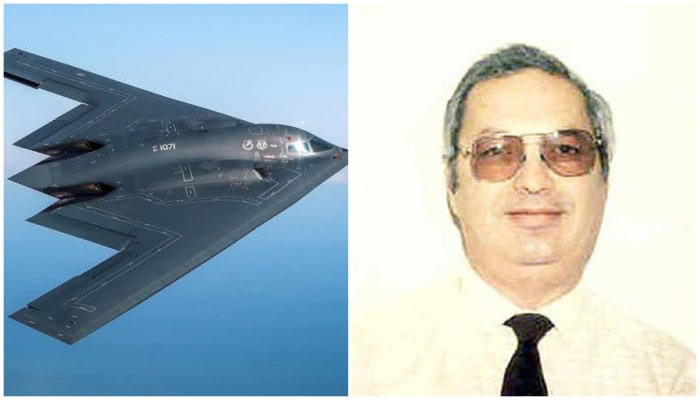
Jattan Singh Gill
In an extraordinary twist of fate, the very aircraft that bombed Iranian nuclear sites on June 22 — the U.S. Air Force’s B-2 Spirit stealth bomber — carries with it a dark legacy tied to a man born in Mumbai, India. Noshir Sheriarji Gowadia, once hailed as a brilliant mind behind the B-2’s revolutionary stealth propulsion system, ended up betraying not one but two nations: his country of birth, India, and his adopted homeland, the United States. The fruits of his treason? China’s leap in stealth missile technology — technology that may one day be turned against democracies themselves.
Gowadia, a Parsi prodigy born in 1944, had achieved academic feats in India by his teens and moved to the U.S. at 19. He quickly ascended America’s aerospace echelons, becoming a senior propulsion expert at Northrop — the defense giant that developed the B-2 stealth bomber. He was no ordinary engineer. By his own account, “the entire geometry” of the B-2’s propulsion design — the very aspect that made it virtually invisible to radar and infrared tracking — came from him.
The B-2 is the ultimate symbol of American aerospace superiority. Capable of flying 10,000 nautical miles on one refueling and dropping 40,000 pounds of ordnance, it remains a central pillar of U.S. strategic deterrence. But while its shadow swept silently across Iranian skies this month, it also cast a long, ironic shadow back to the man who helped build it — and then tried to replicate it for America’s top adversary.
After being let go from Northrop in the late 1980s due to health issues, Gowadia turned his skills into private consulting, working briefly with CIA-linked aircraft projects and Los Alamos. But mounting personal expenses, including a lavish villa in Hawaii, led him to a fateful decision — to sell secrets.
Between 2001 and 2003, Gowadia made several trips to China under various aliases, selling highly sensitive stealth propulsion data for a mere $110,000. The Chinese soon unveiled the Cruise Missiles with exhaust signatures eerily similar to that of B-2 Bombers. United States. satellites later spotted what appeared to be a B-2 clone drone on a Chinese airbase — a chilling sign that Beijing was rapidly closing the gap in stealth warfare.
When FBI agents arrested him in 2005, they uncovered a trove of classified material — hundreds of pounds worth of documents, electronics, and blueprints stored in his Hawaii home. Gowadia later confessed in writing: “What I did was espionage and treason because I shared military secrets with the PRC.”
He was convicted in 2010 on 14 counts under the Espionage Act and sentenced to 32 years in a high-security prison. But the damage had already been done. China had secured a critical piece of stealth technology, handed over not by a spy trained in Beijing — but by an immigrant engineer from India who once swore allegiance to the United States.
The irony is as painful as it is profound. The son of India, who once contributed to America’s most advanced war machine, ultimately helped arm China — a nation whose geopolitical ambitions threaten both Washington and New Delhi alike. In helping a rival totalitarian regime gain stealth capabilities, Gowadia betrayed not just the U.S. but also India’s long-term strategic interests.
As the B-2s continue to soar across global conflict zones — their power on full display in recent Middle East airstrikes — the world must remember the silent war that happens off the battlefield. It is the war of ideas, loyalties, and betrayals. And in that war, Noshir Gowadia stands as a grim cautionary tale: that one man’s brilliance, unmoored from allegiance, can compromise the security of nations and tilt the balance of power against once his own country.