By Dr. Neha Lohamaror,
Founder & Director, Kosh Foundation…
What if education is not only about teaching children to read books, but also teaching them to read the world?
As an educator, I often wonder whether our schools are adequately preparing children for the complex realities they will inherit. We teach them mathematics, science, and languages, but do we teach them how to observe, empathise, ask questions, and understand the lives of people different from themselves? In a rapidly changing world, these skills are becoming just as important as academic knowledge.
I believe cinema, particularly documentary cinema, can play a significant role in addressing this gap.
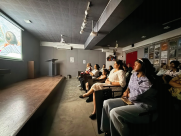
Recently, I attended a documentary screening at The Open Space Society (TOSS), Jaipur, where Kosh Foundation facilitated the participation of a vibrant group of women viewers. The screening featured two remarkable documentaries by women filmmakers—Log Kya Kahenge by Rafina Khatun and Monalisa by Sumedha Bhattacharya. The films explored issues of identity, gender, freedom, social expectations, and patriarchy. While the stories themselves were powerful, what interested me even more were the conversations that emerged afterwards.
The experience reaffirmed my belief that documentaries are not merely films; they are potent educational tools.
Unlike conventional entertainment, documentaries invite viewers into real lives and real experiences. They expose us to voices that are often unheard and encourage us to confront questions that do not have easy answers. They challenge assumptions, provoke reflection, and create empathy. In many ways, they do what the best education is supposed to do.
Today, children are surrounded by visual media. They consume fast-paced videos, reels, and digital content for hours every day—a habit that often fragments attention spans rather than building critical reflection. Instead of fighting the screen, educators must learn to leverage it. Visual storytelling can, and should, become a meaningful learning resource.
More importantly, we should encourage children not only to watch films but also to make them.
Documentary filmmaking is one of the most interdisciplinary learning experiences available to young people. To create a documentary, a child must learn to observe carefully, ask thoughtful questions, conduct research, communicate with others, organise information, and tell a coherent story. In an era dominated by fifteen-second distractions, this process teaches children patience, deep listening, and the value of sustained engagement with a single subject.
In essence, documentary making transforms children from passive consumers of information into conscious creators of knowledge.
During the interaction session at TOSS, I asked both filmmakers how educators could introduce documentary filmmaking to young children. Their responses were deeply insightful.
Filmmaker Sumedha Bhattacharya suggested beginning with play-based learning. Observation games, storytelling activities, role-play, and creative exploration can help children naturally develop curiosity and narrative abilities. Rafina Khatun offered a practical approach. She suggested that children can begin documenting their surroundings using the cameras already available in mobile phones. By capturing everyday experiences and learning basic editing skills, they gradually learn how stories are constructed.
What struck me was the beautiful simplicity of their suggestions. Filmmaking does not require expensive equipment or sophisticated studios. It begins with raw curiosity. It begins when a child notices something worth documenting and decides to ask why.
This approach aligns seamlessly with the vision of the National Education Policy 2020, which emphasises experiential learning, creativity, inquiry, and multidisciplinary education. Documentary projects allow children to engage with their communities, local histories, environmental issues, and social realities in ways that textbooks alone never can.
At Kosh Foundation, we work extensively in the fields of women’s empowerment and children’s education. Experiences such as the TOSS screening strengthen our conviction that learning must extend beyond the classroom walls. Community conversations, art, storytelling, nature walks, and cinema all have an irreplaceable place in the educational journey.
The world does not need more passive consumers of information. It needs thoughtful observers, compassionate listeners, critical thinkers, and responsible storytellers.
Every child has a story worth telling. Every community has stories worth documenting. If we can teach young people to observe their surroundings with curiosity and empathy, and equip them with the tools to tell those stories, we will not only be teaching filmmaking—we will be teaching citizenship, humanity, and lifelong learning.
Perhaps that is the ultimate gift of cinema to education: it transforms screens from windows of distraction into mirrors of empathy and tools for social change.