By: Hardeep Singh Puri
On 10 June, Prime Minister Narendra Modi becomes the longest continuously serving democratically elected Prime Minister in our history. Having served the Indian state across much of the journey in between, I can say the achievement is not the length of the tenure. It is what the office has been made to do.
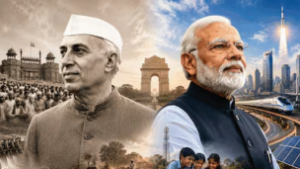
On 10 June 2026, Modi ji completes his 4,399th consecutive day in office, one more than Pandit Jawaharlal Nehru served from his first elected government in 1952 until his death in 1964. The qualifier is worth keeping, because Pandit Nehru, measured from 1947, still holds the record for the longest unbroken tenure. What Modi ji has surpassed is the mark for the longest continuous tenure of an elected head of government in the Republic’s history. I have spent my working life inside the state that lies between those two dates, and the milestone interests me less for its arithmetic than for what it allows one to measure. Pandit Deendayal Upadhyaya taught that a government should be judged by what reaches the last person in the line, by Antyodaya. The distance from Pandit Nehru’s India to Modi ji’s Bharat is the distance the last person has travelled.
A fair account begins with what Pandit Nehru inherited. He inherited a partitioned subcontinent scarred by the largest forced migration in history, an economy drained by two centuries of colonial extraction, a people of whom fewer than one in five could read, and a life expectancy in the early thirties. From that inheritance he built a constitutional democracy that held, while one newly free nation after another fell to the general or the strongman. The Planning Commission set the direction, the public sector held the commanding heights, and a system of licences decided who might produce what. The universities, the laboratories, the atomic and space programmes, the steel towns: the institutional spine of independent India was laid in those years. I joined the Foreign Service in 1974, and the India I represented was a serious country that had chosen to manage scarcity with as much dignity as its machinery allowed.
The cost of that settlement became visible by the time I was a mid-career officer. The state had learned to allocate, but it had not learned to deliver. The distance between a scheme announced in Delhi and a benefit received in a village was where the money vanished. A former prime minister’s own admission, that fifteen paise of every rupee reached the poor, was a verdict on the model itself. The state could plan. It could not reach.
Modi ji’s inheritance in 2014 deserves the same honest accounting. He took charge of an economy the markets had filed among the Fragile Five, weighed down by stalled projects, double-digit inflation fresh in memory, and corruption that had corroded public faith in the state itself. His answer was a different machine altogether. The Planning Commission gave way to the NITI Aayog, which convenes the states rather than instructs them. Identity, a bank account, and a mobile phone were joined into one layer, and the government began to pay citizens directly instead of through intermediaries who had taken their cut for four decades. Direct Benefit Transfer is a plain phrase for a decisive instrument. It moved the test of governance from intention to receipt.
What followed was the reconception of the state as a platform. India built public digital rails, an identity system that works at the scale of a continent, and a payments network the world now studies. More than fifty crore Jan Dhan accounts opened formal banking to families it had never reached. In the same decade, by NITI Aayog’s estimate, nearly twenty-five crore Indians moved out of multidimensional poverty, and the economy the markets had written off now grows faster than any other major economy. The state that once stood between the citizen and the thing the citizen needed now builds the road and stands aside. That is the substance behind the word Bharat.
I can speak to one corner of this from the office I hold. In 2014, ethanol blending in our petrol stood at 1.53 per cent. This year we have reached twenty per cent, a target once set for 2030 and met half a decade early, and the money that once left the country to buy crude now reaches the farmer, who is now an Urjadata, a provider of energy, alongside the Annadata who feeds us. In the same years, the Ujjwala Yojana carried cooking gas into more than ten crore poor households for the first time, with the subsidy paid into the beneficiary’s own account, beyond any middleman’s reach. This is Antyodaya rendered in litres and cylinders. The last person is no longer the one the scheme forgets. She is the one it is built around.
The same ledger runs through brick and steel. Close to four crore pucca homes have been built under the Awas Yojana for families that had never owned one. The metro, which ran in five cities in 2014, runs in more than twenty today. The number of airports has roughly doubled, and UDAN has put air travel within reach of towns that had only watched aircraft pass overhead. The railways have been electrified almost end to end and run their first indigenously built semi-high-speed trains. None of this is abstraction. Each entry is a queue that no longer forms, a journey that no longer consumes a day, a roof that does not leak.
The fiscal architecture moved with the rest. The Goods and Services Tax, for all its early friction, gave the country the single national market that had defeated every government which pursued it for two decades, and the Centre and the states now compete on the ease of doing business and the quality of delivery, a healthier contest than the older one over allocations.
The same confidence reshaped how India carries itself abroad, and here I claim some standing from my years representing the country. Pandit Nehru’s non-alignment was the prudent stance of a poor and new state that could not afford to choose a side. The present doctrine of multi-alignment is the stance of a country that intends to be courted by every side. India carried its Group of Twenty presidency to every state of the Union rather than confining it to the capital, and the framing of India as a voice of the Global South turned an old developmental weakness into a claim to leadership. A state confident of its delivery at home speaks differently in the world.
A record of this scale invites scrutiny, and a democracy as argumentative as ours will supply it. But the question the office is asked has plainly changed, and that is the measure of the distance travelled. Pandit Nehru’s India asked what the state could allocate. Modi ji’s Bharat asks what the state can deliver, and insists on showing the receipt.
That is why 10 June is worth marking, and why the count of days is the least of it. Pandit Nehru built the Indian state. Modi ji has rewired it to reach the citizen in whose name it was built. I have served the state in both its incarnations, and I know which transformation the last person in the line will remember. The promise that once had to be taken on trust somewhere upstream now arrives, traceably, in her own hand. That is the Viksit Bharat we have been asked to build by 2047, and it begins, as Pandit Deendayal Upadhyaya said it must, with her.
(The writer is Union Minister of Petroleum and Natural Gas.)