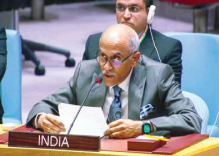
United Nations, March 17: At the United Nations General Assembly, India strongly criticised Pakistan for what it described as “fabricating imaginative” narratives of Islamophobia while ignoring issues within its own borders. Speaking during a session marking the International Day to Combat Islamophobia, India’s Permanent Representative Parvathaneni Harish questioned Pakistan’s credibility on the issue.
Harish pointed to what he termed Pakistan’s “brutal repression” of the Ahmadiyya community and raised concerns over the alleged deportation of Afghan refugees and airstrikes conducted during the holy month of Ramadan in Afghanistan. He asked how such actions could be reconciled with Pakistan’s claims of advocating against Islamophobia.
In a sharp rebuttal, India also criticised the Organisation of Islamic Cooperation, accusing it of being used by Pakistan to make “false and baseless allegations” against India. Harish warned against the growing trend of politicising religion and using it as a tool for narrow political objectives by both state and non-state actors.
Highlighting India’s diversity, Harish noted that the country is home to over 200 million Muslims, one of the largest Muslim populations globally, who actively participate in the democratic process, including in Jammu and Kashmir. He argued that the real “phobia” lies in opposition to India’s multicultural and inclusive society.
He further stated that such divisive narratives reflect sectarian and extremist mindsets rather than reality. Emphasising broader principles, Harish cautioned that focusing exclusively on one form of religious discrimination risks deepening divisions instead of resolving them.
India reiterated that the UN must uphold its universal and impartial character, urging it to address all forms of religiophobia rather than prioritising a single faith. Harish referenced the 1981 UN declaration on eliminating religious intolerance as a balanced framework that protects all religions equally.
Condemning violence and hatred in the name of religion, India reaffirmed its commitment to pluralism and coexistence. Harish highlighted India’s civilisational principle of “Sarva Dharma Sambhava” — equal respect for all religions — as a foundation of its secular ethos.
He concluded by urging the UN to focus on inclusive development, human rights, and peacebuilding efforts without bias, and to promote equality, dignity, and harmony for people of all faiths worldwide.