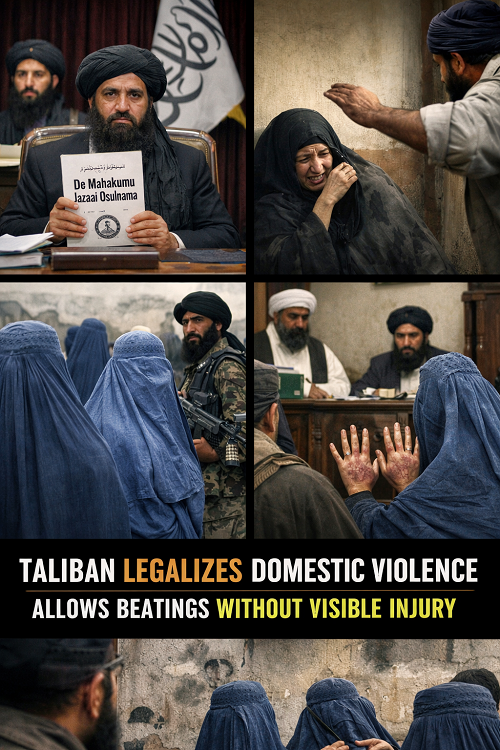
Kabul: A newly introduced penal code in Taliban-ruled Afghanistan has triggered widespread outrage among women’s rights groups and legal experts, with provisions reportedly equating women to “slaves,” permitting husbands to beat wives under certain limits, and institutionalising a rigid social hierarchy with unequal punishments.
The 90-page code, known as De Mahakumu Jazaai Osulnama and signed by Taliban supreme leader Hibatullah Akhundzada, classifies society into tiers—religious leaders, elites, middle class and lower class—with penalties varying by status. Religious scholars accused of crimes may receive only advice, elites face summons, the middle class imprisonment, and the lower class imprisonment plus corporal punishment, according to reported provisions.
Women are placed at the same level as “slaves,” allowing husbands or “masters” to administer discretionary punishment, including beatings that do not cause fractures or open wounds. Serious crimes fall under clerical jurisdiction, while lesser offences invoke ta’zir—discretionary punishment—which in marital contexts can mean a husband beating his wife.
Although women can theoretically seek justice, the code imposes severe barriers: they must prove serious injury in court while fully veiled and accompanied by a male guardian—even if the accused is the husband. Legal advisers say such conditions make redress “extremely difficult,” with some complaints rejected if the husband cannot act as chaperone.
Rights groups warn the code reverses protections from Afghanistan’s previous legal framework, under which domestic violence, forced marriage and rape were criminalised. Even when assault is proven under the new code, the maximum penalty for a husband is reportedly 15 days’ detention.
Advocacy organisation Rawadari also cites Article 34, which criminalises women who leave their husband’s home without permission and relatives who shelter them, prescribing up to three months’ imprisonment.
Human rights observers say the code’s codification of gender inequality and caste-like hierarchy institutionalises discrimination and removes safeguards for women and lower-status groups, deepening fear and legal uncertainty across Afghanistan. (Agencies)