By Puran Chand Sharma
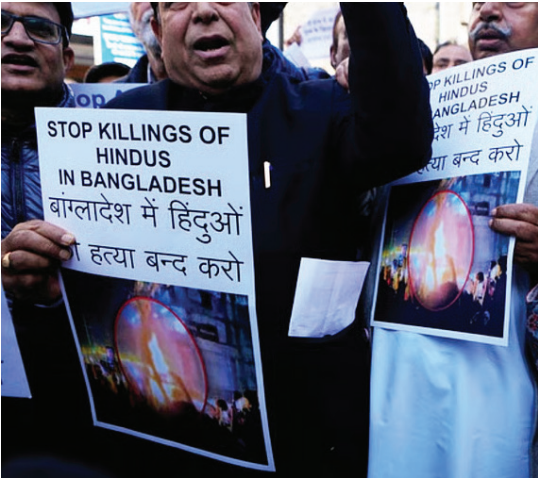
At this critical point of time, incidents involving violence against minorities and other vulnerable communities in Bangladesh have drawn sharp attention across South Asia and globally as well. These include mob lynchings, killings linked to allegations of blasphemy, and reports of broader hostility targeting minorities. India’s Ministry of External affairs has publicly condemned these developments, calling ‘unremitting hostilities. Bangladesh, born out of the 1971 Liberation war with India’s decisive support, was founded on the ideals of secularism, linguistic identity and cultural pluralism. However, in recent decades, selective attacks on religious and ethnic minorities particularly Hindus, Buddhists and Christians have raised serious humanitarian and regional security concerns. These incidents are not isolated law and order problems but systems of deeper ideological, political, and socio-economic challenges. In view of India’s civilizational ties, moral responsibility and strategic interests. New Delhi must adopt clever diplomacy and a proactive, humane approach to safeguard people and uphold regional stability.
Genesis of the Prevailing critical Situation in Bangladesh
- IDEOLOGICAL SHIFT FROM SECULARISM TO RELIGOUS POLARIZATION:-
Bangladesh’s original Constitution upheld Secularism but political accommodation of religious extremism over time weakened this foundation. Radical groups exploited religious sentiments, gradually normalizing intolerance against minorities who are perceived as politically weak and culturally distinct.
- RISE OF ISLAMIC EXTREMISM AND RADICAL NETWORKS:-
Global Jihadist ideologies, cross-border radical influence and local extremist outfits have created an environment where minority communities become “Soft Targets”. Attacks during religious festivals, temple vandalism and targeted killings are often used to instill fear and force migration.
- POLITICAL OPPORTUNISM AND VOTE- POLITICS:–
Minorities are frequently targeted during Election periods. Political silence or delayed actions by authorities emboldens perpetrators, creating a culture of impunity. In many cases, violence is used to alter local demography or seize minority owned property.
- WEAK LAW ENFORCEMENT AND IMPUNITY:-
Delayed justice, Lack of convictions and political Shielding of perpetrators embolden attackers and deepen minority insecurity.
- REGIONAL AND GLOBAL INFLUENCES:-
Cross border radical ideologies, foreign funding of extremist networks and online radicalization worsen the problem, making it transnational in character.
India’s strategic response, what can and should be done
- Firm but Quiet Diplomacy :-
India should raise minority protection consistently in bilateral dialogues, avoiding public grandstanding but ensuring it remains non-negotiable. Confidential diplomacy often yields better results than megaphone diplomacy.
- Linking Cooperation with accountability:-
Economic aid, infrastructure projects, defense cooperation and transit facilities should be informally linked to Bangladesh’s performance on minority safety, rule of law and human rights protection.
- Internationalization Through Multilateral Forums:-
Without directly naming and shaming, India can take recourse to the following significant measures:- * Use platforms like UN Human Rights bodies, BIMSTEC (Bay of Bengal initiative for multi sectoral Technical and economic cooperation) and commonwealth forums. *Support global norms on minority protection, making Bangladesh more accountable internationally. *Intelligence and Counter-Extremism cooperation: India and Bangladesh should deepen intelligence sharing to dismantle extremist networks. A strong Bangladesh state is in India’s interest. *Protection of Cultural and Religious Heritage:- India can offer technical and financial assistance for the protection of temples, monasteries and minority neighborhoods, framing it as cultural preservation, not interference.
Practical and humane solutions to the crisis
- Empowering Bangladeshi Institutions:-*Police Reforms *Fast Track courts for communal crimes *Independent minority commissions. India can provide training, technology, and best practices.
- Economic Upliftment of Minorities:-Poverty fuels vulnerability. Joint development projects in minority- dominated districts reduce radical influence and migration pressure.
- Civil Society and Track-2 Diplomacy:-People to people engagement, academic exchanges, religious dialogue and media collaboration can counter extremist narratives more effectively than state action alone.
- Refugee Management with humanity and security. India must balance compassion with caution:-
*Temporary humanitarian assistance must be made available on merits *Clear distinction between refugees and infiltrators shall be meticulously complied with for better results. *Regional burden sharing mechanisms must promptly evolve and flourish for soothing results.
In this whole process, few Challenges and Ethical Dilemmas do crop up, such as: -*Non- interference vs. Moral Responsibility. *Diplomatic silence vs. domestic public pressure. *Human rights advocacy vs. Regional stability. India must avoid both apathy and excessive adventurism. The solution lies in strategic patience backed by firm resolve.
Having said this all it is keenly observed and noticed that the issue of selective killings and persecution of religious and ethnic minorities in Bangladesh has emerged as a deeply painful and extremely troubling humanitarian and strategic concern in South Asia. While Bangladesh was founded on ideals of Secularism and pluralism, periodic waves of violence -often targeting Hindus, Buddhists, Christians and indigenous communities – raise serious concerns about state capacity, extremist influence and regional stability. So far as India is concerned, the issue is not merely external, it directly affects national security, border stability, domestic harmony and moral responsibility. This complex issue demands a balanced, intelligent, and multidimensional response, avoiding emotional over reaction while ensuring foolproof and firm diplomacy, regional leadership and humanitarian engagement. We shall have to be bit vigilant, cautious with proactive approach, we just cannot allow our wily neighbor to indulge into any thing ridiculous and non sensical in our backyard, ‘ENOUGH IS ENOUGH.’
Conclusion
The selective killings and targeted intimidation of minorities in Bangladesh represent not merely a Law and order failure but a profound moral, constitutional, and humanitarian crisis. When violence is directed at individuals solely on the basis of faith or identity, it strikes at the very foundations of a pluralistic society and erodes the principles upon which modern nation states are built. Silence or denial in such moments does not preserve stability, rather it emboldens and deepens social fractures. Bangladesh is expected to safeguard its minorities which is essential to preserve its own legacy of linguistic nationalism, secular aspirations and hard won sovereignty. The crisis demands a calibrated yet firm response, one that combines diplomatic engagement, global advocacy, humanitarian vigilance and principled pressure without undermining regional stability. Protecting minorities is not interference in internal affairs but it is adherence to universally accepted human rights norms. Ultimately peace in South Asia can not be sustained through selective justice. True security emerges when states protect their most vulnerable citizens without discrimination. Ending targeted violence in Bangladesh is, therefore, not only a test of governance and justice, but a decisive measure of the region’s commitment to humanity, coexistence and civilizational values.