By Girdhari Lal Raina, Ex-MLC
The passage of the Viksit Bharat—Guarantee for Rozgar and Ajeevika Mission (Gramin) (VB–G RAM G) Act, 2025 marks a significant moment in the evolution of India’s rural development policy. Introduced in Parliament on December 16, passed by both Houses, and receiving Presidential assent on December 21, the Act replaces the Mahatma Gandhi National Rural Employment Guarantee Act (MGNREGA), a law that defined an era but increasingly struggled to serve the realities of a transformed rural India.
Predictably, the Congress-led INDI Alliance has opposed the legislation. Equally predictably, its opposition has focused less on the architecture of the law and more on symbolism—particularly the omission of Mahatma Gandhi’s name from the title. This reaction reveals not a principled disagreement with policy, but an unwillingness to engage with reform on its merits.
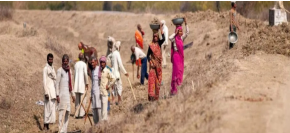
Why Reform Was Unavoidable
MGNREGA, enacted in 2005, was conceived in a vastly different socio-economic context. At the time, the primary challenge was to provide a basic safety net for rural households facing seasonal distress and chronic underemployment. Over two decades, the programme expanded dramatically in scale and fiscal footprint. While it provided wage support to millions, its structural limitations became increasingly evident: persistent delays in wage payments, uneven asset quality, leakages, weak convergence with other development programmes, and limited adaptability to local needs.
The post-pandemic period further exposed these constraints. Despite increased spending, a declining proportion of households were able to complete even the guaranteed 100 days of work. Monitoring across states revealed gaps between physical progress and financial expenditure, instances of non-existent works on the ground, misuse of machinery in labour-intensive activities, and circumvention of attendance systems. These were not merely implementation failures; they reflected the exhaustion of an outdated design.
India’s rural economy today is more complex, aspirational, and interconnected than it was in 2005. Climate stress, migration, digitisation, changing agricultural cycles, and the need for durable infrastructure require a framework that goes beyond wage disbursement. Reform was not ideological—it was administrative necessity. Developmental requirements have also undergone a sea change underlining the need for renewed assessment.
What VB–G RAM G Changes
VB–G RAM G represents a substantive overhaul rather than a cosmetic revision. At its core is an expanded and strengthened statutory employment guarantee. The number of guaranteed days has been increased from 100 to 125 per rural household annually. Importantly, the right remains enforceable: if employment is not provided within 15 days of demand, unemployment allowance becomes payable, restoring a safeguard that had weakened in practice over time.
The Act directly addresses one of the most persistent credibility issues of rural employment programmes—delayed wages. It mandates weekly payment of wages, and in all cases no later than 15 days after work completion. This is not a procedural detail; timely wages are central to restoring trust in public programmes among rural workers.
A major structural reform lies in funding architecture. Under MGNREGA, the cost-sharing mechanism was fragmented and often led to disputes, delays, and fiscal stress at the state level. VB–G RAM G restructures the programme as a scheme with a clear 60:40 Centre–State funding ratio, and 90:10 for North-Eastern and Himalayan states. Wages, material costs, and administrative expenses are now jointly funded. In effective terms, allocations under the new framework amount to a near threefold increase for states compared to earlier arrangements, while also improving predictability.
The Act introduces responsible federalism by setting state-wise normative allocations annually. While the Centre determines these allocations, states bear expenditure beyond the prescribed limits. This ensures ownership, discourages fiscal indiscipline, and incentivises better planning—an essential correction to open-ended spending without outcomes.
Synchronising Employment with Agriculture
One of the long-standing criticisms of MGNREGA was its unintended distortion of agricultural labour availability during peak seasons. VB–G RAM G addresses this by mandating that states pre-announce a pause of up to 60 days during sowing and harvesting periods. This ensures that rural employment complements, rather than competes with, agricultural productivity—strengthening both farm incomes and labour efficiency. Worker is assured of extra work days without overlapping.
Planning from the Ground Up
Decentralisation remains central to the new framework. All works will originate from Viksit Gram Panchayat Plans (VGPPs), prepared through participatory Gram Sabha processes. These plans are digitally and spatially integrated with national platforms such as PM Gati Shakti, enabling convergence across ministries while preserving local decision-making.
Thematic focus has been sharpened. Works are concentrated in four domains: water security, rural infrastructure, livelihood-linked assets, and climate resilience. This marks a deliberate shift from consumption-oriented expenditure to productive asset creation, income diversification, and long-term resilience.
Technology as a Tool of Integrity
Perhaps the most transformative aspect of VB–G RAM G is the institutionalisation of technology to safeguard public funds. The Act mandates biometric authentication, geospatial planning and monitoring, real-time dashboards, and weekly public disclosures. All assets are mapped under the Viksit Bharat National Rural Infrastructure Stack, allowing aggregation of public investments, avoidance of duplication, and outcome-based saturation planning based on local needs.
These measures directly respond to documented instances of misappropriation and weak oversight under the earlier regime. Transparency is no longer discretionary; it is embedded in the design.
The Politics of Symbolism
The opposition’s discomfort with VB–G RAM G stems not from these reforms but from the erosion of symbolic monopolies. For decades, the invocation of Mahatma Gandhi’s name became a substitute for accountability. VB–G RAM G challenges this approach by asserting that Gandhian principles are honoured through delivery, decentralisation, dignity of labour, and ethical governance—not by nomenclature alone.
Gandhiji’s vision of Gram Swaraj emphasised empowered villages, moral responsibility, and self-reliance. Translating this philosophy into modern governance requires adaptation, not stagnation. VB–G RAM G attempts precisely that.
Congress led INDI Alliance’s opposition emanates from a distorted version of secularism which has essentially become a tool to criticise ,abuse and mock Hindu names, symbol, tradition and identity. They don’t have any respect for even Gandhi ji. Gandhi ji all his life talked about Ram as his ideal and Ramrajya as his political objective. Even the samadhi of Gandhi ji proudly displays the Name of Lord Ram prominently. If Congress had an iota of respect for Gandhi ji they would have respected his wish and disbanded their party after independence.
Conclusion
VB–G RAM G is not a repudiation of the past; it is its logical evolution. By combining a strengthened statutory employment guarantee with fiscal discipline, technological integrity, decentralised planning, and climate resilience, the Act lays the foundation for a productive, resilient, and self-reliant rural economy.
Opposition rooted in symbolism may generate headlines, but it cannot substitute for reform grounded in outcomes. VB–G RAM G represents governance that looks forward—aligned with the needs of contemporary India and the aspirations of its rural citizens.
(GL Raina is a former Member of the legislative council of erstwhile Jammu Kashmir and spokesperson of BJP JK-UT.)