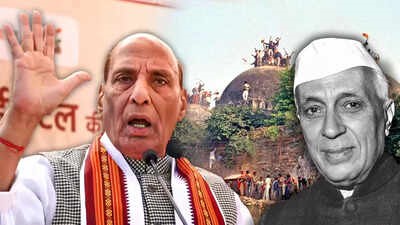
Vadodara: Defence Minister Rajnath Singh on Tuesday alleged that India’s first Prime Minister Jawaharlal Nehru wanted to construct the Babri Masjid with public funds, but Sardar Vallabhbhai Patel opposed the move and prevented it. Singh made the remarks at Sadhli village near Vadodara during a ‘Unity March’ commemorating Patel’s 150th birth anniversary.
Singh said Nehru had also suggested using money collected by citizens for Patel’s memorial after his death for building wells and roads, but Patel’s supporters rejected the proposal. Calling Patel a true liberal and secular leader who opposed appeasement, Singh said the BJP government had restored his stature.
He asserted that Patel stopped the idea of public funds for Babri Masjid and that the restoration of the Somnath Temple was different because its Rs 30 lakh cost came entirely from public donations. Singh added that no government funds were used for the Ram Temple either, describing it as “real secularism.”
The minister said Patel could have been Prime Minister in 1946, as most Congress committees supported him, but he withdrew from the race on Mahatma Gandhi’s advice so Nehru could assume the post. Despite ideological differences, Patel honoured his commitment to Gandhi and worked with Nehru in the government.
Singh claimed political forces later attempted to erase Patel’s legacy, but Prime Minister Narendra Modi restored it by championing the Statue of Unity. He criticised Nehru for suggesting that Patel’s memorial funds be diverted for public works and questioned why Patel was not awarded the Bharat Ratna earlier, while Nehru himself received it.
Addressing the Kashmir issue, Singh said the prolonged conflict could have been avoided if Patel’s recommendations during the region’s merger had been accepted. He praised Patel’s combination of dialogue and firmness, citing Hyderabad’s integration as an example of his decisive leadership.
Drawing parallels with current policies, Singh said the Modi government upheld Patel’s principles through Operation Sindoor, demonstrating India’s ability to respond strongly when provoked. He said India remains peace-loving but will not tolerate aggression.
Singh added that the abrogation of Article 370 strengthened India’s unity and followed the path shown by Patel. He said India now engages with the world confidently and is progressing toward becoming a major economic and strategic power.
The Unity March, organised by the Gujarat government from Karamsad to the Statue of Unity, began on November 26 and will conclude on December 6. (Agencies)