India-Germany defence collaboration addresses a big security gap at last
By Aritra Banerjee
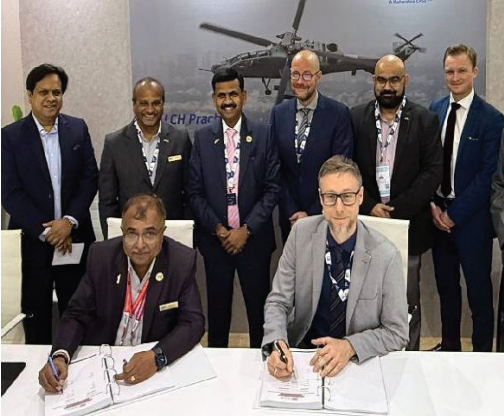
The third day of the Dubai Airshow 2025 delivered one of the event’s most consequential announcements: a new defence–industrial partnership between Indian and German state-backed companies, centred on co-developing a LiDAR-based Obstacle Avoidance System (OAS) for Indian military helicopters.
The contract between Hindustan Aeronautics Limited (HAL) and Germany’s HENSOLDT is understood to be the first major defence-technology transfer between the two countries in nearly three decades. Coming immediately after the India–Germany High Defence Committee meeting in New Delhi, it reflects a substantive deepening of bilateral security cooperation beyond diplomatic signalling.
The OAS programme addresses a long-recognised operational gap. Indian helicopters operate under some of the most demanding flight conditions in the world—high-altitude valleys, narrow approach paths, brownout and whiteout zones, and unpredictable weather systems. These conditions amplify the risk of Controlled Flight Into Terrain (CFIT), historically one of the primary safety challenges in military aviation.
LiDAR-based systems provide a significant improvement over conventional radar-based sensors. Using HENSOLDT’s SferiSense LiDAR sensor head combined with an onboard DVE (Degraded Visual Environment) computer, the suite scans the airspace ahead of the helicopter, generating high-resolution obstacle data and presenting a clear synthetic view for pilots.
Technical information indicates a wire and cable detection probability of at least 99.5% within the first second, with effective detection ranges beyond 1,000 metres, even when the helicopter is travelling parallel to the obstacle. This gives aircrews additional seconds to manoeuvre—critical in mountainous terrain or night operations.
Only a handful of countries have indigenous LiDAR-based obstacle-avoidance technology, and Germany rarely transfers this class of capability. Its inclusion of design ownership, integration rights and long-term sustainment IP makes the Dubai contract an atypically deep technology transfer arrangement.
Under the terms outlined by both companies, HAL will manufacture the system in India, integrate it across Indian helicopter platforms, provide lifecycle support for domestic users, and receive rights to export the OAS to international customers.
The model is not a simple licensed production—it is co-development. HAL and HENSOLDT will jointly refine specifications to suit Indian operating environments, from Himalayan altitudes to coastal humidity. This positions HAL to own and evolve the technology in the long term, strengthening India’s sovereign capability base.
The OAS will first be integrated onto India’s indigenously developed Light Combat Helicopter (LCH) and Advanced Light Helicopter (ALH) families, platforms already in service across the Indian Army, Indian Air Force and Indian Navy.
The timing of the deal is significant. Only a day before the Dubai Airshow announcement, senior defence officials from both countries met in New Delhi to reaffirm deeper cooperation and confirm German participation in India’s upcoming multinational exercises—TARANG SHAKTI and MILAN—in 2026.
The Dubai agreement demonstrates that political alignment is now being matched by industrial outcomes. Berlin’s Indo-Pacific policy, which seeks to diversify partnerships and reduce dependence on legacy supply chains, appears increasingly aligned with India’s Aatmanirbhar Bharat (self-reliance) and Make in India ambitions.
Germany’s willingness to transfer mature LiDAR technology signals confidence in India’s manufacturing ecosystem and long-term market potential. For India, the partnership reduces reliance on older sensor suites and accelerates movement toward modern helicopter avionics at a time when indigenous platforms are being pitched internationally.
While domestic integration is the primary objective, the export dimension adds strategic depth. Countries evaluating ALH and LCH variants—including the Philippines, Argentina, Mauritius, Nepal and Nigeria—have placed increasing emphasis on safety systems capable of supporting multi-role or counter-insurgency operations in complicated terrain.
A co-developed, India-manufactured LiDAR-based OAS validated by a German defence technology firm strengthens India’s export competitiveness. In a global helicopter market where safety and DVE performance are becoming decisive differentiators, HAL’s platforms gain a concrete advantage.
The Indo-German OAS programme represents a rare instance of transfer of high-end sensing technology to India, a clear industrial policy convergence between two major economies, and a reinforcement of India’s long-term ambition to move from licensed production to design-led capability.
For Germany, it provides a strategic foothold in the Indo-Pacific’s defence industry landscape. For India, it enhances the technological depth of its helicopter ecosystem, supports indigenous manufacturing, and adds credibility to its ambitions to “Make for India, Make for the World.”
In a defence relationship that has often moved slowly, the HAL–HENSOLDT agreement is the most tangible and technologically significant collaboration in decades—one that signals the beginning of a more substantive Indo-German defence partnership grounded in hard capability and long-term industrial cooperation. (IPA Service)