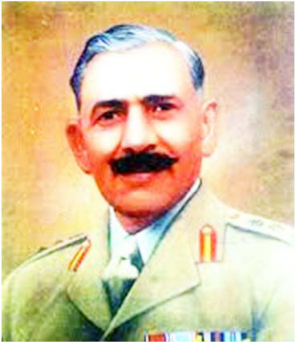
The Saga of a Soldier Who Defended Kashmir with Just 100 Brave men
By Ravi Rohmetra
This is the inspiring saga of Brigadier Rajinder Singh, the man who thwarted Pakistan’s plan to annex Kashmir in 1947. With only about 100 soldiers under his command, he put up a heroic resistance against a force of nearly 6,000 invaders, sacrificing his life to defend the Valley.
Brigadier Rajinder Singh was born on 14th June 1899 in the small village of Bagoona (now renamed Rajinderpura in his honour), located 35 km east of Jammu. He hailed from the Dalpatia clan of the Jamwal Rajputs, a family with a rich martial legacy. His ancestor, General Baj Singh, had laid down his life nearly a century earlier in the defence of Chitral, while his grandfather bore seven battle scars from previous wars. His father, Subedar Lakha Singh, a junior officer in the State Forces, died when Rajinder was just six months old. He was raised by his uncle, Lt. Col. Govind Singh, who nurtured him with care and discipline.
Educated in Prince of Wales College (now Govt. Gandhi Memorial Science College), Jammu, Rajinder Singh graduated in 1921. Known for being an obedient and studious individual, he soon joined the Jammu and Kashmir State Forces as a commissioned officer the same year. Through hard work and military excellence, he rose swiftly in ranks—becoming a Captain in 1925, Major in 1927, and Colonel by 1935. In May 1942, he attained the rank of Brigadier, and by 24th September 1947, he succeeded Maj. Gen. H.L. Scott, a British officer, as the Chief of Staff of the State Forces.
When Pakistan launched a tribal invasion of Kashmir on the night of 21st–22nd October 1947, Brigadier Rajinder Singh answered the call of duty. He fought valiantly with a small band of troops to delay the advancing raiders and protect the Valley. His sacrifice enabled Maharaja Hari Singh to sign the Instrument of Accession and seek military assistance from India, while also giving Sheikh Abdullah time to mobilize local support for the defence of the state.
The Pakistani invasion was planned soon after 15th August 1947, in collaboration with some British elements, aiming to forcibly annex Jammu and Kashmir. The invasion began in the Muzaffarabad-Uri sector and was marked by the desertion of two Muslim companies of the State Forces, weakening the defence line.
When Brigadier Rajinder Singh informed Maharaja Hari Singh of the fall of Muzaffarabad, the Maharaja wished to visit the front. However, Brigadier Singh volunteered to lead the resistance himself, advising the Maharaja to focus on formalizing the state’s accession and seeking Indian help. On 22nd October 1947, with just 100 soldiers, he marched from Srinagar cantonment towards Uri, reaching there at midnight in heavy rain.
The first engagement occurred on 23rd October at Garhi, where he inflicted heavy casualties on the enemy but lost an entire platoon. He then reorganized defences at Uri and received some reinforcements. Understanding the strategic value of the Uri bridge, he destroyed it on 24th October, severely hampering the enemy’s movement. This masterstroke of delaying action was crucial in preventing the rapid fall of the Valley.
He continued a fighting withdrawal, engaging the enemy at Mahura on 25th October, and later at Rampur-Boniyar, where his forces fought until 1:00 AM on 26th October. Facing mounting casualties, they were forced to withdraw. Brigadier Singh was seriously injured in an ambush—hit in the right arm and both legs—but refused to abandon the battlefield. He urged his men to fight on until he succumbed to his injuries near Baramulla.
For his extraordinary courage and supreme sacrifice, Brigadier Rajinder Singh was awarded Independent India’s first gallantry award, the Maha Vir Chakra, posthumously. His brave stand delayed the Pakistani advance just long enough for Indian troops to be airlifted to Srinagar, thereby saving Kashmir.
Brigadier Rajinder Singh’s memory is deeply etched in the soil of Jammu. Rajinder Chowk, located behind the Civil Secretariat, features a park and a statue in his honour. The Brigadier Rajinder Singh Auditorium at Jammu University and Rajinder Bazar are lasting tributes to this gallant soldier, revered as the “Saviour of Kashmir.”
As we observe his birth anniversary on 14th June, we remember his unparalleled bravery and honour the men who stood with him in one of the most decisive moments in Indian history.
(The writer is social activist and a freelancer)