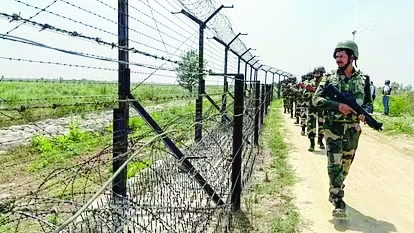
New Delhi: Security officials have revealed that Pakistan’s intelligence agency, ISI, has adopted a new tactic to infiltrate India by using individuals under the influence of drugs or those posing as mentally disturbed. These individuals are reportedly tasked with delivering critical messages to terrorists imprisoned in Indian jails.
Since July this year, more than 10 such cases have been reported, involving Pakistani nationals who have entered India from Pakistan and Pakistan-occupied Jammu-Kashmir (PoJK). Many of these infiltrators have been apprehended and sent to prisons in Jammu, Punjab, and Rajasthan. Authorities suspect that these individuals are ISI couriers, tasked with communicating with jailed terrorists whenever possible.
Interrogations of these individuals have shown that they have been trained in resistance techniques to withstand questioning. Their evasive responses and inconsistent stories have raised suspicions about a larger agenda behind their infiltration, potentially driven by fears of repercussions from their handlers. Officials have noted that these infiltration attempts are part of ISI’s new strategy to avoid detection, as electronic footprints from mobile phones and the internet may expose the plans of state and non-state actors operating across the border.
The infiltration strategy also reportedly includes women and minors, who may be used as couriers. A notable example occurred in July, when a minor from Pakistan’s Attock was intercepted in Punjab. During searches, security personnel discovered a damp piece of paper containing Arabic writing, though it was illegible.
The ISI’s tactics have been linked to drug smuggling operations. In one case from Bijnour village in Rajasthan, a Pakistani national posing as mentally disturbed revealed during intense questioning that he had been hired by two drug lords in Pakistan, Sarfaraz Johiya and Nawaz, to facilitate narcotics trafficking into India and to gather information about the Border Security Force (BSF) deployment.
Another incident involved a Pakistani youth, Mohammed Asad from Lahore, who was intercepted near the zero line in Punjab. He claimed to be involved in a family dispute, but authorities suspect he may have been acting as a courier. Security agencies have requested additional custody for further interrogation.
In October, a 31-year-old Pakistani man, Shahid Imran, entered India through the Jammu sector, claiming he wanted to visit a Kali temple to get married. Officials have noted that infiltrators like him are typically booked under the Foreigners Act and Passports Act, facing a prison sentence of 2 to 8 years, followed by deportation.
Historically, ISI used the Samjhauta Express to carry out covert courier operations during the late 1990s and early 2000s, utilizing “sawari operators” to smuggle drugs and transport funds for terrorist activities in Jammu and Kashmir and Punjab. However, this operation was curtailed after the train service was halted in 2019.
Authorities believe that the ISI’s current courier methods are a continuation of these past tactics as the agency seeks new ways to bypass law enforcement and send vital communication and resources across the border.