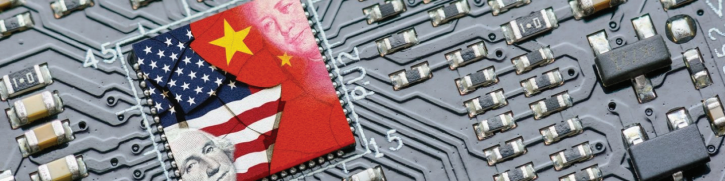
Trump- XI relationship has opened up forbidden areas for collaboration
By T N Ashok
NEW YORK: In a startling move with far reaching consequences, the United States government has brokered a deal under which Nvidia and AMD will remit 15% of their revenue from certain AI chip sales to China directly to Washington. The unprecedented agreement in cross border trade comes paradoxically months after the Trump administration banned the sale of these chips on national security grounds.
Trump predecessor Joe Biden had banned chip and semiconductor sales to China and Nvidia with the maximum volume sales to that country was affected but its CEO then claimed that its global sales would make up for the loss in revenue.. Now Chinese President Xi Jinping broke that barrier by persuading Trump as a part of a quid pro quo which will have major impact in giving a boost to the Chinese technology in AI and semiconductors. On its part, China has agreed equally to give concessions to the US companies.
The arrangement covers Nvidia’s H20 and AMD’s MI308 processors — less powerful versions of their flagship AI chips, engineered specifically to meet export restrictions. These chips were intended to keep a foothold in the Chinese market after earlier Biden-era bans cut off access to advanced U.S. semiconductors. But in April this year, the Trump administration extended the prohibition even to these down-scaled models, citing security concerns.
Then, in mid-July, the door reopened — and with it came the new condition: any licensed sales to China would be subject to a 15% revenue-sharing requirement with the federal government.
While the U.S. has used tariffs, quotas, and export bans before, industry analysts say there is no modern precedent for a direct revenue-sharing arrangement tied to a specific foreign market. Deborah Elms, a veteran trade expert, was blunt: “Unprecedented… I don’t know what the word is, but it’s bad.” Others have likened it loosely to a “golden share” — a rare government stake in a company — but in practice, this is more like a recurring levy than an ownership position.
The timing and method point squarely to the Trump administration’s deal-making style. Just days before the reversal of the April ban, Nvidia CEO Jensen Huang visited the White House. The agreement was struck shortly thereafter, alongside other Trump trade moves — such as the “golden share” condition in the Nippon Steel–U.S. Steel merger and threats of 100% tariffs on foreign-made chips to force domestic investment.
White House officials have not disclosed exactly where the chip-sale revenue will be allocated — whether to the Treasury’s general fund, a strategic technology reserve, or other programs. Nor is it clear whether similar terms could be applied to other sectors.
At the heart of this deal lies a contradiction. As recently as April, the same chips were deemed too risky to export because of potential Chinese military applications in AI. Now, U.S. officials assert that selling the H20 and MI308 “does not compromise national security.” The chips are designed with reduced performance compared to flagship models, but still offer substantial AI computing capabilities.
The Commerce Department’s Bureau of Industry and Security (BIS) is responsible for export licensing, but the Pentagon also plays a role in evaluating the strategic risks of chip exports. Some national security experts argue that allowing even downgraded AI chips into Chinese hands could accelerate Beijing’s military AI programs.
Others take the opposite view: restricting sales only incentivizes China to innovate faster and substitute U.S. technology with domestic equivalents. By keeping China dependent on U.S. tech, the argument goes, Washington retains leverage.
To reinforce that leverage, the White House is considering embedding tracking mechanisms into chips — geolocation or telemetry systems that would alert U.S. authorities if the hardware was diverted to unauthorized uses or locations. Congress, too, is debating stronger enforcement through proposals like the Chip Security Act.
State governments are not direct parties to the 15% revenue-sharing deal. However, they are significant stakeholders in the broader U.S. semiconductor landscape. Through the CHIPS and Science Act, states host new fabrication plants and R&D hubs that benefit from billions in federal subsidies — with conditions attached to limit advanced chip production in China. That makes them indirect beneficiaries of any federal revenue windfalls from export deals, though in this case the revenue appears destined for federal, not state, coffers.
To understand why Nvidia and AMD agreed to this costly concession, it helps to look at the size of the Chinese market. China is the world’s single largest semiconductor consumer, accounting for around half of global chip revenues. For Nvidia, China is not just a side market — it’s a multi-billion-dollar revenue engine. Company projections suggest as much as $15 billion in Chinese sales in the second half of 2025 alone, if licensing remains stable. The earlier suspension of H20 exports was estimated to cost Nvidia roughly $8 billion in quarterly sales; AMD forecast a $1.5 billion hit for the year.
Chinese demand for AI hardware is surging. Analysts expect the country’s AI investment to approach $100 billion in 2025, nearly 50% above last year. Leading firms like ByteDance, Tencent, and DeepSeek had already stocked up on H20 chips before the April ban, underscoring the appetite.
Given these stakes, a 15% revenue skim — while painful — is far preferable to complete exclusion from the market. For Washington, the scale means billions in receipts. Bernstein Research estimates the U.S. could net up to $2 billion from this arrangement in its first year.
The chip deal also sits within a volatile U.S.–China trade relationship. Total bilateral trade in goods exceeded $575 billion in 2024, down slightly from the pre-pandemic peak but still massive. Semiconductors are one of the most strategically sensitive components of that trade, with China importing more chips by value than oil.
Under Trump, trade negotiations increasingly blur the line between national security restrictions and economic concessions. The chip revenue-share appears to serve multiple aims: Monetizing strategic exports: Turning a security-constrained product into a revenue stream. Leveraging future concessions: U.S. officials have hinted that chip export approvals could be used as bargaining chips for Chinese cooperation on rare-earth minerals — critical for everything from EV batteries to missile guidance systems. Domestic political optics: Portraying the U.S. as profiting from, rather than subsidizing, trade with its biggest strategic rival.
From one angle, the deal looks like a win-win-win: China gets access to AI chips it wants and can’t yet replace domestically at the same quality. The U.S. government gains direct revenue from a foreign sale without raising domestic taxes. Nvidia and AMD regain access to a vast market, even if margins shrink.
But the risks are equally real: Precedent risk: Other sectors could face similar levies for China trade, injecting new uncertainty into corporate planning. Security slippage: If the chips do enable military applications, the U.S. may have traded a strategic advantage for short-term revenue. Investor impact: The levy will cut into profit forecasts — a sensitive point for companies whose market valuations are tied heavily to growth expectations.
The revenue-sharing model may remain unique to this moment — an ad-hoc Trumpian deal responding to intense industry lobbying. Or it could mark the beginning of a broader policy trend, where Washington transforms select export restrictions into monetized licensing regimes.
Either way, it has injected a new layer of complexity into the already fraught U.S.–China tech rivalry. For decades, the policy choice was binary: allow sales, or block them. Now, a third option has emerged — sells, but pay the state for the privilege. That hybrid approach could reshape not just semiconductor trade, but how the U.S. manages all “strategic” exports in the years to come. (IPA Service)