A matter of grave concern for the future of our natural heritage
By Bhushan Parimoo
The biodiversity scenario in Jammu and Kashmir today gives anxious moments to every concerned observer. It compels one to question the wisdom and intent of those entrusted with the responsibility to preserve, protect, and above all, improve it.
Students of Earth Sciences view the Earth as one inseparable unit—each part interdependent on the other. It is, therefore, unjustifiable to analyze any segment of it in isolation. Typically, scientists recognize four major spheres: the lithosphere, hydrosphere, atmosphere, and biosphere—corresponding to rocks and soil, water, air, and life. Some also include the cryosphere, which corresponds to ice.
For this reason, concepts such as land ethics, environmental ethics, ecology, biodiversity, and biophilia are essential for a healthy environment. Together, they attempt to balance the relationship between humans and the natural systems upon which they depend—ensuring that all components are accorded due respect.
Today, the environment is often reduced to the mere management of natural resources, overlooking the damage caused by human activities such as deforestation, mining, hunting, overfishing, and overgrazing by livestock. Ecology—the scientific study of relationships among living organisms and their surroundings—must be clearly understood as synonymous with “environment.”
A shrinking paradise
Biodiversity represents the degree of variation in life forms within a species, ecosystem, biome, or across the planet. In Jammu and Kashmir, the Department of Forest, Ecology, and Environment, along with Remote Sensing and Climate Change divisions, are officially tasked with the protection, conservation, and development of forests and natural habitats. Their mandate includes expanding forest cover, conserving biodiversity, cultivating medicinal plants, managing concessions, meeting local fodder and firewood needs, and ensuring participatory forest management.
However, despite these lofty goals, biodiversity protection under its current custodians has deteriorated to one of the most alarming stages of degradation ever witnessed. One is left wondering how to retrieve and restore it to the pristine glory for which this region was once renowned.
Historically, before 1947, Jammu and Kashmir’s forest administration had a reputation for efficiency. Forest Guards of that era played a pivotal role in ensuring discipline and protection. Post-1948, under the slogan of Naya Kashmir, the decline began. In 76 years of administrative change, biodiversity has been pushed from a state of richness to the edge of collapse.
One is forced to ask—do we even need the Department of Forests in its present form? It seems to operate as an inverted prism, consuming most of its funds for its own sustenance, leaving only leftovers for genuine conservation work. Over the years, it has developed a habit of changing names without changing its working style. The result is administratively sponsored vandalism of the environment—accelerated and unrepentant—under the doctrine of “after me, the deluge.”
A trust betrayed
The civil administration’s complacency, camouflaged under comradeship and mutual protection, has granted immunity to acts of omission and commission—all at the cost of the environment. The public has the right to know what real progress has been made beyond media-managed reports.
Authorities conveniently hide under the pretext of climate change. No doubt, climate change is real, but changes in biodiversity are also part of a natural process. Geological history clearly depicts these patterns. Yet, the current trend—accelerated by human neglect—is alarming and bleak for future generations.
Government machinery today seems to operate on the principle of “after me, the deluge,” neglecting the urgency to contain and reverse environmental decline. Effective management must rest on public participation, built on trust, integrity, and accountability. But the thin line between earning and losing that trust has been crossed.
People were promised good governance, transparency, and zero tolerance for corruption. Yet, after decades of such assurances, disillusionment prevails. Much water has flowed down the rivers of this erstwhile state—washing away credibility, honesty, and purpose in every sphere of life.
When imagination fades, landscapes die
The effects of this neglect are now visible. Unfortunately, the underlying causes remain unaddressed. As one saying goes, before landscapes die, they first vanish in imagination. That is precisely what has happened to the landscape of Jammu and Kashmir.
Once dotted with awe-inspiring lakes, meadows, ranges, and snow-capped peaks, the region has suffered rampant vandalism—reducing its natural grandeur to a shadow of the past. Our elders understood that sustainable development is impossible without environmental preservation. They knew to draw only what was needed from nature and to leave the rest for future generations.
This region once represented one of the richest segments of Himalayan biodiversity across the entire range. Today, that legacy stands at risk.
The need for a holistic approach
Biodiversity must be understood in its totality—the variation of life forms within ecosystems and biomes that make up our planet. Environmentalism, in essence, calls for a broad ideology and movement centered on conservation and improvement.
Concepts like land ethics, environmental ethics, ecology, and biophilia emphasize the scientific study of relationships between organisms and their natural surroundings. It must be recognized that environmental damage—caused by deforestation, mining, hunting, fishing, and overgrazing—demands urgent, flexible, and scientifically informed policy mechanisms.
Our focus must be to create strategies that leave behind a better environmental legacy—for our children and generations thereafter.
As the Great Law of the Iroquois teaches, “All decisions must be made with consideration for the next seven generations.” Sadly, today’s environmental safeguards are viewed only as a temporary defense against damage, not as an enduring trust for posterity.
(The writer is a Jammu-based environmentalist.)
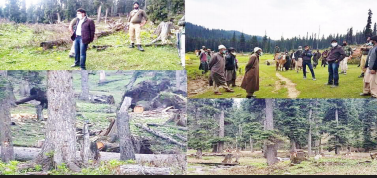
— Picture taken on 13th May, 2020
(The then Deputy Commissioner, Pulwama, Dr. Raghav Langar was reportedly shocked to witness the widespread destruction and illegal logging in the Sangarwani Forest area. After trekking 20 to 30 kilometers into the forest, he discovered that hundreds of trees had been felled for timber. Yet, no one from the Forest Department was held accountable for this vandalism—not even the Chief Conservator of Forests, the Conservator of Forests, or the Divisional Forest Officer concerned. Hardly any record shows action taken in such countless cases.)