V. Anantha Nageswaran
When strikes closed the Strait of Hormuz at the end of February — the channel through which close to a fifth of the world’s oil and the bulk of India’s crude oil and cooking gas pass — the script for India seemed already written. A country that imports nine-tenths of its crude and more than half its cooking gas through the Gulf was, by the textbook, headed for queues at the pump, empty kitchens, a run on the rupee and a scramble for dollars. Nearly four months on, with the Strait reopening and crude back near its pre-crisis level, none of that came to pass. Not a single retail outlet ran dry. Every household that wanted a cylinder got one. India faced neither a 1991 moment nor a 2013 one. Macroeconomic stability held.
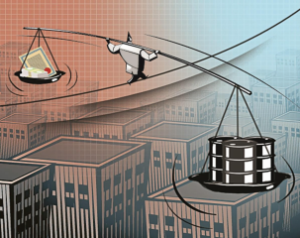
This was not an accident, and it was not luck alone. It was the work of a government that chose to act as it had during the pandemic — deliberately and gradually, building one measure upon another rather than reaching for a single dramatic lever. The first priority was the household. Throughout, not a single retail outlet ran out of stock, and every kitchen had its cylinder. The import-linked cost of a 14.2 kg cylinder rose above 1,600 rupees, yet the household price was held near 900 rupees, and lower still for the poorest. The memory of the early pandemic months, when panic among migrant workers set off a wave of reverse migration to the villages, was instructive. Commercial and bulk users were asked to give way to protect the home.
On the fuels that power the wider economy, the government chose to absorb the shock rather than pass it on. It cut excise duty on petrol and diesel by ten rupees a litre, forgoing about 1.7 lakh crore in revenue, and eased the burden on aviation fuel. The marketing companies then held pump prices steady for more than two months before a single restrained revision. The logic is worth stating plainly: in such uncertainty, only the government has the balance sheet and the time horizon to bear the risk, and it chose to absorb the impact on the fiscal account rather than on households and firms. Special support for the airlines and a credit-guarantee scheme for micro, small and medium enterprises followed the Covid-era template of targeted and effective interventions.
Behind the price cushion lay a real defence of supply. Domestic refiners lifted cooking-gas output by half within a week, largely replacing the lost imports. India quickly widened its sources, deepening purchases from the United States and Russia and adding new suppliers, so that less energy arrived through the Strait, and it secured the waivers it needed to keep buying Russian crude. The government also pressed measures for the longer run: converting homes from cylinders to piped gas, a coal gasification programme, a further push on ethanol blending, and strategic crude storage agreed on the Prime Minister’s visit to the United Arab Emirates. India was among the few nations that kept its cargoes moving even as Hormuz traffic fell to a trickle.
The external accounts were managed with the same patience. The government removed withholding and capital gains taxes on foreign institutional purchases of government debt and widened the securities open under the Fully Accessible Route, drawing money into the bond market. A new non-resident dollar deposit scheme is expected to bring in a sizeable sum of dollars. The free trade agreements signed over the years did their quiet work: exports of non-oil, non-gems-and-jewellery merchandise and services in April and May 2026 grew by more than 12 per cent over the same period a year earlier.
The headline numbers reassure. Gross foreign direct investment in the last financial year reached ninety-five billion dollars, breaking out of the seventy-to-eighty-billion-dollar band of the post-pandemic years. The current account deficit was barely 0.6 per cent of GDP in FY26 and is now expected to be only marginally higher in FY27.
Honesty also requires acknowledging that fortune lent a hand. The crude basket climbed past a hundred and twenty dollars within weeks of the closure, but from May, a fall in China’s oil purchases and steady releases from the United States reserve eased it back below a hundred, and China’s resumption of fertiliser exports spared the budget a heavy blow. Had the conflict dragged on, or oil settled near $120, the picture would feel less comfortable; sound policy and good fortune both played their part. Indeed, fortune eventually favours sound policymakers.
In a sign of the revisions to come, Goldman Sachs recently upgraded its growth forecast for India to 6.8% for CY26 and 6.5% for FY27, both up by 30 bp from previous forecasts.
The medium term, though, allows no complacency. In a world of fragmented alliances, weaponised supply chains and capital that can be turned on and off, the pressure on the balance of payments may outlast the conflict that threatened it. India must place a very high premium on attracting foreign direct investment. A balanced bilateral investment treaty framework, certainty in tax policy, state governments respecting the integrity of contracts, dependable logistics and single-window clearances that actually clear will draw the global supply chains now seeking to spread their bets.
The deeper issue is import dependence, and not in energy alone. The merchandise trade deficit runs at about eight per cent of national income; strip out oil, and it is five per cent; strip out oil and gold, and it is still three and a half. Comparable large economies do better. India must indigenise what it can produce competitively and what it must. Its firms and trade bodies must work harder on their agreements — particularly the new pacts with the United Kingdom and the European Union, which take effect this year and should boost labour-intensive exports. None of this is possible without skilled hands, which is why the training of young Indians in trade skills must now proceed on a war footing.
These tasks will demand persistence and speed. Even as it turns to them, the government must also attend to a southwest monsoon that has so far disappointed, and to the arrival of artificial intelligence and what it will mean for Indian work and Indian life. The Gulf conflict tested one kind of resilience; the years ahead will test others. India met the first test in good order. That is a reason for quiet confidence — and for getting on with the next.
(The author is Chief Economic Advisor to the Government of India. His views are personal)