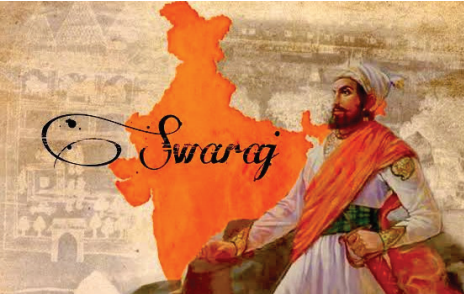
“Shivaji gave the Hindus not only a sword but a spine. He infused- self respect in a broken race.”
– Vinayak Damodar Savarkar
In case we have an urge to understand the personality of Shiva Ji in the right perspective and to properly evaluate his remarkable achievements in short span of life and valiantly taking on the mighty and well established Mughal Empire on the Indian soil, we shall have to holistically comprehend the thought process of his mother ‘Jijabai’ right from her early childhood.
Jijabai incarnated in the family of Lakhuji Jadhav Rao in the town of Sindkhed Raja (Maharashtra) in the year 1598. Lakhuji Jadhav Rao was a brave Maratha Sardar under Nizamshahi Sultanate. Right from childhood Jijabai exhibited positive signs of outstanding wisdom, courage and patriotism. There is an interesting anecdote of her early childhood:
One day she raised a query to her father, “Everyday when I get up early in the morning and go on top of the house I do have a glimpse of foreign flag fluttering on the top of religious places which I do not like and relish. It is not our flag as such. I fervently pray it be removed from here. She further queried whether he would remove it once for all. Her father retorted instantly, “Never, never”. He further added that it wasn’t an achieveable dream and could not be realized. Little Jijabai got saddened for a while, but did not give up and kept her spiritual desire alive.
In due course of time when Jijabai got married to Shaha Ji Bhonsle, father of Shiva ji, she finding an opportune time raised the same query with her husband and in reply there of, received the ditto reply, “It is all utopias and cannot metamorphose into a reality”. Despite this repeated set back, she wouldn’t get bogged down and kept her dream intact till the favourable time dawned on the national horizon.
Jijabai’s Powerful Vow and the Divine Fulfilment
Having talked to her father Lakhu ji Yadav and Shaha Ji Bhonsle, Jijabai decided to keep her dream alive and get it fulfilled through the medium of her son. She got deeply engaged in the worship and incessant penance of Bhawani and Bhagwan Shiv. Accordingly, with the passage of time Jijabai was blessed with a son in 1630 at Shivneri Fort near Junnar in present day Maharashtra. Her newly born child was given the name Shiva during the course of the naming ceremony. Mother Jijabai was deeply religious and she played a very crucial role in shaping Shiva Ji’s character.
From young age, Shiva Ji was inspired by tales from the Ramayana, Mahabharata and the Indian heroes. Thus, he developed a vision of Swarajya (SELF –RULE) for the Hindus, which shaped his future mission.
Rise of Shiva Ji: Founding the Maratha Power
Early Conquests: Shiva ji captured Torna fort at the age of 15 years in 1645, followed by Raigad and Kondana (later Sinhagad). These victories laid the foundation of the Maratha Kingdom.
Establishment of Hindu Rule
Shiva ji gradually took over territories from Adil Shahi of Bijapur and Mughals. He was a skilled diplomat who maintained relations with the Portuguese, English and Mughals when it was needed.
Shiva ji pioneered a unique military strategy called Ganimikava. Its Key Features are being enumerated below:
– Surprise Attacks, quick raids and ambushes;
– Use of hills, forests, mobile units rather than large armies;
– Avoiding open field battles unless favourable;
– Espionage and strong intelligence network;
– Built and used hill forts as bastions of defence.
Shiva ji’s strategy in nutshell is “The enemy should be harassed and not allowed to counterattack effectively.”
Major Achievements
1. Coronation as Chhatrapati (1674) at Raigad fort.
2. Declared himself as an independent HINDU KING of a sovereign state.
3. Revived ancient Hindu political traditions and cultural rituals.
4. Naval Power: Built India’s first modern naval fleet and protected Konkan coast from Siddi of Janjira, Portuguese and British.
5. Forts like Sindhudurg and Vijaydurg were developed as naval strongholds.
6. Administrative Reforms: Introduced a well organized Ashtapradhan Mandal (Council of eight ministers) for effective and productive administrative measures; main focus of administrative reforms was on Justice, taxation, revenue reforms and welfare. This also promoted religious tolerance and respect for all sects.
Important Wars and Conflicts
1. Battle of Pratapgad (1659): In this battle the opponent was Afzal Khan of Bija Pur. Shiva ji defeated and killed Afzal Khan using a concealed weapon (Baag Nakha). This was a major psychological and strategic victory for Shiva Ji’s forces.
2. Battle of Kohlapur (1659): In this battle, Shiva ji’s opponent was Zaman Rustam of Bijapur. Shiva ji wisely used guerilla tactics and successfully routed a much larger Army.
3. Skirmishes with the Mughals:
– In 1660s a series of attacks were launched against Mughal held forts. Chhatarpati Shiva Ji captured forts like Purander, Rajgad and many others.
– Sacking of Surat (1664 & 1670): Shiva ji plundered Surat, the wealthy Mughal Port city. These raids were symbolic attacks on Mughal prestige and financial centers.
– Escape from Agra (1666): After being summoned and insulted by Aurangzeb, Shiva ji dramatically escaped from house arrest. Disguised in fruit baskets, he escaped with his son Sambha ji.
– Battle of Sinhagad (1670): Shiva ji’s forces under Tana Ji Malusare captured Kondana fort (renamed Sinhagad) by virtue of a fierce battle wherein Tana ji died heroically. Shiva ji got emotional and said, “We won the fort, but lost the Lion Tana ji Malusare”.
Shiva ji left for heavenly abode in1680 at Raigad fort out of illness.
Legacy
– Shiva ji established the Maratha Empire, which later became the dominant power in India after the Mughals;
– Symbol of Resistance, Nationalism, Courage and Good Governance;
– Revered in Maharastra and across India as a Hero of Hindu resurgence and Indian Independence.
Concluding Remarks
Chhatarpati Shiva Ji successfully established Hindvi Samrajya 351 years back and was coronated as a Hindu King which infused tremendous self confidence, self respect and infinite courage amongst the Hindu society. His coronation ceremony was accomplished by Pandit Gagga Bhatt in 1674. The most significant fort Raigad was made the capital and Shiva ji got seated on the Golden Singhasana as a Hindu King. Sultan of Bijapur and the Britishers accorded recognition to Shiva Ji as independent Hindu kIng.