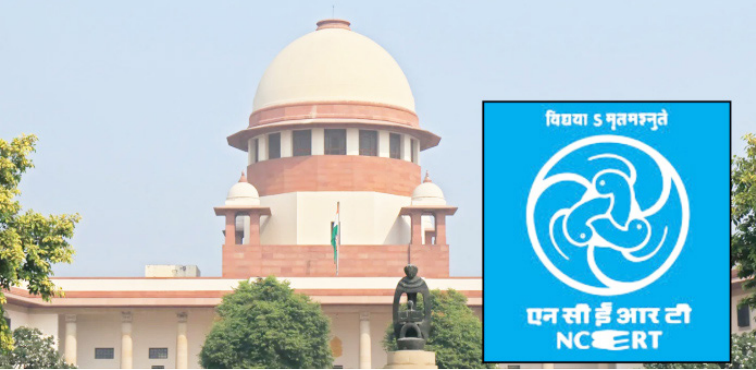
The judiciary, which purports to be the “protector of democracy,” simultaneously defends itself aggressively against even the slightest attempts at scrutiny and accountability.
On 24th February (Tuesday), the National Council of Educational Research and Training (NCERT) released “Exploring Society: India and Beyond (Part 2, First Edition),” a Class 8 textbook that featured updated chapters addressing challenges encountered by the judiciary, including corruption and the accumulation of pending cases.
The move did not sit well with the Supreme Court of India as it announced a complete ban on the publication on 26th February (Thursday). It remarked that the inclusion of such material in a textbook intended for high school pupils was a deliberate attempt to discredit and undermine the judiciary’s dignity and pronounced that the scandalisation of the institution seemed to be tantamount to criminal contempt.
NCERT and Ministry of Education under fire
A three-judge panel, led by Chief Justice of India Surya Kant and consisting of Justices Joymalya Bagchi and Vipul M Pancholi, referred to the new release as criminal contempt of court. Furthermore, the NCERT Director, the Ministry of Education and the Secretary of School Education were also served with a contempt notice, which required them to explain why they should not be charged with contempt of court.
The NCERT Director was also told to provide the identities of those who prepared the controversial chapter. The original meeting minutes from the section where the same was discussed and decided upon must be presented on the following hearing date in accordance with the direction.
“It shall be the personal responsibility of the NCERT Director and the principal of every school where the book has reached to effectuate immediate seizure and sealing of all copies of the book on their premises, and submit a compliance report. Ensure that no instruction is imparted based on the subject book. Principal Secretaries of all states are to comply. Compliance to be sent within 2 weeks,” the justices declared.
They added, “Any attempt to circumvent this order through electronic means or altered titles shall be seen as direct interference, wilful breach and defiance of directions.” The court also directed that people who authored and defended the chapter will not be associated with the NCERT or any other ministry in future and stated, “That’s very little consequence. They fired a gunshot, the judiciary is bleeding today.”
CJI’s strong reaction
According to Kant, the judiciary’s distinguished past and its contributions to the preservation of legal aid, access to justice, the basic structure doctrine and constitutional morality have been ignored. He mentioned that the book opted not to explore the court’s transformative efforts and actions. He stressed that exposing impressionable young minds to such a biased narrative could result in long-lasting misconceptions and added that the book is going to reach not only students but also teachers, parents and the next generation.
The chief justice wanted heads to roll because the book was a part of a long-running, carefully planned plot to discredit the court but insisted that the goal was to preserve the integrity of the national curriculum and the institution’s reputation, not to quell valid criticism.
The apex court forbade the book from being published, reprinted or distributed digitally in any manner. It also warned that any attempt to get around the directive by using electronic means or changing the title would be viewed as a wilful violation and direct interference with the administration of justice.
Additionally, it mandated that all existing physical and digital copies, including those in storage, retail stores and educational institutions, be immediately confiscated and removed from public access.
Solicitor General Tushar Mehta, representing the Centre, issued an unqualified apology on behalf of the government and NCERT. He promised that individuals in charge of the chapter would not be connected to the Ministry of Education or NCERT in the future and assured that an even more unequivocal public apology would be released. He disclosed that just 32 physical copies had been distributed and would be retrieved.
Judiciary and the Question of Accountability
A dearth of judges, extensive case backlogs and judicial corruption were highlighted as the three main issues facing the judiciary in Chapter 4, “The Role of the Judiciary in Our Society.” It outlined hundreds of complaints brought against judges and even mentioned the statement by former Chief Justice of India B R Gavai to highlight that even the judiciary had admitted structural corruption.
“Sadly, there have been instances of corruption and misconduct that have surfaced even within the judiciary. Such occurrences inevitably have a negative impact on public confidence, potentially eroding faith in the integrity of the system as a whole,” the book cited Gavai’s remark from last July.
He had further conveyed, “However, the path to rebuilding this trust lies in swift, decisive and transparent action taken to address and resolve these issues. Any erosion of this confidence risks weakening the judiciary’s constitutional role as the ultimate arbiter of rights. Transparency and accountability are democratic virtues.”
The judiciary, which purports to be the “protector of democracy,” simultaneously defends itself aggressively against even the slightest attempts at scrutiny and accountability. It claims to welcome criticism but reacts defensively when asked to confront longstanding issues that have plagued it for decades and have even been pointed out by its own members.
The latest NCERT edition sought to educate students about genuine challenges encountered by one of the key constitutional institutions. However, this was perceived as contempt of court, essentially suggesting that the judiciary is infallible and that anyone, including the elected government, who dares to shed light on legitimate concerns will be brought to heel.
Critique, opposition and backlash are part and parcel of a democratic nation like India and are directed at everyone, from the most powerful politicians to local leaders, media personalities, doctors, actors and individuals from various other fields. It is regarded as the true spirit of freedom of expression.
However, the Indian courts, which pride themselves as guardians of fundamental rights and the Constitution, cannot be subjected to the same liberties, as any disagreement or dissent could be classified as “contempt,” delivering a setback to the ideals they assert to uphold.
The judiciary has created a distinct set of regulations that enable it to function in line with its preferences, safeguard its own interests and intervene in different matters. However, it remains immune to examination, as even the most innocuous conversations about corruption are abruptly silenced without pause.
The judiciary appears to operate beyond the reach of all laws and even the Constitution, where all are answerable to its jurisdiction but it bears no such obligation towards anyone. Can such a country truly be called a democracy when one institution possesses unrestrained power while others must remain in fear of when and how that authority might be wielded against them?
Conclusion
The controversy regarding the NCERT textbook is being viewed as a continuation of a decades-old pattern in which accountability is demanded from others but resisted when directed inward. It highlights an ongoing debate about transparency, scrutiny and the balance of power within democratic institutions.
*(Based on an Article by Rukma Rathore in Op India)