
By Er. Rajesh Pathak, Bhopal
‘Come and attend the Shakha, if you want to know the RSS’ – this is heard these days at events organized on the eve of 100 years of the Sangh coming into existence. What does Shakha stand for? Let us look at some episodes related to the RSS to understand that:
In one Shakha, there was a celebration of ‘Makar Sankranti Utsav’, and coincidentally Atal Bihari Vajpayee was also in the same city. He paid a visit to the Shakha and occupied a place in one of the rows behind another swayamsevak who was already seated before him. He heard the Boudhik (speech) along with others like a common swayamsevak.
While paying a visit to a ‘Sangh Shiksha Varg’ (Sangh Training Course), the then Chief of the RSS, Rajju Bhaiya, was delivering a speech in a Shakha conducted in a hall. Sunderlal Patwa, then Chief Minister of MP, also came to join the event but arrived late. He sat outside the hall and listened to the speech. “I got late; now making an entry into the hall would violate discipline,” he himself said.
The swayamsevak who comes to the Shakha remains only a swayamsevak beyond all distinctions. In an engineering college in Bhopal, a Shakha is conducted where, along with the principal of the institution, professors and students also participate. The Shakha is conducted by a so-called fourth-grade employee of the college itself. He is the Mukhya Shikshak (Principal Instructor) of the Shakha. Everybody follows his instructions.
Swami Vivekananda said that every nation has a mission to be fulfilled and a destiny to be attained. It was to bring into action what Vivekananda preached that the RSS came into existence. The Sarsanghchalak of the RSS, Mohan Bhagwat, says that universal norms are regulated not through truth alone but also through power. In building a strong society and achieving national goals, what is essentially required is organization. Instead of wasting time on problems, what is truly needed is to work on solutions.
How? The guiding actions to be emulated are clearly reflected in the daily prayer of the Shakha of the RSS. The prayer is a glorification of Bharat Mata and a collective resolution of the swayamsevaks towards her and towards God. Personal resolve is ingrained in the outlook of every swayamsevak, but collective resolution and values evolve through the RSS prayer. This spirit expresses devotion, love and dedication towards the matrubhoomi (motherland). What and how one may offer to the country is reminded through the prayer, along with a supplication that God may help us in doing so.
Shakha, notably, is conducted in the open ground, barring special occasions and certain circumstances. The Sangh’s working is simple, though deeply psychological, and gradually becomes ingrained in the personality of those attending the Shakha. The games played there stir vigor and instill a collective spirit, which continues to grow over time. Discussions on the lives of great personalities are also conducted, which clarify the higher purpose of life. Personal and national character gradually begin to mould. A sense of pride in one’s ancestors flourishes. The swayamsevak joining the discussion learns how to express himself and gains confidence to speak before people. His outlook regarding the goals and working of the Sangh develops and matures over time.
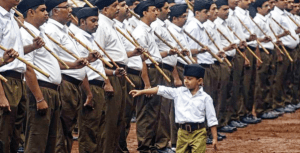
In the Shakha, patriotic songs are sung, inspiring love for the nation. The daily prayer strengthens mental resolve and reminds participants of their goal. As an exercise in developing the habit of working together, the parade (Samta and Sanchalan) is conducted, with everyone marching forward in complete harmony. Swayamsevaks of all ages, categories and levels join the Shakha’s events together, inspiring a spirit of equality. Thus, a swayamsevak himself does not realize when he becomes a sincere and responsible unit of the nation by attending the Shakha. (Tatvamasi)
Note: Please refer to the novel ‘Tatvamasi’ written by Shreedhar Paradkar, Pracharak, Akhil Bhartiya Sahitya Parishad’s Rashtriya Sangathan Mantri, and the eminent author of several other books.