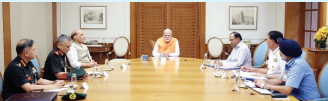
NEW DELHI: As tension continues to escalate between India and Pakistan following the deadly terror attack in Pahalgam last week, Prime Minister Narendra Modi on Tuesday chaired a crucial meeting with the top defence establishment at his residence.
Defence Minister Rajnath Singh, National Security Advisor Ajit Doval and the chiefs of three services were present at the meeting. Chief of Defence Staff General Anil Chauhan was also part of the meeting.
According to government sources, Modi asserted that the armed forces have “complete operational freedom” to decide on the mode, targets and timing of India’s response.
While expressing complete faith and confidence in the professional abilities of the armed forces, the prime minister affirmed that it is the national resolve to deal a crushing blow to terrorism.
“They have complete operational freedom to decide on the mode, targets and timing of our response,” he was quoted as saying by sources.
India has been weighing its countermeasures ever since the attack in which 26 civilians, mostly tourists, lost their lives in the scenic valley in Anantnag.
Security forces have launched search operations at multiple places in Jammu and Kashmir for the terrorists who sprayed bullets indiscriminately at the tourists, in one of the deadliest attacks in the region in decades.
India has alleged cross-border links to the attack with Prime Minister Modi vowing to pursue the terrorists behind the attack and their patrons—a clear reference to Pakistan—to the “ends of earth” and inflict the harshest punishment on them.
New Delhi’s tough assertions have pushed the two nuclear-armed neighbours on the brink of a regional war, with the political leadership in Islamabad also raising war rhetoric and provocations.
On April 23, a day after the attack, India announced a slew of punitive actions against Pakistan, including the suspension of the Indus Water Treaty.
Top Security brass huddles in emergency meet
New Delhi: In the wake of the devastating terror attack in Pahalgam, which claimed the lives of 26 individuals — most of them tourists — Union Home Secretary Govind Mohan convened a high-level meeting on Tuesday to review the internal security situation and assess the evolving threat perception.
The meeting was attended by key security leaders, including Director General of the Border Security Force (BSF) Daljit Singh Chaudhary, Director General of the National Security Guard (NSG) Brighu Srinivasan, and Director General of the Assam Rifles Lt Gen Vikas Lakhera. Key officials from other paramilitary forces, which included Additional Director General of the Sashastra Seema Bal (SSB), Anupama Nilekar Chandra, also attended the deliberations.
Sources said that the discussion focused on tightening border security, enhancing counter-terror capabilities, and coordinating intelligence sharing across forces in view of heightened tensions following the April 22 attack that happened in Jammu and Kashmir’s Pahalgam.
The BSF is tasked with securing India’s borders with Pakistan and Bangladesh, the SSB guards the frontiers with Nepal and Bhutan, while the Assam Rifles monitors the India-Myanmar border. The NSG, India’s premier counter-terrorism unit, specialises in high-risk operations and urban hostage rescue missions.
The Pahalgam attack has triggered a series of swift and significant policy decisions from the central government. In a strong diplomatic rebuke, the Cabinet Committee on Security (CCS) decided to suspend the 1960 Indus Waters Treaty, accusing Pakistan of violating its provisions. The CCS also issued a directive mandating that all Pakistani nationals — excluding those with diplomatic, official, or long-term visas — must exit the country by April 29.
Following the CCS decision, Union Home Minister Amit Shah personally contacted chief ministers across the country, instructing them to ensure compliance with the exit order for Pakistani nationals. Subsequently, Union Home Secretary Govind Mohan held a virtual meeting with state chief secretaries to monitor implementation and ensure that individuals with revoked visas depart India before the deadline.
Prime Minister Narendra Modi, in a strongly worded statement on April 24, vowed to bring the perpetrators of the Pahalgam attack — and those supporting them — to justice. “We will identify, pursue, and punish every terrorist and their enablers. India will go to any length to protect its people,” he said.
In a rare show of political unity, leaders from all major political parties pledged their full support to the government during an all-party meeting convened the same day. The collective resolve reflected a national consensus for decisive action against terrorism and cross-border extremism.
As security agencies intensify their efforts and diplomatic measures escalate, the nation remains on high alert, with vigilance and preparedness at the forefront of India’s response to the latest threat