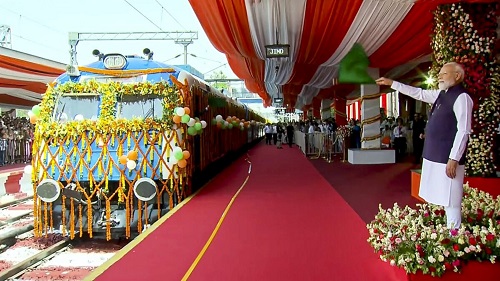
New Delhi: Prime Minister Narendra Modi today flagged off India’s first hydrogen-powered train between Jind and Sonipat at Jind railway station in Haryana.
The launch of the first Hydrogen- powered train marks an important step towards the adoption of clean and sustainable mobility in the railway sector.
On the occasion, Prime Minister also dedicated to the nation as well as lay the foundation stone of National Highway projects worth over 12 thousand 470 crore rupees in Haryana. Mr Modi dedicated the 157 kilometer long Delhi-Amritsar-Katra Expressway.
The Greenfield corridor forms part of the 667 kilometer Delhi-Amritsar-Katra Expressway. The expressway will reduce travel time between Delhi and Katra from about 14 hours to nearly six hours, while cutting the Delhi-Amritsar journey from about eight hours to four hours.
Addressing the gathering, Prime Minister Modi said that over the past twelve years Indian Railway has witnessed major transformation. He noted that Haryana has witnessed a new phase of development in recent years and has moved forward on the path of progress. Mr Modi added that the launch of the country’s first hydrogen train has given Jind a special place in India’s history.
The Prime Minister highlighted that today Jind is emerging as a symbol of the good governance model of the BJP and the NDA. Highlighting the future of rail transport, the Prime Minister said that the railways of the 21st century will be driven by hydrogen technology.
He informed that the hydrogen train has started operations on the Jind-Sonipat route, covering a distance of around 90 kilometres, and will be expanded further in the future.
The Prime Minister said that only three to four countries in the world currently have the capability to operate hydrogen trains. He highlighted that India’s hydrogen train has a power capacity of three thousand two hundred horsepower and is among the most powerful and longest hydrogen-powered trains in the world.
Speaking on the occasion, Union Railways Minister Ashwini Vaishnaw termed the launch of India’s first hydrogen-powered train a historic achievement in the country’s technological advancement.
He noted that this milestone is the result of a strong national resolve to develop indigenous hydrogen technology. Mr Vaishnaw emphasised that the train is completely environment-friendly, with no requirement for diesel or petrol.
Mr Vaishnaw highlighted that this achievement is part of the broader railway modernisation drive undertaken by the Narendra Modi government over the past several years.
Highlighting investments in Haryana, the minister said that the railway budget for the state has increased significantly from 315 crore rupees earlier to around three thousand 500 crore rupees at present. He added that railway projects worth about 18 thousand crore rupees are currently underway in the state.
Designed, engineered and integrated in India, the train has been developed using indigenous technology, reflecting the country’s growing capabilities in advanced railway engineering. With an operational speed of 75 kilometer per hour on the Jind-Sonipat section and a design speed of 110 kilometer per hour, the train is not only safer but also faster on this 89-kilometre section. More from our correspondent.
With the introduction of Hydrogen- powered train, India has joined the select group of countries that have operational hydrogen-powered trains.
These include Germany, Japan, China and the United States. Most hydrogen passenger trains currently operating globally comprise only two or three coaches and are primarily deployed on short regional routes.
In contrast, the Indian Railways trainset has been configured as a 10-coach passenger train with a capacity of around two thousand 600 passengers, demonstrating the scalability of hydrogen-powered rail transport for high-capacity passenger operations.
The train is powered by hydrogen fuel cell technology, which converts hydrogen into electricity to propel the train.
The process produces only water vapour as a by-product, resulting in zero carbon emissions during operation. The train is equipped with multi-layer safety systems capable of detecting hydrogen leaks, heat, flames and smoke.
The hydrogen facility has been established at Jind to enable safe, efficient and reliable hydrogen – powered rail operations.
Indian Railways is also exploring the deployment of hydrogen technology on heritage railways, including the Kalka-Shimla route, by leveraging the experience gained through the Jind-Sonipat Hydrogen Train project. (Agencies)