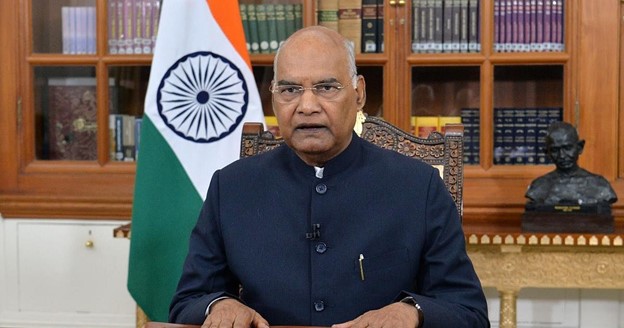
New Delhi, Oct 16: Former President Ram Nath Kovind on Thursday cautioned that rapid technological advancements and climate change are creating new human rights challenges, particularly for informal workers and communities displaced by environmental crises.
“Economic progress must always walk hand in hand with human dignity,” Kovind said while addressing the 32nd Foundation Day of the National Human Rights Commission (NHRC) and the National Conference on Human Rights of Prison Inmates. He stressed that climate change has evolved from an environmental concern into a human rights imperative, urging that India’s progress be judged not only by economic growth but also by its ability to protect its most vulnerable citizens.
Kovind noted that while India has a robust constitutional and institutional framework for human rights, “true progress depends on compassion and inclusion.” Describing human rights as “expressions of a deeper moral and civilisational consciousness,” he said India’s heritage—anchored in dharma, karuna (compassion), and nyaya (justice)—continues to guide the nation’s approach to dignity and justice.
Applauding the NHRC for giving “voice to the voiceless” over the past three decades, he lauded its work in areas such as custodial justice, bonded labour, trafficking, and the rights of women, children, and persons with disabilities.
On prison reforms, Kovind asserted that any form of violence or inhuman treatment of inmates “is against our constitutional and moral values.” He urged prison authorities to adopt gender-sensitive and child-friendly systems, viewing correctional facilities as spaces for “reform, rehabilitation, and hope.”
Highlighting mental health as an emerging human rights priority, Kovind said emotional and psychological well-being must be treated on par with physical health and praised NHRC’s initiatives promoting community-based mental health care.
NHRC Chairperson Justice V. Ramasubramanian said the Commission has handled about 24 lakh cases since its inception in 1993 and awarded ₹263 crore in compensation across 8,924 cases. In 2024 alone, it registered 73,849 complaints, took 108 suo motu cases, and disposed of 38,063.
“The Commission continues to strive to meet the expectations of victims of human rights violations,” Ramasubramanian said, adding that the NHRC has undertaken studies on Dalit rights, tribal welfare, mental health, and custodial deaths while strengthening partnerships with global human rights institutions, especially in the Global South.
NHRC Secretary General Bharat Lal, in his welcome address, described the Commission as the “conscience keeper of human rights,” highlighting digital initiatives such as HRCNet, which allows citizens to file complaints online in 22 languages.
“Prisons must not be seen merely as spaces of punishment but as institutions for rehabilitation, learning and reformation,” Lal said, noting that the NHRC is focusing on issues like manual scavenging, beggary, and hazardous work, alongside capacity-building for police and correctional officials.
Reflecting on India’s unopposed re-election to the UN Human Rights Council for 2026–28, Lal said it underscored the nation’s “unwavering commitment to human rights” and its growing influence globally.
“Human rights cannot rest on institutions alone,” he added. “It is a shared moral duty of the government, civil society, and every citizen to ensure that every individual lives with dignity and without fear.” (Agencies)