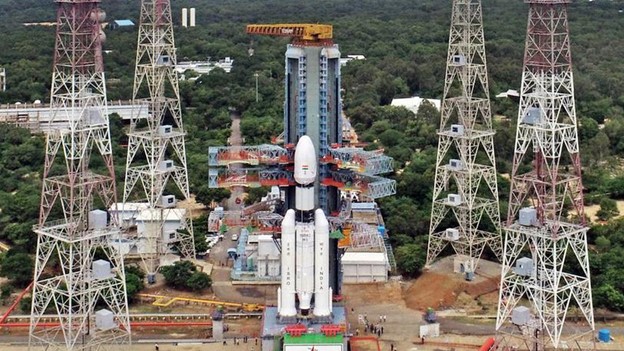
Sriharikota (Andhra Pradesh), Nov 2: India’s space agency ISRO is gearing up for the launch of its heaviest communication satellite, CMS-03, weighing around 4,410 kg, onboard the powerful LVM3-M5 rocket—nicknamed ‘Bahubali’ for its heavy-lift capability. The liftoff is scheduled for 5.26 p.m. on Sunday from the second launch pad at the Satish Dhawan Space Centre here.
The mission marks a major milestone as CMS-03 will be the heaviest satellite ever launched from Indian soil into a Geosynchronous Transfer Orbit (GTO). The three-stage LVM3-M5, also known as the Geosynchronous Satellite Launch Vehicle (GSLV) Mk III, is designed to carry payloads of up to 4,000 kg into GTO and up to 8,000 kg into Low Earth Orbit (LEO).
According to ISRO, the fully assembled 43.5-metre-tall rocket has been integrated with the spacecraft and moved to the launch pad for final pre-launch operations. The Bengaluru-headquartered space agency said the LVM3-M5’s cryogenic stage (C25), two solid strap-on motors (S200), and a liquid propellant core stage (L110) make it a reliable and fully indigenous heavy-lift launcher.
Though some reports suggest the satellite may have defense applications, ISRO has not officially confirmed this. The CMS-03 is described as a multi-band communication satellite aimed at providing advanced services across the Indian landmass and surrounding oceanic regions.
This will be the fifth operational flight of the LVM3 rocket. ISRO’s last LVM3 mission was the historic Chandrayaan-3, which successfully landed on the Moon’s south pole in 2023, making India the first country to achieve that feat.
Earlier, ISRO’s heaviest communication satellite GSAT-11, weighing 5,854 kg, was launched in 2018 aboard the European Ariane-5 rocket from French Guiana. Sunday’s mission, however, underscores India’s growing self-reliance in launching heavy communication satellites using its own launch vehicles.
The powerful S200 boosters providing lift-off thrust were developed at the Vikram Sarabhai Space Centre in Thiruvananthapuram, while the L110 liquid stage with twin Vikas engines was designed at the Liquid Propulsion Systems Centre, ISRO said. (Agencies)