
Shaleen Mahajan
The fragile Himalayan ecosystem has once again been placed at the intersection of aggressive infrastructure expansion and environmental protection. The recent issuance of show-cause notices by the National Green Tribunal (NGT) to the National Highways Authority of India (NHAI) and its contractor, M/s Gawar Mandi Highways Private Ltd, for illegal and unscientific muck dumping along the Beas River near Mandi, Himachal Pradesh, is not merely a project-specific dispute. It exposes deeper structural weaknesses in India’s environmental governance framework, particularly in ecologically sensitive hill states.This illustrates how infrastructure-led development, when pursued without scientific planning and regulatory accountability, becomes environmentally destructive and constitutionally impermissible.
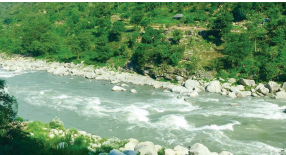
“The controversy originated from a letter petition filed by residents of a housing colony in Sauli Khad, Mandi, alleging unscientific and unauthorised dumping of construction debris during the four-laning of the Mandi–Pathankot highway.Recognising the gravity of the allegations, the NGT exercised its suo motu jurisdiction and constituted a joint expert committee to investigate the matter.
The committee’s findings revealed widespread violations. Large quantities of muck had been dumped along the banks of the Beas River, into Sauli Khad and Ropa Nullah which is a tributary of the Beas river, and at non-designated dumping sites. These activities were carried out without protective measures such as retaining walls, geo-textiles, slope management, or drainage safeguards.
In a monsoon-prone and seismically active Himalayan region, such practices pose severe risks. Unscientific dumping can obstruct river courses, increase flood vulnerability, destabilise slopes, trigger landslides, and cause long-term sedimentation and ecological degradation. Taking serious note of these findings, NGT Chairperson Justice Prakash Shrivastava issued show-cause notices to NHAI and the contractor, questioning why exemplary environmental compensation should not be imposed. The Tribunal further directed the submission of time-bound remediation and restoration plans with clearly identified budgets and implementing agencies, signalling a shift from symbolic compliance to enforceable accountability.
The Beas River case is not an anomaly. It forms part of a recurring pattern of environmental violations across Himachal Pradesh and other Himalayan states, revealing chronic failures in monitoring, enforcement, and institutional coordination.
In Shimla, the NGT intervened in the widening of NH-5 following landslides allegedly caused by slope destabilisation and improper debris disposal. The Himachal Pradesh High Court has addressed similar concerns in cases involving muck dumping into the Bhakra Dam reservoir, where sedimentation severely reduced fish production, directly affecting the livelihoods of thousands of fishermen families.
Public warnings by former Shimla Deputy Mayor have highlighted that despite the Disaster Management Act, 2005 being in force, illegal muck dumping continues unabated, intensifying flood and landslide risks. These repeated judicial and administrative interventions collectively demonstrate that environmental degradation in hill infrastructure projects stems not from legal vacuum but from weak enforcement and administrative apathy.
Illegal muck dumping strikes at the core of India’s environmental regulatory framework.Under the Environment (Protection) Act, 1986, dumping construction debris into rivers and natural drainage channels constitutes pollution prohibited under Section 7, with penal under Section 15. Such actions degrade water quality, aquatic ecosystems, and surrounding habitats.
At the local level, municipal bye-laws, such as the Dharamshala Municipal Corporation (Control and Regulation of Muck Dumping) Bye-Laws, 2019, prohibit dumping at non-designated sites and mandate prior permission, verification of dumping locations, scientific stabilisation, and penalties for violations. Non-compliance reflects not mere procedural lapses but wilful disregard for environmental safeguards.
Further, highway projects in hill regions require comprehensive Environmental Impact Assessments (EIAs), including detailed muck management plans. The failure to implement these plans exposes deficiencies in EIA quality, post-clearance monitoring, and enforcement by regulatory authorities, undermining the credibility of environmental clearance processes.
Beyond mere statutory violations, unregulated muck dumping strikes at the very foundation of Indian environmental jurisprudence by breaching its core doctrinal principles. The Polluter Pays Principle mandates that those responsible for environmental harm must bear the full financial burden of prevention, remediation, and ecological restoration; accordingly, the NGT’s issuance of show-cause notices for exemplary environmental compensation reaffirms that project proponents such as the NHAI cannot escape liability by shifting blame to private contractors, as environmental responsibility under Indian law is absolute and non-delegable. Equally, the Precautionary Principle assumes heightened significance in ecologically fragile regions like the Himalayas, where even limited human interference can trigger irreversible consequences, and where the absence of complete scientific certainty cannot be invoked to justify environmentally hazardous activities, the onus squarely rests on project authorities to demonstrate environmental safety rather than on affected communities to establish harm post facto. Complementing these doctrines is the principle of Sustainable Development, which recognises that while infrastructure projects may serve legitimate public purposes, they cannot lawfully proceed by undermining ecological stability; expedient practices such as dumping construction debris into river systems impose enduring environmental and social costs that far outweigh any short-term developmental gains. Taken together, these principles establish a regime of strict liability, rendering project authorities accountable for environmental damage irrespective of intent, negligence, or contractual delegation.
The case highlights the institutional importance of the NGT as a specialised environmental adjudicatory body. Unlike conventional courts, the Tribunal combines adjudicatory, regulatory, and remedial powers.The NGT can take suo motu or letter-based cognisance, constitute expert committees, impose environmental compensation, and direct restoration and preventive measures. Its criticism of NHAI’s repeated absence during hearings reflects judicial intolerance towards administrative apathy in matters involving environmental risk and public safety.The Tribunal’s approach underscores that environmental compliance by public authorities is not discretionary but legally enforceable.
Courts across the Himalayan region have consistently intervened in similar cases. In the Luhri Hydroelectric Project, the Himachal Pradesh High Court ordered a probe into rock cracks and illegal dumping, acknowledging the link between unscientific construction and geological instability. In Chamba, the Court directed disciplinary action against officials for failing to prevent dumping in forest areas, marking a shift towards personal accountability.The Uttarakhand High Court has similarly halted debris dumping near the Laxmi Narayan Temple complex, recognising that environmental degradation also threatens cultural heritage and constitutional rights under Articles 21 and 25.These interventions collectively establish that unscientific muck dumping is not a minor regulatory lapse but a grave environmental and constitutional violation.
The narrative of development versus environment is a false and dangerous binary. Article 21 of the Constitution, as interpreted by the Supreme Court, includes the right to a clean and healthy environment. Environmental safeguards are therefore substantive constitutional guarantees, not procedural obstacles. Ironically, environmentally reckless construction undermines infrastructure itself. Landslides, floods, and slope failures repeatedly damage roads and bridges, endangering lives and public investment.Following environmental laws does not slow down or block development; rather, it is essential for ensuring that development is stable, lawful, and long-lasting.Sustainable development is possible only when environmental compliance is treated as a foundational requirement rather than a procedural obstacle.
The Beas River case clearly highlights how repeated and unchecked infrastructure activities, when not properly regulated, gradually cause serious and long-term environmental damage in the Himalayan region. It exposes systemic governance failures while reaffirming the role of judicial institutions in enforcing ecological accountability.
The NGT’s intervention reinforces that environmental governance is a constitutional mandate grounded in Articles 21, 48A, and 51A(g). Whether this action leads to lasting reform depends on institutional compliance, scientific planning at the project design stage, and sustained judicial vigilance.
For now, the message is unequivocal. Development at the cost of ecology is neither lawful nor sustainable and the Himalayas can no longer afford such neglect.