Adversary sought ceasefire after heavy losses; 100+ terrorists neutralised in strikes on nine launchpads
Jammu Tawi, May 7: Senior military officials on Thursday described ‘Operation Sindoor’ as a landmark shift in India’s counter-terror strategy, asserting that the tri-services operation dismantled terror infrastructure across the border while exposing Pakistan’s military weaknesses and neutralising its “nuclear blackmail.”
Marking the first anniversary of the operation launched in response to the April 22, 2025 Pahalgam terror attack that killed 26 civilians, mostly tourists, top commanders of the Army, Navy and Air Force highlighted the scale and success of the coordinated strikes.
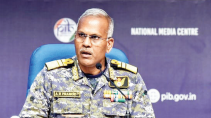
The briefing was attended by Director General Naval Operations Vice Admiral AN Pramod, former Director General Military Operations Lieutenant General Rajiv Ghai, and Deputy Chief of Air Staff Air Marshal Awadhesh Kumar Bharti.
Vice Admiral Pramod said the operation showcased India’s capability to conduct deep precision strikes inside Pakistan using long-range weapons. “India effectively called Pakistan’s bluff on nuclear threats,” he said, adding that the operation reflected clear strategic direction and operational freedom granted to the armed forces.
He said the Navy worked closely with the Army and Air Force during the strikes carried out on the night of May 6–7, 2025. Forward deployment of naval assets also forced Pakistani naval and air units into a defensive posture near their coastline and harbours, restricting their movement.
Air Marshal Bharti said the mission was executed with “complete clarity of objectives” and targeted terror infrastructure in Pakistan-occupied Jammu and Kashmir as well as deep inside Pakistan.
“When the first weapon hit its target on May 7, it symbolised the resolve of the Indian people and partial justice for the victims of the Pahalgam attack,” he said.
Bharti said Indian forces struck 11 Pakistani airfields and destroyed 13 aircraft, including a high-value airborne asset. He added that Pakistan failed to inflict any major damage on Indian installations.
Pakistan’s retaliatory drone and UAV attacks were effectively neutralised through India’s layered air defence systems, including indigenous platforms deployed across multiple sectors, he said.
Lt Gen Rajiv Ghai said Operation Sindoor achieved its objectives within a calibrated framework, following which Pakistan sought cessation of hostilities. He said intelligence inputs indicated that over 100 terrorists were neutralised across nine terror camps.
“Pakistan suffered more than 100 casualties in exchanges along the LoC and targeted strikes,” he said, while remarking that Pakistan should focus more on combat capability than narrative building.
Officials said over 65 per cent of the equipment used during the operation was indigenously manufactured, including missiles, surveillance systems and electronic warfare platforms.
Launched on May 7, 2025, Operation Sindoor targeted terror infrastructure linked to Lashkar-e-Taiba, Jaish-e-Mohammed and Hizbul Mujahideen. After four days of confrontation, both sides agreed to a ceasefire on May 10 following military-level talks.
Officials described the operation as one of India’s most coordinated military responses and a benchmark in joint warfare and precision counter-terror action.