NH-44 closure triggers petrol shortage, Long queues at fueling stations in Srinagar
Sunil Dutt
Jammu Tawi, Sept 15: The latest closure of the Srinagar–Jammu National Highway (NH-44) has once again exposed the Valley’s precarious dependence on this single lifeline for essential supplies. Petrol queues stretching for hours in Srinagar, stranded truckloads of fruit rotting at roadside, and widespread disruption in supply chains have triggered sharp criticism from all quarters. Among the loudest voices has been that of Chief Minister Omar Abdullah, who asked the Centre to hand over the highway to the elected government of Jammu and Kashmir if it “cannot manage” the road.
“Truck drivers are quite worried as the highway is closed. And trader groups are suffering,” Omar told reporters in Srinagar. “If the highway had been under me, then I would have opened it by now. This highway is under the Government of India. If they cannot manage it, then hand it over to us.” He even dialled Union Transport Minister Nitin Gadkari, pressing for urgent restoration of traffic, and posted a long thread on X highlighting the frustrations of fruit growers.
At first glance, Omar’s statement resonates with the anger of stranded transporters and anxious citizens. But his political assertion raises a serious question: was the highway any better managed under their erstwhile governments headed by National Conference, PDP, or Congress in J&K? Those with longer memories recall that frequent landslides, endless traffic snarls, and week-long closures were the norm during earlier regimes. People then too suffered in silence, cut off from petrol, vegetables, and even medicines for days together. The highway has never been free from fragility, and its poor record is not the making of just one government in Delhi.
Current Crisis on the Ground
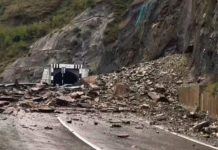
The present blockade, triggered by landslides at Tharad, has disrupted oil tanker movement and left filling stations in Srinagar struggling to meet demand. From early Monday morning, residents rushed to pumps, resulting in serpentine queues and panic buying. Some stations even ran dry temporarily, compounding public anxiety.
“I have been waiting for over an hour just to get five litres of petrol,” said Imran Ahmad of Rajbagh. Long lines of cars and two-wheelers choking Srinagar’s streets became the most visible symptom of how dependent the Valley remains on the 250-kilometre road link.
Divisional Commissioner Kashmir, Anshul Garg, however, attempted to reassure citizens. “LPG and diesel stocks are adequate, while there is shortage of petrol, but it is expected to be refilled within two days,” he said. Garg stressed that restoration work was being carried out “day and night” and that full connectivity would be restored shortly. To reduce pressure, Mughal Road and Sinthan routes were opened under traffic police advisories, though congestion was reported on Mughal Road as fruit-laden trucks diverted there.
Officials urged commuters not to travel against advisories, warning that overtaking and indiscipline could further choke the routes. Helplines were also issued by traffic police to provide real-time updates.
The Politics of Highway Control
Omar Abdullah’s sharp comments have given a political twist to what is essentially a recurring logistical and engineering problem. By demanding that the Centre “hand over” the highway to J&K’s elected government, Omar sought to project himself as the champion of stranded citizens. But his statement ignores the lived reality of J&K residents who have experienced highway woes for decades, including during his own tenure as Chief Minister from 2009 to 2015.
During that period, routine landslides at Ramban and Banihal, long traffic blockades, and sudden weather disruptions were commonplace. Fruit growers, traders, and ordinary citizens faced exactly the same hardships then as they do now. The Congress-NC coalition government too could do little beyond sending bulldozers and JCBs after each fresh slide, leaving the people to suffer in endless jams. Similarly, PDP-led governments offered little respite.
The truth is that the highway’s treacherous geography, fragile mountain slopes, and decades of under-investment have created a chronic vulnerability. No government—whether in Srinagar or in Delhi—has fully succeeded in providing a permanent solution. The widening and four-laning projects, taken up in the past decade, remain works in progress. To now claim that an elected J&K government could instantly stabilise NH-44 sounds less like a practical solution and more like political posturing.
Public Frustration Mounts
Meanwhile, the continuing blockade is creating real hardship. Shortages of petrol have overshadowed the otherwise adequate stocks of diesel and LPG. Panic buying has pushed residents to hoard, straining supplies further. Transport operators, whose vehicles remain stuck on the highway, are losing revenue daily. For apple growers at the peak of the harvest season, each day’s delay means thousands of rupees lost as produce spoils in stranded trucks.
The closure has also sparked protests by some trade associations, with a few even demanding Omar Abdullah’s resignation for not doing enough. Ironically, while he blames Delhi, local voices are questioning his own role as opposition leader. If the highway was truly under better management during his tenure, why do citizens recall otherwise?
Centre’s Response and Alternatives
Union Transport Minister Nitin Gadkari, after Omar’s call, promised “concrete steps within 24 hours” to address the problem. Simultaneously, Omar urged Railway Minister Ashwini Vaishnaw to run the newly inaugurated freight train service regularly until the highway is fully functional. Rail freight may indeed prove a vital alternative in reducing Kashmir’s singular dependence on the highway.
For now, the administration has kept Mughal Road open to ensure essential supplies and advised citizens not to fall prey to rumours. Divisional Commissioner Garg said that restoration was a top priority and that fuel stocks would normalise soon.
Conclusion: Memory of the Past Cannot Be Erased
Chief Minister Omar Abdullah’s strong words highlight a genuine crisis but also attempt to shift the entire blame onto the Centre. Yet, the history of NH-44 is too fresh in public memory to be rewritten. The Valley’s residents know all too well that the highway’s fragility long predates the current dispensation. During NC, PDP, and Congress tenures alike, the same queues, shortages, and fruit losses were routine.
The real challenge lies not in trading blame but in finally finding durable alternatives: all-weather tunnels, reliable rail freight, and scientific slope management. Until then, political statements will provide headlines, but ordinary people will continue to suffer on this fragile mountain road.
Authorities have urged commuters to strictly follow advisories. “Commuters are advised not to travel against advisory on NH-44. Lane discipline must be maintained; overtaking will cause congestion,” the traffic police said in its statement. Citizens were also asked not to believe in rumours about road restoration and to rely only on official updates via @Traffic_hqrs on Twitter and the Facebook page of Jammu and Kashmir Traffic Police.
300-metre stretch at heart of highway chaos
Narrow, uneven patch in Udhampur traps thousands of trucks; only 1000 Vehicles ply daily against average of 10000
At the centre of the ongoing highway crisis in Jammu & Kashmir is a 300-metre-long, narrow, and severely uneven stretch constructed by the National Highways Authority of India (NHAI) to facilitate traffic movement after a landslide buried a portion of the road.
The reports reveal that the diversion was built earlier this month between Tharad and Balli Nallah in Udhmapur district after the existing road was buried under debris from a mountain collapse.
This muddy stretch is the primary reason behind the current highway disruption.
“This stretch is so narrow that only one vehicle can pass through at a time. Its surface is so uneven that vehicles struggle to move and often get stuck in the mud,” officials disclosed.
They suggested that stretch requires widening, and its surface should be properly leveled for fast movement of vehicles.
A group of fruit growers from Sopore accused the NHAI of failing to widen the road and level its surface.
“NHAI is responsible for maintaining the road. We have been hearing for the past 15 days that the road would be made fully functional for transporting fruits to various markets across the country, but hundreds of trucks carrying apples remain stranded,” they said.
Officials admitted that traffic movement has been severely hampered by the condition of the stretch. “On a normal day during peak fruit season, around 10000 vehicles, including 1000 apple trucks, ply on the highway. But due to the current road conditions, only 700 to 1000 vehicles are able to pass through. Besides, around 2500 vehicles are being diverted via Mughal Road, resulting in a daily backlog of 6000 vehicles,” they said.