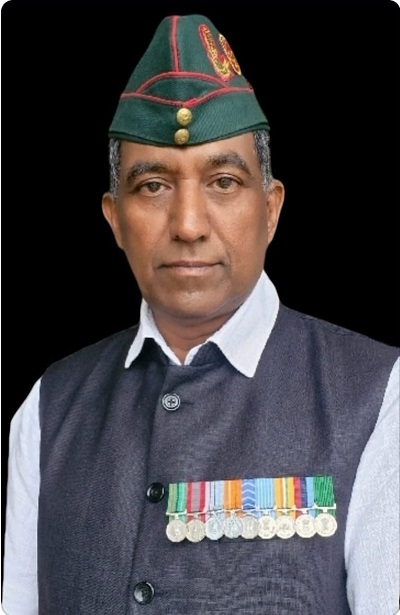
Col Dev Anand Lohamaror — Defence & Strategic Analyst
South Asia is once again witnessing a subtle but significant geopolitical shift — one that echoes old fault lines and signals the return of ideological ambitions dressed in modern diplomacy. Bangladesh, a nation created in 1971 with India’s decisive military and diplomatic support, has become the centre of a symbolic yet provocative act. A map on the cover of the book The Art of Triumph: Bangladesh’s New Dawn, authored by interim head Muhammad Yunus, shows India’s northeastern states — Assam, Tripura, Meghalaya, Nagaland, Mizoram — and parts of West Bengal as part of a so-called “Greater Bangladesh.” The book was ceremonially gifted to Pakistan’s Chairman Joint Chiefs Gen. Sahir Shamshad Mirza and several Western leaders, making it clear that this was not an artistic coincidence but calculated cartographic messaging.
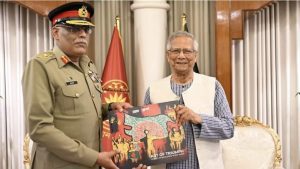
This episode is neither accidental nor harmless. It resurrects an ideological dream rooted in narratives from the pre-Partition era — the belief that religious, cultural or demographic continuity could justify territorial reconfiguration. The “Greater Bangladesh” idea has long lived on the margins, but by projecting it on a diplomatic platform, Dhaka has attempted to give fringe rhetoric a veneer of legitimacy. The timing is equally significant: Dhaka has been deepening engagement with Beijing and Islamabad just as India has recalibrated transit and trade concessions citing security concerns. Yunus’s remark in China that the Northeast has “no sea access except through Bangladesh” was not commentary on geography — it was a soft assertion of leverage.
The pattern mirrors a well-studied playbook: begin with symbolism, maps, academic references and cultural gestures before political articulation. China laid claim to the South China Sea through maps and narrative tools long before it deployed naval assets or constructed bases. The Bangladesh move is an echo of that tactic — a test balloon to measure response, plant a narrative, and normalize revisionist imagery without crossing into open provocation.
There is a deeper strategic ecosystem surrounding this narrative. Pakistan, having lost strategic ground in Kashmir, sees an opportunity to open an ideological front in the East. Turkey’s pan-Islamist soft-power push in South Asia has grown, providing rhetorical and cultural support networks. Certain Western strategic circles historically aligned with the view that a strong India must be balanced in the region now find Dhaka useful as a pressure point. China, meanwhile, sees in Bangladesh an opportunity to extend its maritime and continental arc around India. Against this backdrop, Bangladesh’s interim leadership appears eager to assert new geopolitical independence, even if it means riding a dangerous narrative.
The ideological dimension cannot be ignored. The re-emergence of radical preacher Zakir Naik in the region — reportedly being welcomed back into Dhaka’s influence circuits — signals ideological recalibration. Historically, extremist, separatist and missionary influence networks probed the Northeast as a potential social fault line. Today, however, the ground has changed. Over the past decade, the Northeast has seen unprecedented connectivity improvements, border security upgrades, infrastructure projects, cultural revival and mainstream integration into India’s strategic vision. What was once a vulnerable flank has transformed into a fortified frontier.
This episode is not about a book cover; it is about narrative combat, psychological shaping and geopolitical testing. Maps are instruments of imagination before they become instruments of policy. By gifting this book, Dhaka has engaged in symbolic aggression — a move designed to plant psychological seeds in international perception spaces and test India’s response appetite.
India’s reaction must therefore be anchored in strategic calm and layered action. Diplomatic protest is necessary but not sufficient. India must continue reinforcing the eastern theatre quietly but decisively: completing critical road-rail-air connectivity grids, strengthening forward air bases, enhancing mobility corridors, and fortifying the Siliguri Corridor with multi-layered defence architecture. Economically, India must accelerate alternative connectivity through Myanmar and strengthen maritime access via the Andaman-Nicobar command to eliminate any potential coercive leverage.
Narrative defence is equally essential. Revisionist cartography must be confronted in academic, media and diplomatic arenas before it gains currency. Sovereignty is defended not only at borders but also in discourse. India must also signal to Bangladeshi civil society and political mainstream that allowing their nation to become a proxy laboratory for external geopolitical experiments carries grave long-term risks.
Ultimately, India’s response will be defined by firmness without provocation, patience without passivity and preparedness without noise. Condemnation is not enough. New Delhi must harden deterrence, build redundancy in strategic pathways and remain vigilant against ideological infiltration. The doctrine is clear: no cartographic adventurism, no psychological warfare and no manufactured narratives targeting India’s territorial integrity or morale will be tolerated. These are not assaults on paper; they are attempts to undermine sovereignty and civilizational confidence.
South Asia still has a choice between cooperative stability and revisionist agitation. Whether Bangladesh chooses historical gratitude and pragmatic partnership or continues down the path of symbolic defiance will shape the strategic climate of the Bay of Bengal. India, however, has already chosen its path — peace where possible, firmness where required, and strategy, not sentiment, as the guiding compass. The map may be printed on paper, but India’s response will be written in capability, clarity and resolve.