There is a long way to go from emerging economy to a vibrant one
By Dr. Gyan Pathak
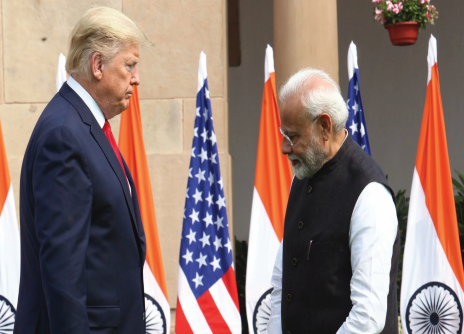
US President Donald Trump’s calling India a ‘dead economy’ speaks more of his frustration in extracting the level of benefit he hoped to gain from trade negotiations with India and less of the real state of Indian Economy. He clearly used the term metaphorically to humiliate, and in this sense of the term the remark is absolutely unacceptable. Nevertheless, India must take note of this remark seriously, without any overreaction, since it can potentially damage India’s economic prospects.
While doing so India must keep in mind that the country is still an ‘emerging economy’ and at times manifesting symptoms of a ‘dead economy’. It is still far from becoming a ‘vibrant economy’, though in response to Trumps humiliating remark, Union Minister Piyush Goyal has said that India is on the way to becoming the third biggest economy of the world.
The “dead economy” remark has created a political storm in India. The leader of the Opposition Rahul Gandhi has taken the Trump’s remark literally and said, “He is right, everybody known this except the Prime Minister and the Finance Minister. I am glad that President Trump has stated a fact.”Rahul Gandhi even accused the Prime Minister of India Narendra Modi of “killing” the economy, and blamed demonetisation, a “flawed” GST, “Assemble in India”, MSMEs “wiped out” and “farmers crushed”.
Several other leaders took the usage of the phrase “dead economy” outrageous since it hurt their sensibilities and pride. They not only criticised Trump for the remark but also Rahul Gandhi for his agreement with the remark. Rahul Gandhi politically attacked the PM Narendra Modi led government, while he was politically attacked in return by the BJP leaders. All these are political derailments from the real issue of the real state of the economy of our country, and if we need to pay urgent attention to rectify the weaknesses.
What is a dead economy? Since dead economy is not a formal or technical term of economics, we cannot treat it as such. It is just a metaphorical term, a descriptive phrase, to refer to a system of economy that is not performing well, becoming stagnant, or declining. A dead economy is thus characterised by massive unemployment or underemployment; little to no industrial or commercial activity, collapse of key institutions such as banks, factories, or infrastructure; instability of its currency, hyperinflation or deflation; lack of investor or consumer confidence; government insolvency or failure to deliver basic services; large scale poverty and social unrest, and so on. It is why the term “dead economy” is used by politicians, journalists, and informed citizens to criticize economic mismanagement and to call for urgent reform to overcome the weaknesses of the economy.
We all know the propaganda and the narrative being pushed by PM Narendra Modi led government. His ministers and leaders of BJP have been telling the country that India has become a vibrant economy under the able leadership of PM Narendra Modi, and we will have a developed India (Vikasit Bharat) by 2047.
What is then a vibrant economy and non-vibrant economy? A vibrant economy is characterized by strong and sustained economic growth for all of its citizens, where businesses thrive, and individuals have enough opportunities to improve their livelihoods. On the other hand, a non-vibrant economy is stagnant or declining, lack or innovation, and widespread high level of inequality and poverty.
It is obvious that Indian economy has also some symptoms of dead economy is several sectors. Though it is growing on paper, it is facing deep structural, social, and policy-related stains, that prevent it from realising its full potential, especially for the majority of its population.
Growth is jobless, especially in quality, formal-sector jobs. Youth unemployment is estimated above 15 per cent while educated youth are facing even higher rate of unemployment. Many are employed in low-wage, informal, or in the jobs that are actually unemployment in disguise.
Agriculture still supports 40 per cent of the population and contributes 18 per cent in the GDP. Farm incomes are stagnant and agrarian suicides continue.
Manufacturing hasn’t grown fast enough to absorb labour leaving agriculture. Make in India hasn’t delivered transformative results due to bottlenecks, land and labour rigidity, and global competition. MSMEs facing financing issues and poor market access.
There is a demand crisis. Private consumption, the biggest driver of India’s economy, is not recovering evenly. Middle class and lower-income groups have seen stagnant wages and rising costs, especially in healthcare, fuel, food, and education.
Inequality is growing. It has rising number of billionaires, but also millions sliding into poverty and stuck in informal work. 800 million people are still dependent on free foodgrains by government. Malnutrition, stunting, wasting, and mortality of children are also very high.
Since people are not earning enough, government is largely depending on indirect taxes for revenue generation, that disproportionately burden the poor. Public sector banks are stressed. Public investment is still low while private investment is not picking up. Fiscal stress continues.
There are many more that need urgent attention to make India’s emerging economy into a vibrant one. There is no point in being quarrelling with the phrase “dead economy”. India must realise its position that it is still emerging economy, and must act fast to emerge as a “vibrant economy”. The deception in the name of third largest economy of the world must not blind us about the hard ground economic reality. (IPA Service)