Trilateral cooperation with Pakistan and Bangladesh is on immediate agenda also
By Satyaki Chakraborty
China has come out officially in support of the main opposition party in Bangladesh, Bangladesh Nationalist Party (BNP) as the chief adviser of the interim government Dr. Muhammad Yunus prepares to announce the dates of the general elections shortly. Political sources say that the announcement might be made as early as August 5 or before. August 5 is the first anniversary of the fall of the Awami League led Sheikh Hasina government which ruled for consecutive fifteen years.
The interaction of the Chinese Ambassador Yao Wen in Dhaka with the newsmen at the National Press Club indicated in clear terms that China is depending more on BNP and Jamaat-e-Islami as against the new party of the students National Citizens Party (NCP) which is in continuing conflict with the BNP in the political sphere though both are supporting the interim government. Political analysts say that China must have assessed the probability of BNP’s victory in the coming elections and accordingly is laying the ground for high level collaboration.
In Bangladesh Government relations and ties with the political parties, China always enjoyed an advantageous position. Even in Sheikh Hasina’s tenure, after India, China was the second country which enjoyed the patronage of the Awami League government. The relationship got a bit strained in the fag end of the Hasina rule, but Awami League government welcomed Chinese assistance to economic development of the country, especially investment all along. Only with the United States, the relationship of Sheikh Hasina was too strained in the last one year of her tenure as the then Biden administration termed the 2024 January general elections rigged and gave support to the watchdog groups who called for fresh elections.
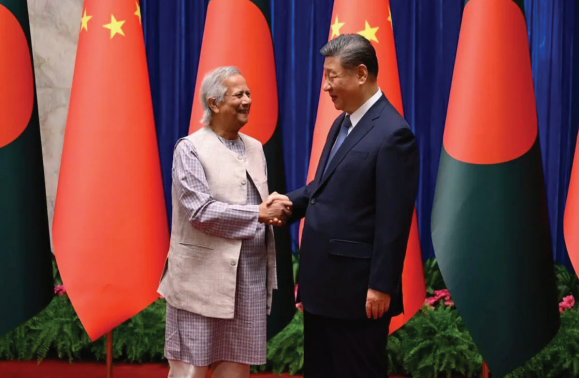
In the last nearly one year of the rule of this interim government, China has expanded its political and economic relations both at the level of government and the political parties. All the political parties including BNP, Jamaat and NCP have visited China and had talks with both the senior government officials and the Communist Party of China leaders. The interim chief adviser Dr. Yunus visited China in March this year terming the visit as historic and highly successful. China promised to transform Bangladesh into an export hub of Asia by setting up a number of export oriented industries and clusters in different districts of the country. Dr. Yunus assured Bangladesh cooperation in China’s massive Teesta Development Project in which earlier India was supposed to take part.
The latest articulation of Chinese position means that China is not encouraging NCP which thinks BNP as its principal rival and focuses its campaign against the BNP.NCP is engaged in maximum number of clashes with BNP. Recently BNP supporters attacked a NCP rally at Muradpur. NCP also talked of taking revenge. NCP is finalizing its manifesto for next Bangladesh and it will be ready by August 3 so that the NCP leadership can observe the August 5 anniversary on the basis of this manifesto. Convener Nahid Islam in his public meetings is warning the NCP supporters that the Awami League is a known fascist but it has been dismantled, but there are other type of fascists who are influencing the Yunus government. He was indirectly mentioning the BNP among other fascists.
As against this, BNP working chairman Tarique Rahman, son of Begum Khaleda Zia told a meeting of BNP workers through a video address from London on Wednesday that fascism, extremism and other divisive forces are active, they have to be fought by the BNP steadfastly. The BNP workers at the booth level have been told not to give any opportunity to the NCP workers to influence the voters BNP has also announced that Khaleda Zia is contesting in the general elections. This means that if BNP wins, Khaleda will be the Prime Minister.,
As regards, Awami League, the leadership at local level knows that the situation is very grave and life threatening for the party supporters, but in the last two weeks, there has been a resurgence. In the latest incident in Gopalgunj, the NCP supporters were literally beaten by the Awami League supporters of the local area when they came to remove a tomb of Sheikh Mujibur Rahman. Even the police did not protect the NCP supporters. Some of them even beat the NCP demonstrators. The NCP leadership protested to the local police , but nothing happened.
The Awami League is waiting for instructions from Sheikh Hasina through her intermediaries on how to observe August 5 this year. Both the BNP and the NCP are expecting a big rally by Awami League supporters on that day in support of the ousted Prime Minister but so far, no programme has been announced by Awami League. Like earlier times, it can be a mobilization of Hasina supporters without any announcement.
At the Bangladesh government level, hectic activities are on about implementation of the some of the decisions of the National Consensus Commission on the six major issues affecting the country. During the first round of talks between the National Consensus Commission and political parties, consensus was reached on 62 out of 166 proposals submitted by six commissions.
Based on these agreed proposals related to the constitutional, electoral system, judiciary, public administration, police, and anti-corruption reform commissions, the consensus commission sent a draft of the issues to be included in the final July Charter to the political parties. According to Commission sources 30 parties have agreed on the proposal of forming a legislative body under the Constitutional Reform Commission, 24 supported defining qualifications and disqualifications of upper house members, 19 backed provisions on reserved seats for women in parliament, and 29 appointing a deputy speaker from the opposition.
Besides, 24 parties agreed on legislation concerning parliamentary committees and members, 28 supported the impeachment process of the president, 30 Bangla as the state language, 31 on the identity of Bangladeshi citizens, and 28 on defining crimes like abolishing or suspending the constitution. Thirty-three parties agreed on dignity and coexistence among all communities, 31 supported expanding fundamental rights, and 23 backed parliamentary approval of international treaties.
On local governance, 28 parties backed holding elections, 27 financial reforms, 27 placing government officials under local authority, 24 supported revenue-raising powers, 25 district coordination councils, and 23 transitional provisions. Twenty-four parties agreed to bring political parties under the Right to Information Act.
Other key agreements include amending the RTI Act (32 parties), the Official Secrets Act (27), forming Cumilla and Faridpur divisions (28), and establishing a land court (25). Thirty parties backed constitutional safeguards against power misuse, 32 agreed on ending the practice of legalising illicit earnings, 31 on preventing the abuse of state power via beneficial ownership, and 29 on anti-corruption and money laundering legislation.
On election finance, 25 parties supported transparency measures, 29 automating service sectors, and 31 private sector accountabilities. Thirty parties backed common reporting standards, 29 increasing the number of ACC commissioners, and 26 amending the ACC Act. Twenty-five parties agreed on the tenure of ACC commissioners, 31 on renaming the selection committee, 25 on its structure; and 27 on the appointment process. Thirty-one supported its evaluation method.
This is a massive task, but the Bangladesh officials say that the general election work will simultaneously proceed with the implementation of the recommendations step by step. Earlier Dr. Yunus said that the national elections will be held latest by April 2026, but now, the preparations suggest that the elections might be held much earlier, between December and February next year. (IPA Service)