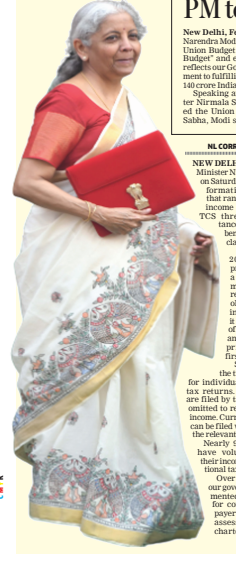
NEW DELHI: Finance Minister Nirmala Sitharaman on Saturday unveiled “transformative” tax reforms that ranged from a simpler income tax law to higher TCS threshold for remittances and income tax benefits for the middle class.
Sitharaman in 2025-26 Budget promised to bring a simpler, less voluminous new law to replace six decades old law governing income tax, saying it will have the spirit of “Nyay” (justice) and will work on the principle of “trust first, scrutinise later”.
She also extended the time limit to 4 years for individuals filing updated tax returns. Updated returns are filed by taxpayers who had omitted to report their correct income. Currently, such returns can be filed within two years of the relevant assessment year.
Nearly 90 lakh taxpayers have voluntarily updated their incomes by paying additional tax.
Over the past 10 years, our government has implemented several reforms for convenience of taxpayers, such as faceless assessment, taxpayers charter, faster returns, almost 99 per cent returns being on self-assessment, and Vivad se Vishwas scheme.
Sitharaman in her Budget speech said the objectives of her taxation proposal are reforms in Personal Income Tax with special focus on the middle class, rationalization of TDS/TCS for easing difficulties and voluntary compliance.
The Budget increased the threshold for tax deduction at source for better clarity and uniformity.
Individuals earning up to Rs 12 lakh in a year will not have to pay any taxes after she raised the exemption threshold from Rs 7 lakh. An additional Rs 75,000 standard deduction is available for the salaried class.
Presenting her eighth straight budget, she also altered tax slabs for people earning above this threshold to help save up to Rs 1.1 lakh in taxes for those with income up to Rs 25 lakh in a year.
The raising of the rebate leads to 1 crore people not having to pay any tax, she said.
The overall tax slab rejig will benefit 6.3 crore people, or more than 80 per cent of taxpayers.
“The new structure will substantially reduce taxes on the middle class and leave more money in their hands, boosting household consumption, savings and investment,” Sitharaman said presenting what was dubbed as ‘reformist’ budget for the next fiscal in Lok Sabha.
The Budget for April 2025 to March 2026 fiscal (FY26) proposed to raise foreign investment limit in insurance sector to 100 per cent from current 74 per cent and continued spending spree on infrastructure while raising allocations for social sectors as well as providing for measures for poor, youth, farmers and women.
All this she did while managing to stick to the fiscal consolidation roadmap, projecting a fiscal deficit of 4.4 per cent of the GDP in FY26 as against an estimated 4.8 per cent in the current year ending March 31.
Commenting on the announcements, Prime Minister Narendra Modi said it is a “people’s budget” that fulfils the dreams of every Indian and said that it is a “force-multiplier” that will boost consumption, investment and growth.
“The budget lays a strong foundation to increase savings and make citizens partners in development,” he said.
Sitharaman’s budget has proposals aimed at boosting both consumption and investment, which in turn are expected to give a flip to domestic economic activity, protecting the growth outlook amidst global uncertainties. While maintaining the thrust on infrastructure development, it also continued to provide increasing support to the MSME and the agricultural sector.
Also announced were duty cuts on intermediaries and certain lifesaving drugs.
To balance the revenue lost, she budgeted a modest increase in capital spending at Rs 11.21 lakh crore in the next financial year compared to a lowered Rs 10.18 lakh crore in current fiscal. Besides, an increase in dividend expected from the Reserve Bank and other government-owned financial institutions will also help to contain the losses.
The budget comes against the backdrop of the Indian economy growing at its weakest pace since pandemic and rising geopolitical risks particularly with the new US President Donald Trump threatening to impose widespread tariffs including on India.
The 6.4 per cent GDP growth estimated for the current fiscal and 6.3 to 6.8 per cent in the next are well below the 8 per cent growth needed to meet the ambitious goal of making India a developed nation by 2047.
“Our endeavour will be to keep the fiscal deficit each year such that the central government debt remains on a declining path as a percentage of the GDP,” she said, projecting debt at 50 per cent of GDP by March 2031.
Other measures include a national mission to push high-yielding crops with a special focus on pulses and cotton production, hike in the limit of subsidised credit to farmers to Rs 5 lakh from Rs 3 lakh, missions to push manufacturing and exports, a new policy for labour intensive sectors like leather and footwear and a scheme to make India a global hub for toy manufacturing.
The finance minister also announced a social security cover for nearly 1 crore gig workers and a Rs 10,000 crore fund of funds for start-ups.
Another major announcement was setting a target of at least 100 GW of electricity from nuclear energy by 2047 and amendment to nuclear liability regulations to allow private sector investment.
Sitharaman also announced reduction in duties on a raft of goods including open cells, while fully exempting critical minerals such as cobalt, scraps of lithium-ion battery, lead, zinc and a few others from import duty.
She proposed a hike in the threshold of tax collected at source on remittances under the RBI’s Liberalised Remittance Scheme from Rs 7 lakh to Rs 10 lakh, benefiting the travel and foreign exchange sectors. Students and individuals seeking medical treatment will also benefit from this.
Rationalising TDS provisions, the finance minister increased the thresholds for non-deduction across various TDS provisions broadly ranging from Rs 5,000 to Rs 50,000. The threshold for TDS on rent has been increased from Rs 2.40 lakh to Rs 6 lakh.
That apart, omissions of higher TDS/TCS rates are now applicable for non-filers.
The Union Government unveiled several big-ticket plans for poll-bound Bihar in the FY26 Budget, which include setting up of a makahana board, a greenfield airport as well as financial support for Western Koshi Canal Project in the Mithilanchal region of the state.
The Finance Minister also announced the establishment of a National Institute of Food Technology, Entrepreneurship and Management in Bihar and the expansion of hostel and other infrastructure capacity at IIT-Patna.
Other announcements for Bihar include the capacity expansion of Patna airport and development of a brownfield airport at Bihta.
PM terms Budget as ‘People’s Budget’
New Delhi, Feb 1: Prime Minister Narendra Modi on Saturday termed Union Budget 2025-26 as “People’s Budget” and emphasized that, “It reflects our Government’s commitment to fulfilling the aspirations of 140 crore Indians”.
Speaking after Finance Minister Nirmala Sitharaman presented the Union Budget in the Lok Sabha, Modi said, “This budget is a force multiplier. This budget will increase savings, investment, consumption and growth”.
The Prime Minister said, “We have opened many sectors for the youth. Common citizens are going to drive the mission of Viksit Bharat”.
He said, “This budget is a force multiplier. This budget will increase savings, investment, consumption and growth. I congratulate Nirmala Sitharaman and her entire team for coming up with a people-centric budget”.
Speaking about other steps taken in the Budget , Modi said in terms of reforms, many important steps have been taken in this budget.
“Encouraging the private sector in Nuclear Energy is historic. It will ensure a big contribution of Civil Nuclear Energy in the development of the country” he said.
“In the budget, priority has been given to all the sectors of employment in every way. I would like to discuss those reforms which are going to bring a big change in the coming times. Due to infrastructure status, the construction of big ships in India will be encouraged, Atmanirbhar Bharat Abhiyan will gain momentum” the PM further added.
He noted that usually the focus of the budget is on how the government treasury will be filled, but this budget is exactly the opposite of that.
“The budget will fill the pockets of citizens of the country, the savings of citizens of the country will increase and they will become partners in development,” Modi added.
LG, NC satisfied; Congress, PC, CPI(M) criticizes
Jammu Tawi, Feb 1: Lieutenant Governor Manoj Sinha hailed the Union Budget for 2025-2026, presented by the Finance and Corporate Affairs Minister Nirmala Sitharaman, in Parliament on Saturday.
The Lieutenant Governor has posted on X: “My heartfelt thanks to Hon’ble Finance Minister Smt. Nirmala Sitharaman Ji for a pragmatic Budget for Viksit Bharat. Grateful to Hon’ble PM Shri Narendra Modi Ji for putting the economy on a fast-track and bold development initiatives for poor, youth, farmers and women.
Big boost to the middle class. The revised tax rate structure is a historic move to bring change in the lives of the middle class. Hon’ble PM has also provided huge relief to taxpayers by raising the TDS limit on rent, enhancing social security and formalizing the gig economy.
Budget 2025-26 reflects India’s growing aspiration for accelerated growth and to stimulate private sector investments. The focus on agricultural growth with various initiatives including Agri District Programme seeks to translate the vision of rural prosperity and social equity.
India is the fastest-growing among all major global economies and this budget will further boost infrastructure sector, MSMEs, energy sector, innovation, employment generation, and push transformative reforms in key sectors for more inclusive and more sustainable growth.”
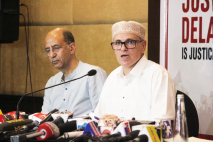
Meanwhile, the ruling National Conference on Saturday expressed satisfaction over some of the announcements made in the Union Budget 2025 while the other parties including Congress, Peoples Conference and CPI (M) criticised the financial plan.
NC Spokesman and MLA Zadibal, Tanvir Sadiq while speaking to the media persons here said that some of the reforms in the Budget were positive.
However, he said that Jammu and Kashmir should be included in the 50 new tourist destinations and medical tourism. ‘We are expecting J&K to be included in it,” he said.
Jammu & Kashmir Pradesh Congress Committee (JKPCC) Chief Tariq Hameed Karra said it has ignored the genuine case of youth of J&K for special attention.
“The union budget has ignored J&K in terms of the special focus needed here to give relief to the worst suffering people especially the youth in special circumstances prevailing in this border region and rather the budget focused more on Bihar & Delhi for political considerations,” he said.
In his stinging remarks on Chief Minister Omar Abdullah over Jammu & Kashmir’s allocation, Peoples Conference president Sajad Gani Lone said that it is time for him to seek the return of shawls gifted by him to Union Ministers and revise his cloudless weather commentary made at Sonamarg in Ganderbal district.
In a post on X, Lone pointed out that there has been a reduction in J&K’s allocation in the Union Budget. “The proposed allocation to J&K in the Union Budget is approximately 41,000 crores. It is approximately 1,000 crore less than the previous allocation. When adjusted for inflation, it is reduced by another 2,000 to 3,000 crores,” he said.
The CPI (M) said that the Union Budget 2025-26 is a “cruel betrayal” of the requirements of the people of India. “Instead of addressing the root cause of the demand problem being faced by so many sectors of the economy, the lack of purchasing power in the hands of large sections of the population because of mass unemployment and shrinking wages, the Modi government through the budget is seeking to stimulate the economy by giving tax cuts to the small minority with higher incomes even as expenditures are cut.”
“While the Economic Survey shows the desperate plight of India’s labour force, pointing out the decrease in earnings over the last five years, this budget with its emphasis on cutting government expenditures while giving concessions to the rich will only increase the huge inequalities in India. Instead of mobilizing resources by taxing the rich and the big corporate houses and pushing up public investment that would help generate employment and ensure a minimum wage for our people, it has chosen to do the opposite,” the statement added.