A reflection on Parshurama Jayanti and the enduring legacy of valour, devotion, and righteousness
By Ravi Rohmetra
Parshurama, the sixth incarnation of Vishnu, is the epitome of valour and devotion towards his parents. Once, his father Jamadagni became angry with his wife Renuka and ordered Parshurama to kill her. Parshurama obeyed and carried out the आदेश. Pleased with his act, Jamadagni asked his son to seek any boon. Parshurama wished for his mother to be brought back to life. It was Parshurama’s wisdom that restored his mother to life. In this way, he proved his devotion to both his parents.
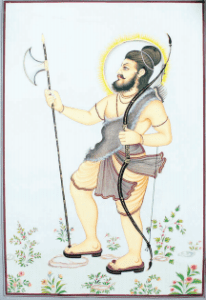
Later, Jamadagni and his Kamadhenu cow were killed by King Kartavirya Sahasrarjuna. Deeply grieved, Parshurama vowed to rid the earth of evil and free it from tyranny. The evildoers fled in fear of him. Eventually, Kashyap Muni ordered Parshurama to leave the world, and he retired to Mount Mahendra, where he began living in penance.
The birth of Parshurama is celebrated on the third day of Shukla Paksha in the month of Vaishakh. A fast is observed on this day, believed to bless devotees with sons. The day is also associated with Parshurama Dwadashi. According to the Varaha Purana, those who observe this fast attain divine merit and are reborn with great fortune. Akshaya Tritiya is another name for this auspicious day, and it is believed that any good deeds performed on this day yield permanent merit. It is also considered the beginning of the Treta Yuga.
With the revival of Hindu traditions after the medieval period, the celebration of Parshurama Jayanti regained prominence. Besides fasting, processions and satsangs are organized in many towns across Northern India.
According to one legend, Parshurama once visited Lord Shiva, but his path was blocked by Lord Ganesha. In anger, Parshurama threw his axe at him. Ganesha, knowing the axe had been given by Shiva, allowed it to strike, resulting in the loss of one of his tusks. Seeing her son injured, Goddess Parvati was filled with rage and threatened to punish Parshurama. She assumed the form of Shakti (Goddess Durga), embodying supreme power. Fortunately, Lord Shiva intervened and pacified her. Upon his request and Ganesha’s appeal, Parvati forgave Parshurama. In turn, Parshurama gifted his divine axe to Ganesha and blessed him.
Another legend narrates that Parshurama reclaimed land from the sea. He is believed to have fired an arrow from his bow that landed in Goa at Benaulim (Banavali), creating a sacred site known locally as Solkache Tollen, or Lotus Lake. He is also credited with reclaiming the coastal regions of Konkan, Malabar, and Kerala.
Parshurama played important roles in the Mahabharata as the teacher of Karna and Drona. He is worshipped as the Mool Purush (founder) by several Brahmin communities, including Bhumihar, Chitpavan, Daivadnya, Mohyal, Shukla, Awasthi, and Tyagi.
His grandfather was the great sage Richeeka, a direct descendant of Brahma. Parshurama is unique among the avatars of Vishnu as he is considered immortal and is believed to have witnessed later incarnations such as Rama, Krishna, and Buddha.
In the Ramayana, Parshurama played a significant role in the episode of Sita’s swayamvara. He had given Lord Shiva’s bow to King Janaka. Suitors were challenged to lift and string this divine weapon, but none succeeded until Lord Rama. While stringing it, the bow broke with a thunderous sound that reached Parshurama, who was meditating on Mount Mahendra. Enraged, he appeared at the scene. However, upon realizing Rama’s divine nature as an incarnation of Vishnu, Parshurama was pacified and blessed him.
There is also a legend involving Surya, the Sun God. Parshurama once grew angry at the intense heat and shot several arrows into the sky, alarming Surya. When his wife Dharini went to fetch more arrows, she was overcome by the heat. Surya then appeared before Parshurama, pacified him, and gifted him two items—sandals and an umbrella—to protect against the sun.
It is a matter of satisfaction that the then Chief Minister, Jenab Omar Abdullah, declared a restricted holiday on 12 May 2013 on the occasion of Bhagwan Parshurama Jayanti for the Jammu province. This decision was appreciated by lakhs of followers of Bhagwan Parshurama across Jammu and Kashmir.
(Ravi Rohmetra is a freelance writer and social worker.)