Aditya Pandey
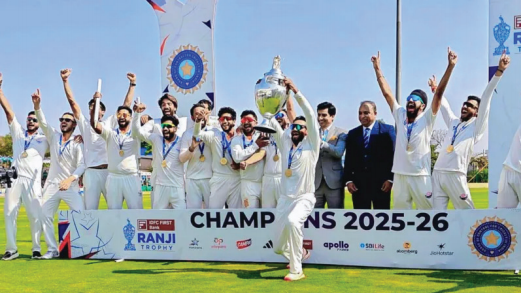
Cricket is the most loved sport in India. Every cricket season brings new heroes, new tournaments, and new celebrations. Recently, Jammu & Kashmir (J&K) won the Ranji Trophy for the first time in the tournament’s history. J&K defeated Karnataka, which has won 8 titles, the second most after Mumbai. J&K took the mammoth lead of 477 runs with six wickets in hand. Hence, the draw was called, and J&K were declared the champions. The entire country celebrated this victory, but deep down, no one knows the runs which are scored from the bat. How it is made, how it is reached to the players and whether it is Kashmir willow or English willow.
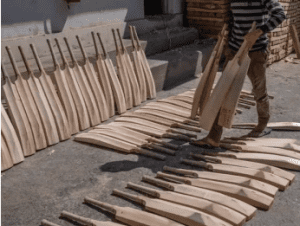
Every cricket fan might know the brands of bats, but they may not know where the wood comes from. Behind many of those shots lies a small industry in Kashmir. For more than a century, the valley has been known for producing cricket bats made from Kashmir willow. Kashmiri districts like Pulwama, Anantnag, where artisans shape blocks of wood into bats used across India and many cricket-playing nations. Even today, when cricket is growing, the people who are making the bats are facing struggles.
Old craft in Kashmir
The cricket bat industry in Kashmir is more than 100 years old. The craft developed during the British era when willow trees were planted in the Valley, and local craftsmen began shaping the wood into cricket bats. Over time, this region became India’s main hub for bat manufacturing. Most of the cricket bats are produced along the Jammu-Srinagar highway, especially in villages like Bijbehara, Sangam, Charsoo and a few parts of Anantnag district.
Today, around 400 bat manufacturing units are operating in Kashmir, many of them are small family-running workshops. The industry is estimated to produce nearly 30 lakh bats every year and has an annual value of roughly Rs. 300 crore. (Source: National Herald, 2022; Modern Woodwork Asia, 2023). (Fig. 1: Key Indicators of the Kashmir Cricket Bat Industry, around 400 manufacturing units produce nearly 30 lakh bats annually with an estimated industry value of ₹300 crore.)
This industry supports livelihood. It is estimated that over one lakh people depend on this trade directly or indirectly, including artisans, wood cutters, transporters, and shopkeepers. (Source: National Herald, 2022). For many families in the valley, bat making is not just a business. It is their main source of income.
Kashmir willow vs English willow
Every cricket fan has heard of the English willow. These bats are used by international players and often cost hundreds or even thousands of dollars. But the wood used in Kashmir bats actually comes from the same species of trees, like Salix Alba or white willow. (Source: IDR Online, 2024).
The difference between the willows lies between branding, finishing and market perception. Meanwhile, English willow bats are marketed as premium products in global cricket. Its prices start from $300 and can reach up to $1,500. (Source: VOA News, 2022).
On the other hand, Kashmir willow bats are much cheaper. Its minimum price is $50, and the maximum is about $500, making them accessible to ordinary players and young cricketers. (Source: VOA News, 2022). (Fig. 2: Price Range Comparison of English Willow and Kashmir Willow Bats English willow bats typically range from $300 to $1500, while Kashmir willow bats range from $50 to $500.)
Because of the reasonable cost, Kashmir bats dominate street cricket, school cricket and many domestic markets. In fact, industry voices state that Kashmir willow bats supply a large share of affordable bats globally. (Source: VOA News, 2022).
Despite all this, the Kashmir willow industry rarely receives the attention or branding support that English willow enjoys.
Crisis in Industry
One of the biggest problems is the shortage of willow trees. Bat manufacturing depends entirely on willow woods, and these trees take 15 to 20 years to mature before they can be used. (Source: IDR Online, 2024). Over the years, the supply of raw material has been declining because many willow plantations have been cut down faster than replantation. The farmers are also shifting to other trees like poplar, which grows faster and is in heavy demand for the plywood industry. (Source: ABC News, 2022).
This shift makes economic sense for farmers, but it creates serious problems for bat manufacturers. Some reports say that around 50 of the 400 factories have already shut down due to a shortage of raw materials. (Source: VOA News, 2022).
If the same shortage continues, the supply chain will be affected from wood cutters to factory workers.
Pressure on small manufacturers
Raw material shortages are not the only challenge; in fact, many small factories of bat are struggling with limited technologies and outdated production systems. In some workshops, the seasoning process in which the willow wood is dried still takes six months to a year, holding the money and slowing the production. (Source: National Herald, 2022).
At the same time, competition from international brands and imported products is increasing day by day. Many Kashmiri manufacturers lack strong marketing networks or global branding. As a result, valley bats are often sold at lower prices despite good quality. For small family businesses, these pressures can mean shrinking profits and uncertain futures.
Gap between slogan and support
India often promotes initiatives like “Make in India”, which aims in strengthening the domestic manufacturing. In this campaign, the Kashmir bat industry perfectly fits into this vision. It is a traditional artwork, it supports thousands of jobs, and it produces a product which is highly linked to India’s most popular sport. Still, many manufacturers feel that policy support has been limited.
Experts and industry groups have suggested solutions such as large-scale willow plantation drives, better technology for wood seasoning, and stronger branding for Kashmir willow bats.
In Kashmir, thousands of craftsmen spend hours cutting, shaping, sanding, and polishing willow wood to create a bat. Their work rarely appears on television screens, yet it is deeply connected to the sport.
Protecting the most prestigious industry in the Kashmir valley is not just a business. It is about protecting livelihoods, preserving a traditional craft and honouring a small but important part of India’s cricketing culture.
The writer is a student of M.A. in New Media Communications at the Indian Institute of Mass Communication (IIMC), Jammu.