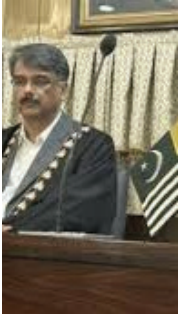
The political environment in “Azad” Jammu and Kashmir (“AJK”)—an Indian territory under Pakistan’s unlawful occupation—continues to be marked by instability. This persists despite a majority in the Legislative Assembly rallying behind Raja Faisal Mumtaz Rathore of the Pakistan People’s Party (PPP) as the region’s new “Prime Minister” following the ouster of Chaudhry Anwar-ul-Haq through a no-confidence motion on November 17, 2025. Rathore was sworn in the next day. He became the fourth “Prime Minister” of the region in as many years.
Serious doubts remain over whether this leadership change will usher in stability. Several factors underpin this scepticism. Foremost among them is the proximity of the next Assembly elections, scheduled for July 2026. Major political parties have already shifted into campaign mode, each seeking to capture power independently and calibrating its strategies accordingly. The Pakistan Muslim League—Nawaz (PML-N), for instance, has chosen to sit separately and remain outside the government despite having backed the PPP in Rathore’s election. The two parties had joined forces to engineer Haq’s removal.
Haq, a member of the Pakistan Tehreek-e-Insaf (PTI) led by the incarcerated former Prime Minister Imran Khan, had earlier broken away from the party—along with several legislators—to assume office. That splinter group has since disintegrated further, leaving only two legislators loyal to Haq by the end of the crisis.
Compounding the political uncertainty is near-permanent civil unrest. The region routinely witnesses protests over the absence or failure of basic civic amenities, underscoring deep public frustration and governance deficits.
It is well established that Pakistan installs its preferred nominee as the “Prime Minister” of “AJK”. At the federal level in Islamabad, the PML-N and the PPP operate in close coordination: the PPP supports the PML-N–led coalition government under Prime Minister Shahbaz Sharif while remaining outside the federal cabinet. In “AJK”, however, these roles are effectively reversed.
Deeper malaise
Yet this arrangement does little to address the deeper malaise. “AJK” remains politically and economically marginalised, reflecting Islamabad’s enduring mistrust of the region’s Jammu and Kashmir lineage. Despite decades of control, Pakistan’s central establishment has consistently treated “AJK” as a peripheral appendage rather than as an integral stakeholder in its own governance.
The prevailing political atmosphere is one of profound uncertainty, where—as the fate of the ousted “Prime Minister” Haq demonstrates—allegiances are fluid and loyalty often exacts a high price. Conspicuously absent from this churn is the will and aspiration of the local population. Pakistan’s mainstream political parties have long marginalised genuine political sentiment in “AJK”, treating the region less as a polity with its own agency and more as a bargaining chip in the broader Kashmir narrative.
The decline of the Jammu and Kashmir Muslim Conference illustrates this erosion starkly. Once the dominant political force in the undivided Jammu and Kashmir, the party has been reduced to a pale shadow of its former self. Formerly a top-tier outfit, it is now widely perceived as a pro-establishment appendage—its voice muted, its relevance diminished. Its prolonged alignment with Islamabad has come at a steep political cost. In the latest phase of “AJK’s” uneasy politics, the party finds itself increasingly out of step with popular sentiment, which is steadily hardening against Islamabad’s heavy-handed interference and the steady erosion of local autonomy.
It was, therefore, no coincidence that the no-confidence motion against Haq remained in limbo for an extended period. Although the motion was drafted and signed by legislators from both the PPP and the PML-N, it was tabled much later, leaving the region mired in prolonged uncertainty and the administration effectively paralysed. Reports suggested differences not only between the PPP and the PML-N but also within the PPP itself over the choice of successor.
Amid this impasse, Pakistan’s President Asif Ali Zardari and Prime Minister Sharif were reportedly engaged in consultations to manage the evolving situation. Factional rifts within the PPP became evident as at least four leaders emerged as front-runners: Chaudhry Muhammad Yasin, the PPP’s “AJK” president; Chaudhry Latif Akbar, Speaker of the Assembly; Raja Faisal Mumtaz Rathore; and Sardar Yakub. In the end, Rathore emerged the consensus choice—and, as events unfolded, the beneficiary of Islamabad’s tacit backing. The PML-N, too, appeared inclined towards his candidature. Shahbaz Sharif reportedly telephoned Rathore after his election, assuring him of full cooperation—an endorsement that underscored, once again, where the real locus of power in “AJK” lies.
Public anger
The most immediate challenge confronting any incumbent is the surging public anger over economic hardship, institutional neglect, and political disenfranchisement. This discontent has found expression through the Joint Awami Action Committee (JAAC), a broad-based coalition of traders, students, lawyers, and civil society groups. In recent months, the JAAC has led sustained protests against high electricity tariffs, chronic shortages, and rising prices of subsidised wheat flour. Despite appeals for restraint from Islamabad, several demonstrations turned violent. Defying a direct appeal from the Pakistan Prime Minister, the JAAC enforced a region-wide shutter-down and wheel-jam strike from September 29. The unrest peaked on October 1–2, when police firing left at least ten protesters dead and over a hundred injured.
Although an agreement was reached on October 4, it is widely seen as cosmetic, failing to address the JAAC’s core demands. Protests have since continued sporadically. At the heart of the agitation lies electricity pricing: residents argue that a region producing hydropower at roughly PKR 3 per unit should not be subjected to inflated tariffs laden with federal taxes and surcharges. The issue has come to symbolise broader perceptions of economic exploitation.
Many in “AJK” view their “Prime Minister” as an appointee of distant power centres in Islamabad and Rawalpindi, with the military establishment accused of chronic political interference. This perception has fuelled a deep sense of alienation, captured in the slogan “no taxation without representation”. Public anger is further amplified by elite privileges and the contentious allocation of 12 reserved Assembly seats to “refugees” from across the Line of Control—an arrangement that even prompted resignations within Haq’s cabinet. Together, these grievances underline the growing chasm between the rulers and the ruled, casting a long shadow over the region’s political future…(Courtesy: borderaffairs.com)