By Dr. Neha Lohamaror
Founder, Kosh Foundation..
As educators, we often search for learning spaces beyond classrooms—spaces where stories nurture empathy, curiosity, and critical thinking. On 17 July 2026, I had the privilege of attending the ALT EFF Film Club at The Open Space Society (TOSS), Jaipur, along with two little girls whose tickets were sponsored by the Kosh Foundation, a not-for-profit organisation. What unfolded over the next few hours was much more than a simple film screening; it became an immersive lesson on humanity’s relationship with nature, animals, memory, and ourselves. I witnessed firsthand how cinema can become a powerful classroom for nurturing imagination, inquiry, and observation.
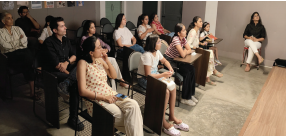
Kosh Foundation believes that meaningful education happens through lived experiences. Taking children to cultural events, historical places, and community conversations is just as important as teaching them from books. In an era where children’s leisure time is increasingly dominated by algorithm-driven entertainment and shrinking attention spans, thoughtfully curated film screenings offer a refreshing alternative. Such experiences encourage young minds to reflect, question, engage in meaningful dialogue, appreciate diversity, and develop emotional intelligence. This is precisely what TOSS achieves through its carefully selected lineup of international short films and the enriching community discussion that follows.
The first film, Would You Still Love Me If I Was a Sticky Frog?, blended humour, wildlife, and a long-distance love story into an imaginative narrative. Beneath its playful title lay a thoughtful reminder about the rapid depletion of Malaysia’s forests. The protagonist passionately advocates for environmental conservation, believing that even small individual actions contribute to meaningful change. Her partner, however, questions whether one person’s efforts can truly make a difference, leading to conflict in their relationship. As the story unfolds, they engage in honest and constructive dialogue, eventually rediscovering mutual understanding and respect.
The second screening, Papillon (Butterfly), was an Oscar-nominated animated short film inspired by the life of French Olympic swimmer Alfred Nakache, a Jewish athlete who survived the Holocaust but lost his wife and child to it. Beautifully animated and emotionally resonant, it illustrated that with hope and courage, one can survive even under the harshest circumstances. For young viewers especially, such stories communicate values of perseverance far more effectively than moral instruction ever could.
The film lineup concluded with Shera, a touching story from the Himalayas that explored friendship, childhood, and the mysterious presence of a leopard. Rather than portraying wildlife as an enemy, the film encouraged viewers to think deeply about coexistence. Ultimately, the films were united by a common, pressing question: Are conflicts between humans and wildlife inevitable, or is coexistence possible?
The conversations after the films proved equally transformative. The guest speaker, Kia, an animal communicator, introduced the audience to the fascinating world of interspecies communication, intuition, and telepathy. She shared perspectives associated with Rupert Sheldrake’s work on telepathy, encouraging participants to explore ideas that lie outside mainstream scientific thinking. Whether one accepts these views or not, the discussion invited deep reflection on humanity’s relationship with other living beings. Kia narrated the remarkable story of Koko the gorilla, famous for communicating through sign language and demonstrating extraordinary emotional intelligence. Stories like these invite us to reconsider long-held assumptions about intelligence, consciousness, and the emotional lives of animals. We learn, for instance, that octopuses can solve complex puzzles, dolphins use unique signature whistles that function like names, bees construct perfect hexagonal boxes to optimize hive space, the Clark’s nutcracker remembers seed locations months later even beneath the snow, elephants mourn their dead, and the Olive Ridley turtles uses the Earth’s magnetic field to navigate across thousands of miles for synchronised mass breeding.
The evening concluded with an open mic where members of the audience shared personal memories inspired by nature, places, and the environment. The session was refreshingly simple. There were no elaborate speeches or rehearsed performances, only authentic stories that revealed how deeply landscapes, rivers, trees, and animals shape our identities. These conversations reminded us that environmental conservation is not merely a scientific or political issue; it is also deeply cultural and profoundly personal.
Education today often measures academic achievement through examinations while neglecting to nurture qualities such as cultural sensitivity, environmental consciousness, and ethical reasoning. Exposing children to conscious cinema and thoughtful art helps them embody these virtues. Hence, community film clubs, museums, theatre, cultural hubs, and literature festivals offer alternative learning spaces that should not be viewed as optional enrichment, but as an integral part of core education.
For the two girls attending through the Kosh Foundation’s sponsorship, the evening represented much more than entertainment. They watched films that encouraged curiosity, listened to ideas that challenged assumptions, and observed respectful conversations among people from different walks of life. Cinema possesses a unique ability to bridge science and emotion, facts and imagination, knowledge and compassion. Sometimes, a seventy-minute evening of meaningful cinema can teach lessons that remain with us for a lifetime.