
Omkar Dattatray
Those gathered at Chisoti village for breakfast on their way to the Machil Mata Yatra were caught completely unaware when nature unleashed its fury in the form of a cloudburst, triggering flash floods and landslides that washed away everything in their path. The tragedy claimed heavy human and material losses. At least 65 people, mostly pilgrims, were killed, hundreds were injured, and 33 persons are still missing.
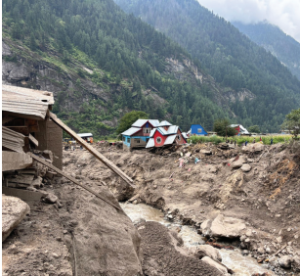
The Chisoti tragedy was unprecedented. There was no effective forewarning that could have saved precious human lives or reduced the destruction of property. Makeshift shops were completely damaged, and a pall of silence hangs over the affected area. The Central Government and the UT Administration have been making every effort to rescue, rehabilitate and provide relief to the affected people.
We are living in an age of science and technology where weather forecasting is expected to provide timely warnings so that people can protect themselves from natural disasters. Unfortunately, no effective warning reached the people, preventing them from moving to safer places before the cloudburst, flash floods and landslides struck. Had there been timely forecasting and advance warnings, the loss of lives and property could have been substantially reduced.
What has happened cannot be undone. However, the need of the hour is to develop a robust forecasting and early warning system so that people can be evacuated well before such disasters occur. Sadly, this was not the case during the Kishtwar tragedy.
The moot question is whether we have learnt any lessons from this natural calamity. Human memory is short. As the Urdu saying goes, “Raat Gayi, Baat Gayi.” Unfortunately, this appears to apply even to disasters such as the Chisoti cloudburst. We must remain prepared to face nature’s fury by improving preparedness, remaining alert and moving vulnerable people to safer places whenever warnings are issued.
The Central Government, the UT Administration, the NDRF, SDRF, police, local volunteers and other disaster management agencies should remain fully prepared to respond to such emergencies. Government agencies as well as the public must stay informed about weather forecasts and disaster warnings and act accordingly. Scientific forecasting, efficient coordination and timely evacuation can significantly minimise casualties during disasters such as cloudbursts and flash floods.
We should learn from tragedies like the Chisoti cloudburst and prepare comprehensive contingency plans to prevent the loss of precious lives in future.
Meanwhile, the Jammu and Kashmir Government is yet to conclusively identify what exactly triggered the devastation in Kishtwar. Was it a cloudburst or a glacial lake outburst? Chief Minister Omar Abdullah, while chairing a review meeting on relief and rehabilitation, underlined that the exact cause is still unknown.
More than a week after the tragedy, officials in the Disaster Management Department were still assessing whether the devastation resulted from a cloudburst or a glacial lake outburst. The disaster claimed 65 lives, left 33 people missing and severely disrupted the Machil Mata Yatra in the upper reaches of Kishtwar.
Chief Minister Omar Abdullah observed, “Whether it was a cloudburst or a glacial lake outburst, the fact remains that this tragedy struck at the busiest time of the year in Chisoti village. Had it occurred at any other time, the impact might have been less severe. These are the lessons we must take forward.”
The Government is now working on long-term strategies to safeguard vulnerable areas from recurring natural disasters. The Chief Minister pointed out that the Meteorological Department had issued weather advisories, including warnings against unnecessary travel, highlighting the importance of clear Standard Operating Procedures (SOPs) for vulnerable regions.
He emphasised that medium- and long-term measures should include scientific assessment of vulnerable areas, protection of agricultural land, discouraging habitation along flood-prone nallahs, and creating preventive mechanisms. Simultaneously, the Government continues efforts to trace the missing persons and rehabilitate families whose homes and livelihoods have been devastated.
The Kishtwar tragedy has once again highlighted the increasing vulnerability of Jammu and Kashmir’s mountainous regions to extreme weather events driven by climate change. While the disaster is largely attributed to nature’s fury, questions are also being raised about whether adequate precautions were taken by the local administration to minimise risks to pilgrims and settlements located in vulnerable areas.
Nature’s fury cannot be controlled by human beings. However, with proper planning, coordination and preparedness, the scale of human suffering can certainly be reduced. Sustainable development that maintains ecological balance is essential for protecting Jammu and Kashmir’s fragile environment.
Living in an ecologically fragile Himalayan region, we have repeatedly witnessed devastating floods, landslides, earthquakes and cloudbursts. Climate change has made such extreme weather events more frequent over the past decade. Unfortunately, neither governments nor the public appear to learn lasting lessons from these disasters.
We failed to learn from the devastating floods of September 2014 that ravaged Srinagar. Authorities have continued to overlook large-scale encroachment of floodplains and wetlands, which once acted as natural reservoirs for floodwaters. We wake up only after disasters strike. In many ways, these natural disasters have increasingly become man-made disasters.
We have indiscriminately felled forests, encroached upon riverbanks, altered natural watercourses and disturbed ecological balance in the name of development. The consequences are visible today in the form of frequent cloudbursts, flash floods and landslides.
Following the Kishtwar and Kathua cloudbursts, Chief Minister Omar Abdullah has rightly directed the constitution of a team of experts to identify vulnerable locations across Jammu and Kashmir and recommend measures to prevent future loss of life. He has also appealed to religious leaders to regulate smaller pilgrimages in mountainous regions whenever weather conditions warrant caution.
The need of the hour is to prevent further damage to Jammu and Kashmir’s fragile environment. Strengthening disaster prevention mechanisms is even more important than post-disaster management. Governments and citizens alike must strike a proper balance between development and environmental conservation.
To sum up, it can be said that we have still not learnt enough lessons from tragedies like Kishtwar and Kathua. We must become wiser by protecting our forests, rivers and fragile ecosystems. Only by maintaining harmony between development and nature can we minimise the loss of human lives and property. Unless we stop degrading our natural resources and environment, such disasters will continue to inflict avoidable suffering.
The author is a columnist, social activist, KP activist and freelancer.