A balanced reflection on its historical evolution, social contributions, and relevance to India’s journey towards Viksit Bharat
Prof. (Dr.) Jayadeba Sahoo
“Uttishthata Jagrata Prapya Varannibodhata” — “Arise, awake, and attain the highest wisdom; stop not till the goal is reached.” — Katha Upanishad (1.3.14)
Few voluntary organisations in modern India have generated as much admiration, scrutiny, scholarly interest, and public debate as the Rashtriya Swayamsevak Sangh (RSS). As the organisation marks its centenary in 2025, the milestone offers an opportunity not only for celebration or criticism but also for a balanced assessment of its historical evolution, philosophical foundations, social contributions, and continuing role in India’s democratic and civilisational journey.
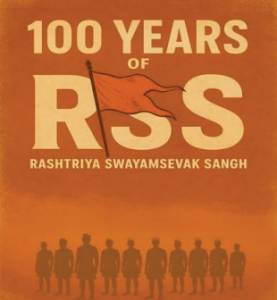
Founded on Vijayadashami in 1925 by Dr. Keshav Baliram Hedgewar in Nagpur, the RSS has grown from a small volunteer movement into one of the world’s largest socio-cultural organisations. Established during British colonial rule, when India faced political uncertainty, social fragmentation, and cultural introspection, the organisation sought to strengthen society through discipline, character-building, and national unity. Dr. Hedgewar believed that political freedom alone would not ensure national regeneration unless supported by ethical citizenship and social cohesion.
Central to this vision was the daily shakha, where volunteers participated in physical training, intellectual discussions, patriotic songs, and community activities. This long-term emphasis on social organisation distinguished the RSS from political parties primarily engaged in electoral politics.
The RSS’s relationship with India’s freedom movement continues to be debated among historians. It is well documented that Dr. Hedgewar participated in the Non-Cooperation Movement and was imprisoned by the British in 1921. However, after founding the RSS, the organisation largely focused on social mobilisation rather than leading major Congress-led mass movements. While supporters regard this as a long-term nation-building strategy, critics question its institutional role in the anti-colonial struggle. A balanced historical understanding acknowledges both the documented evidence and the continuing scholarly debate.
Perhaps the organisation’s most widely recognised contribution has been its emphasis on Seva (selfless service), inspired by the Bhagavad Gita’s doctrine of Nishkama Karma:
“Karmanyevadhikaraste Ma Phaleshu Kadachana” — “You have the right to action alone, never to its fruits.” (Bhagavad Gita 2.47)
Over the decades, RSS volunteers and affiliated organisations have participated in disaster relief, refugee rehabilitation, educational initiatives, healthcare services, rural development, and humanitarian assistance during floods, earthquakes, cyclones, and the COVID-19 pandemic. These efforts, often undertaken alongside government agencies and other civil society groups, highlight the important role organised voluntary action can play in strengthening national resilience.
The centenary also coincides with renewed national attention to the Indian Knowledge System (IKS). The National Education Policy (NEP) 2020 recognises India’s intellectual traditions by encouraging the integration of Indian languages, classical knowledge, ethics, experiential learning, and multidisciplinary education into modern curricula. Long before the policy’s adoption, several educational institutions inspired by the broader Sangh tradition promoted Sanskrit, yoga, value-based education, environmental awareness, and cultural literacy.
The Indian Knowledge System extends far beyond ancient scriptures. It encompasses philosophy, mathematics, astronomy, medicine, linguistics, architecture, governance, ecology, and aesthetics. It seeks to combine scientific inquiry with ethical responsibility and intellectual excellence with social well-being.
The ancient maxim “Sa Vidya Ya Vimuktaye” — “That alone is true knowledge which liberates” — reflects an educational philosophy in which learning aims at the holistic development of individuals and the welfare of society.
Another important idea associated with the RSS is civilisational consciousness—the belief that India’s unity rests not only on political institutions but also on a shared cultural heritage shaped by centuries of philosophical dialogue, linguistic diversity, pilgrimage traditions, and ethical values. Supporters see this as strengthening national self-confidence in an increasingly globalised world. Critics, however, argue that any expression of cultural nationalism must remain firmly aligned with constitutional equality, democratic pluralism, and the rights of all citizens. These continuing debates contribute to India’s vibrant intellectual discourse.
The Rig Veda’s celebrated verse, “Ekam Sat Vipra Bahudha Vadanti” — “Truth is one; the wise describe it in many ways” — has often been cited as an enduring expression of India’s pluralistic civilisational ethos.
As India aspires to become a Viksit Bharat by 2047, questions of education, innovation, sustainability, ethical leadership, and social cohesion assume increasing importance. Economic growth alone cannot guarantee lasting national progress. Scientific advancement must be accompanied by constitutional values, environmental responsibility, cultural confidence, and active civic participation. In this context, the ideals of service, discipline, and community engagement promoted by the RSS, alongside similar contributions from other civil society organisations, remain relevant to the broader national development agenda.
The timeless ideal of “Vasudhaiva Kutumbakam” — “The whole world is one family” — offers a universal framework for engaging with contemporary global challenges. It suggests that civilisational confidence can coexist with inclusivity, dialogue, and international cooperation.
After a hundred years, the Rashtriya Swayamsevak Sangh remains one of India’s most influential and widely debated organisations. Its achievements, controversies, and intellectual contributions will continue to invite scholarly examination. For historians, educators, policymakers, and citizens alike, its centenary provides an opportunity to reflect on larger questions of national identity, civic responsibility, educational renewal, and India’s future as a democratic and culturally rooted nation.
Ultimately, the true measure of any enduring institution lies not merely in its longevity but in its constructive contribution to society. As India moves towards 2047, the continuing dialogue between constitutional democracy, scientific progress, and the ethical wisdom embedded in the Indian Knowledge System will remain central to shaping a confident, inclusive, and globally engaged nation.
The Rig Veda’s timeless invocation, “Ā No Bhadrāḥ Kratavo Yantu Viśvataḥ” — “Let noble thoughts come to us from every direction” — continues to illuminate India’s path, where ancient wisdom and modern aspirations converge in the shared pursuit of knowledge, justice, harmony, and human flourishing.
— The author is Senior Professor (Former Dean & Head), Faculty of Education, Rajiv Gandhi (Central) University, Itanagar.